- Select Language
R530C 6.0-inch Industrial PDA | Qualcomm Octa-core...
One Device, Dual Functions – A Projector and a Com...
The PM156-1 is a 15.6-inch portable PC monitor fea...
The U9000 handheld PDA combines advanced barcode s...
A handheld terminal in a dealer's warehouse has already been purchased, tested and packed, yet it has not earned a single scan for the business that will eventually use it. Between the factory and the end customer sits the least supervised phase of the device's life: dealer stock. Inventory audits at this stage usually count boxes and reconcile serial numbers, which answers the finance question but ignores the hardware question — what is happening inside each unit while it waits. The R350C PDA, the RFID Industrial PDA D802 and the N60 Inventory Management PDA all pass through this phase, and each one ages differently depending on where it is stored. Treating dealer stock as one undifferentiated pile is the reason some units arrive at customers already tired. This article splits dealer stock into three states and attaches a specific check routine to each, so the next audit verifies condition, not just quantity.
The instinct from warehouse operations is that an unused device is a safe device. For consumer electronics that is roughly true. For industrial handhelds it is not, because the components that degrade fastest in storage are exactly the ones these devices depend on: lithium batteries self-discharge toward damaging voltage levels, elastomer seals lose their shape under constant compression, and firmware falls further behind with every release published while the box stays closed. A unit that sits for six months is not the same unit that entered the box, even though the serial number has not changed and the shrink wrap is intact. Dealer inventory audits built only around counts will therefore certify stock that has quietly drifted out of ready-to-ship condition. The fix is not more auditing — it is sorting stock by state, because the degradation pattern depends on where the unit is, not on how long the purchase order has been open.
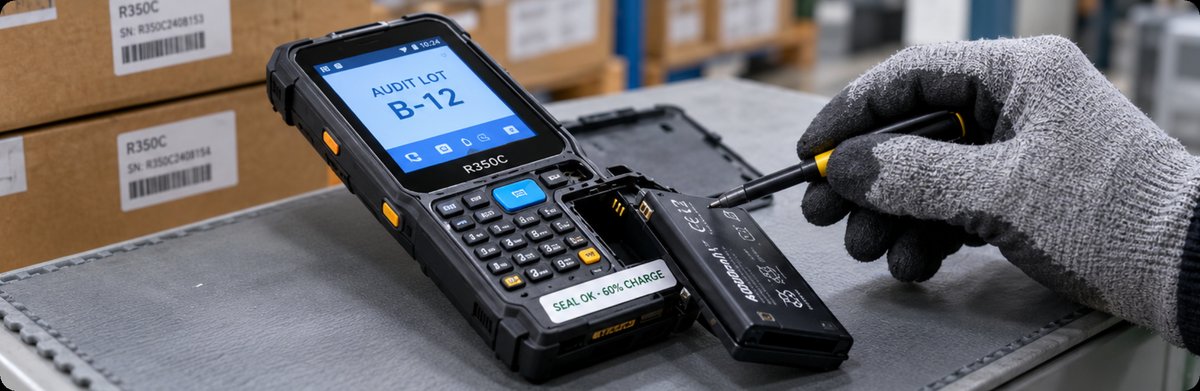
The first state is factory-sealed inventory: units that arrived in their original packaging and have not been opened since. The dominant risk here is the battery. A lithium cell left unattended discharges over months, and a cell that drops below its protection threshold may refuse to wake up or accept charge without a recovery cycle. For sealed stock the audit question is simple: how long has this box been closed? Units past roughly one quarter in storage should be opened, powered on and topped back to a moderate charge before being resealed — not because the specification demands it, but because a battery that dies in the box converts a sellable unit into a warranty claim. The second sealed-stock check is the seal itself: packaging tape and protective films that show lifting or bubbling indicate the box has been opened before, which moves the unit out of the sealed category whether or not anyone recorded it. Every unit promoted out of sealed stock during an audit should get a boot test on the spot, since unsealing is the only reliable way to confirm the device inside still matches the label on the outside.
The second state is the demo shelf, and it is the most deceptive because the units look busiest and healthiest. Demo devices power on every day, run their scan engines hundreds of times for walk-in customers, and sit on chargers overnight — a duty cycle far heavier than light field use. Two parts wear disproportionately here. The scan engine and, on RFID models, the read module accumulate actuations at a rate no customer site will match, so a demo unit's scanning hardware is effectively pre-consumed. The touchscreen accumulates its own history: constant tapping with unspecified hands, exposure to shop lighting and dust. Demo stock therefore needs a different audit question — not "does it still work" but "how much of its actuation life has the showroom already spent". A practical rule is to log demo units separately with their own serial list, rotate them off the shelf on a fixed schedule, and sell them as open-box units with an honest description rather than letting them masquerade as new stock after a year of demonstrations.
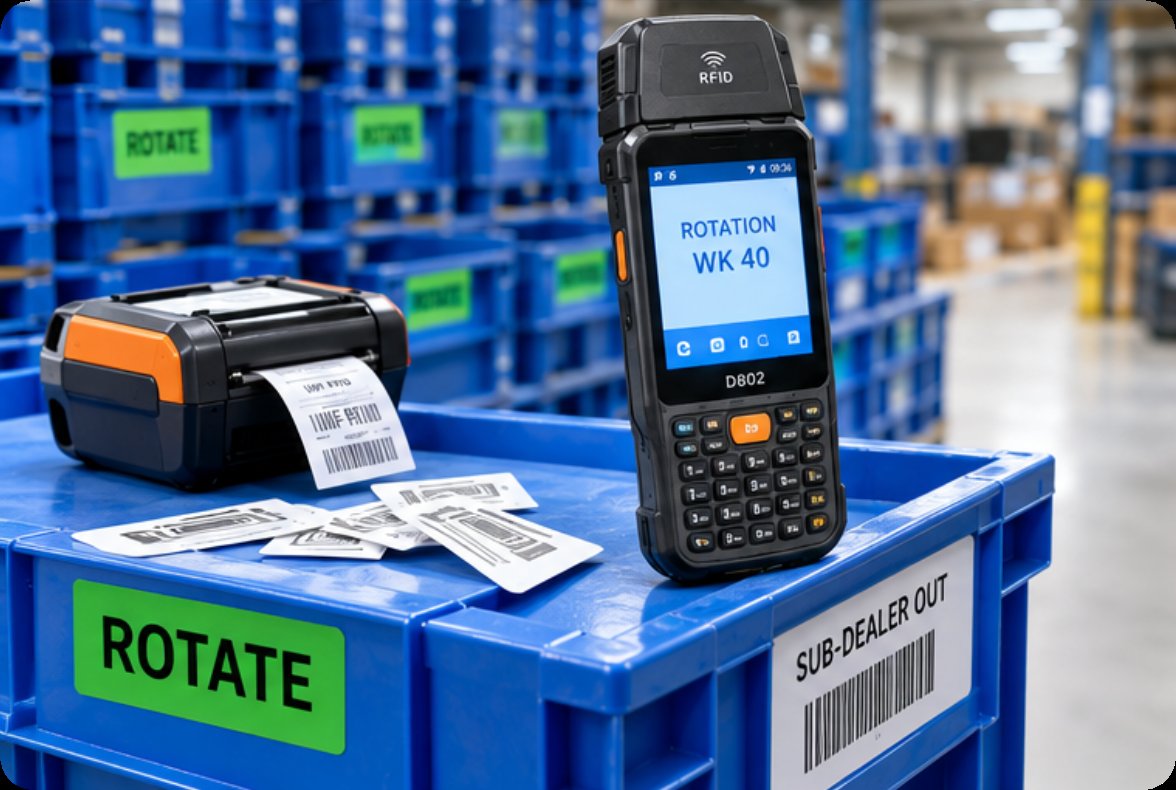
The third state is rolling stock — units in active channel circulation, moving between the dealer's shelves, sub-dealers and customer trials. These face the mechanical risks that sealed and demo units escape: drops during repacking, battery swaps performed without the manufacturer's procedure, and charging through whatever cradle happens to be available. The audit focus for rolling stock is on the parts that connect: battery contacts, cradle pins, USB covers and strap anchors. A unit that works but shows corrosion or wear on its charging contacts will fail unpredictably in the field, and the failure will be blamed on the device rather than on the handling it received in the channel. For the R350C, whose battery is designed to be swapped hot without a reboot, verify that field swaps were done with the detachable pack procedure rather than forced removal. For the N60, exercise the removable battery latch. Every rolling unit should also be reconciled against its movement log, because a device whose location history has gaps is the one most likely to have absorbed an undocumented drop.
The three states call for different checks on different hardware, and the table below maps the state-specific focus onto each model. The D802's product page does not publish structured specifications, so its column records the functional areas its page does describe — barcode scanning, RFID reading and rugged construction — rather than inferring numbers that were never stated.
| Stock State | R350C PDA | RFID Industrial PDA D802 | N60 Inventory Management PDA |
|---|---|---|---|
| Sealed in box | Open, power on and restore charge; verify the detachable 4000mAh pack still boots the unit | Power-on self-check of barcode and RFID functions after any unsealing | Power on and charge; confirm the removable 4200mAh battery wakes normally |
| Demo shelf | Track keypad and touchscreen actuations from constant demonstration | Log scan and RFID read module usage — the wear leaders on demo duty | Check the 5.99-inch display for burn-in signs and touch accuracy after heavy demo traffic |
| Rolling stock | Verify hot-swap battery changes followed the detachable-pack procedure | Inspect housing seals and module covers for repacking damage | Exercise the battery latch and confirm glove/wet touch response still holds |
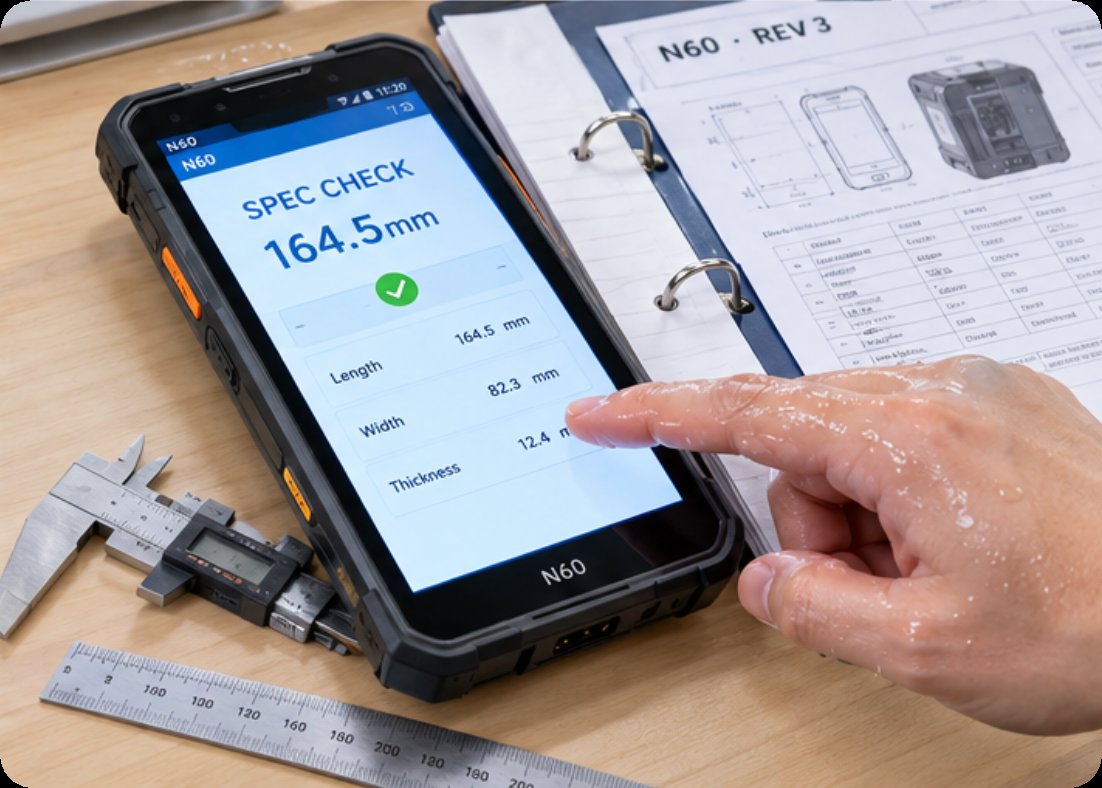
Two of the three pages publish environmental figures that belong directly in the audit plan. The R350C is rated for operation between -10°C and 50°C with 5% to 95% non-condensing humidity, which means an unheated stockroom in winter or a damp coastal warehouse can push units outside their rated envelope while they sit in boxes. The N60 publishes dimensions of 164.5mm × 79.4mm × 12.3mm, relevant to audit logistics because its larger footprint changes how many units fit per shelf and how much handling each audit cycle requires. The comparison below lists the storage-relevant published figures side by side; the D802 column is omitted because its page publishes no structured specifications.
| Field | R350C | N60 |
|---|---|---|
| Battery | 4000mAh 3.8V detachable, hot-swap supported | 4200mAh removable, over 12 hours of working time |
| Display | 4.0-inch IPS, 480×800, multi-touch | 5.99-inch IPS, 1080×2160, glove and wet-hand touch |
| Platform | Qualcomm QCM2290 quad-core 2.0GHz, Android 13 | Octa-core 2.0GHz, Android 10.0 |
| Dimensions | 155mm × 70mm × 20.5mm, under 300g | 164.5mm × 79.4mm × 12.3mm |
| Environmental | -10°C to 50°C operating, 5%–95% humidity non-condensing | Not published on the product page |
Batteries and seals degrade physically, but there is a third degradation that leaves no mark on the hardware: firmware debt. Every Android security patch, scan-engine tuning update and bug fix released while a unit sits in dealer stock widens the gap between that unit's software and the current release. A sealed unit manufactured two OS generations of patches ago will need a staging process — update, retest, re-box — before it can ship as current stock, and the audit is the natural point to measure that gap. Sorting units by firmware vintage during the inventory count turns an invisible liability into a workable queue: newest units stay sealed for fast shipment, mid-age units get scheduled updates, and units too far behind are flagged for imaging before sale rather than being discovered at customer onboarding. The D802, built around RFID and barcode data collection, is particularly sensitive here because read-performance tuning frequently arrives in firmware — a two-year-old image can measurably underperform a current one on identical hardware.
Dealer stock maintenance is not a parallel process to selling — it is the quality gate in front of selling. When the audit sorts units into sealed, demo and rolling states, the handover to a customer becomes a recorded event: the unit leaves with a known battery history, a logged demo record or a documented movement trail, and its firmware position is on file. If you are selecting hardware for a distribution network, start from the device families that document their own maintenance story — the rugged handheld terminals lineup covers the full range from the compact R350C PDA through the RFID Industrial PDA D802 to the N60 Inventory Management PDA. For a wider view of the rugged device portfolio behind these units, see our rugged mobile computing solutions, and for notes on how these models compare against alternatives in the market, our product comparisons and competitor analysis collects the published evaluations. An audit that ends with sorted, documented, updated stock does not just satisfy the count — it guarantees that the next scan a customer performs is the unit's first honest one.