- Select Language
R366-S 5.5-inch Industrial PDA | Qualcomm Octa-cor...
R860-S 5.5-inch Industrial PDA with Thermal Printe...
Full SpecificationsModelHotus ST9‑JOSWindows 10 Pr...
Maintenance instructions: Store at room temperatur...
P11 Series Next-Gen Enterprise Rugged Industrial ...
A dam site runs on three kinds of attention, and each lands on a different person. Somebody sits at the gate house watching the numbers that feed the reservoir ledger. Somebody walks the crest and the drainage galleries with a tablet in the rain. Somebody takes the night shift and confirms that every reading since dusk reached the database. Understaff any of the three and the gap does not stay hidden: a missed seepage note becomes a soaked instrument pit, and an unverified night batch becomes a correction argument at the morning meeting. The right device in each role decides whether the shift ends with clean records or with reconstruction work.
This guide lays out the three roles as a water data chain, then matches each station to a device. The three units were chosen because they split the work without splitting the fleet: all three share the 8-inch 1200×1920 panel class, all three speak to the same back end, and each carries one feature the others deliberately lack. Plants that run a mixed fleet tend to converge on this shape after a season of trial and error, and the reasoning holds from a small run-of-river station to a large storage reservoir.
Before any device is assigned, the work has to be named. At most sites the chain looks like this: intake readings at the gate house, inspection rounds along the crest and galleries, and a closing verification pass that reconciles the day. The first role produces the dense, steady stream of data — gate openings, levels, intake turbidity — typed against a live feed. The second produces the sparse but critical observations — a damp patch where none was yesterday, a piezometer that needs a manual reading. The third produces trust: a person who confirms the batch, signs it, and hands a clean ledger to the next morning. Each role fails differently, so each gets a different tool.
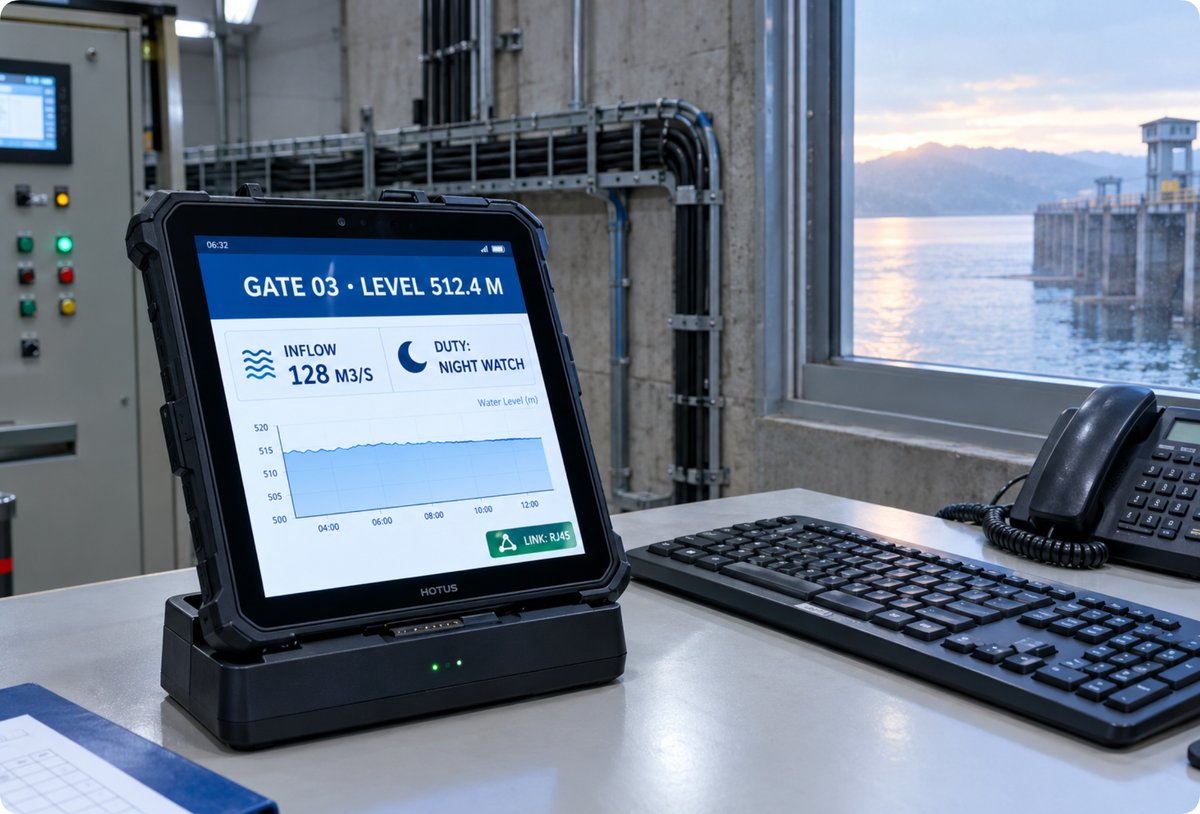
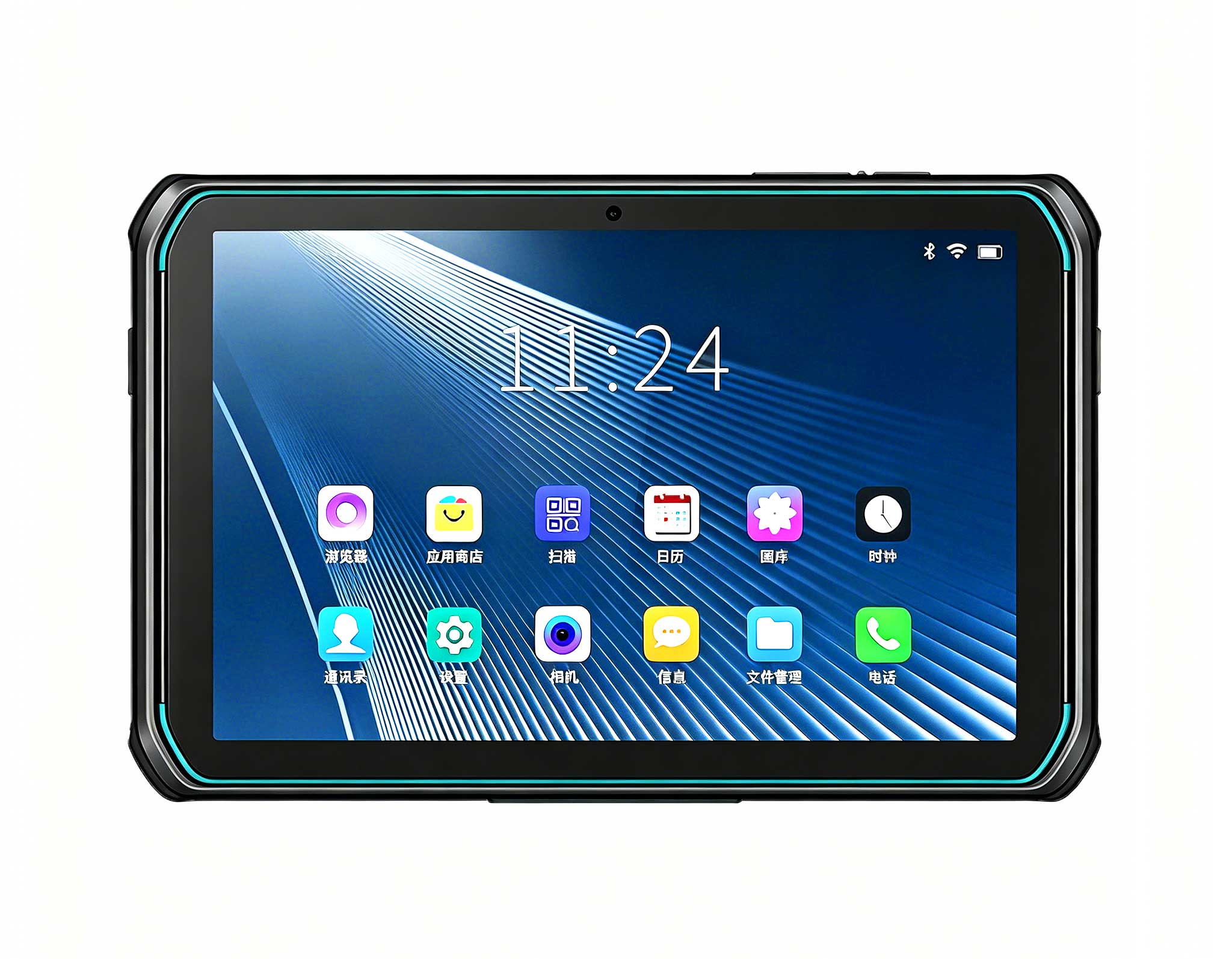
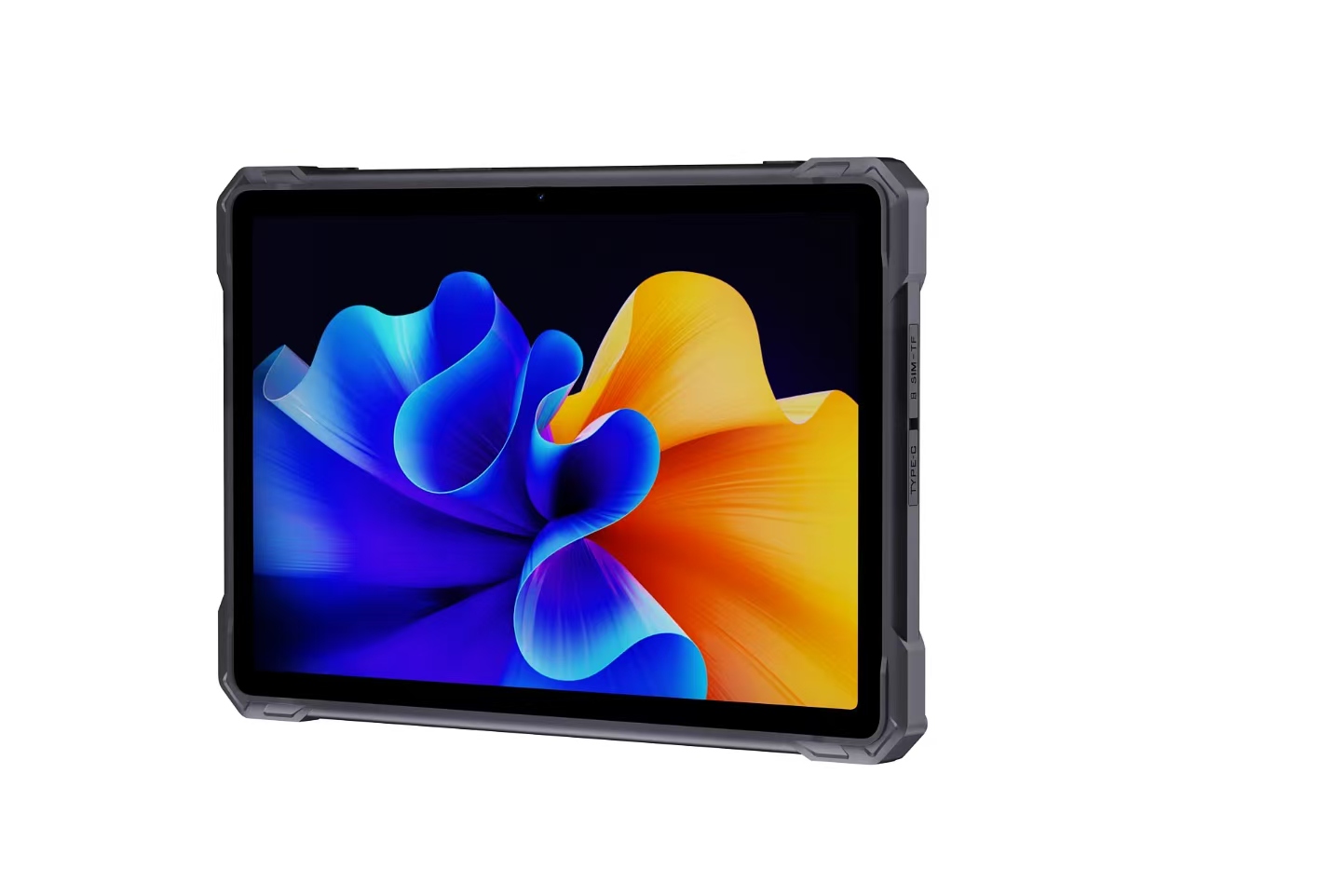
The gate house post rewards a device that never asks to be recharged mid-shift and never loses the plant network. The HTNJ08B rugged tablet takes this seat. Its chassis is rated IP67 against water, one step above the other two, which matters in a room where condensation forms on the inside of window steel and floor drains back up in flood season. It survives a 1.22-meter drop, relevant because gate house desks are narrow and tablets end up on the floor more often than anyone admits. The N6000 Pentium with four cores keeps a dashboard, a SCADA web client and a spreadsheet open without stutter, and the 560-nit panel reads cleanly against glare off the water at noon.
The detail that settles the assignment is on the edge: the HTNJ08B carries RJ45 alongside USB-A, USB-C, mini HDMI, TF, SIM and a 12-pin POGO connector. A wired link into the plant switch removes the last argument about radio dead zones inside a concrete structure, and the POGO dock option lets the desk unit live on a charging cradle that doubles as its stand. The 7.6V 3500mAh battery is smaller than the others, which sounds like a flaw until you notice the post never leaves the room — a docked tablet needs a stable cradle, not a marathon cell. Cameras read 5 MP front and 8 MP rear with autofocus and an LED, enough to photograph a gauge through a window when a visual record is requested.
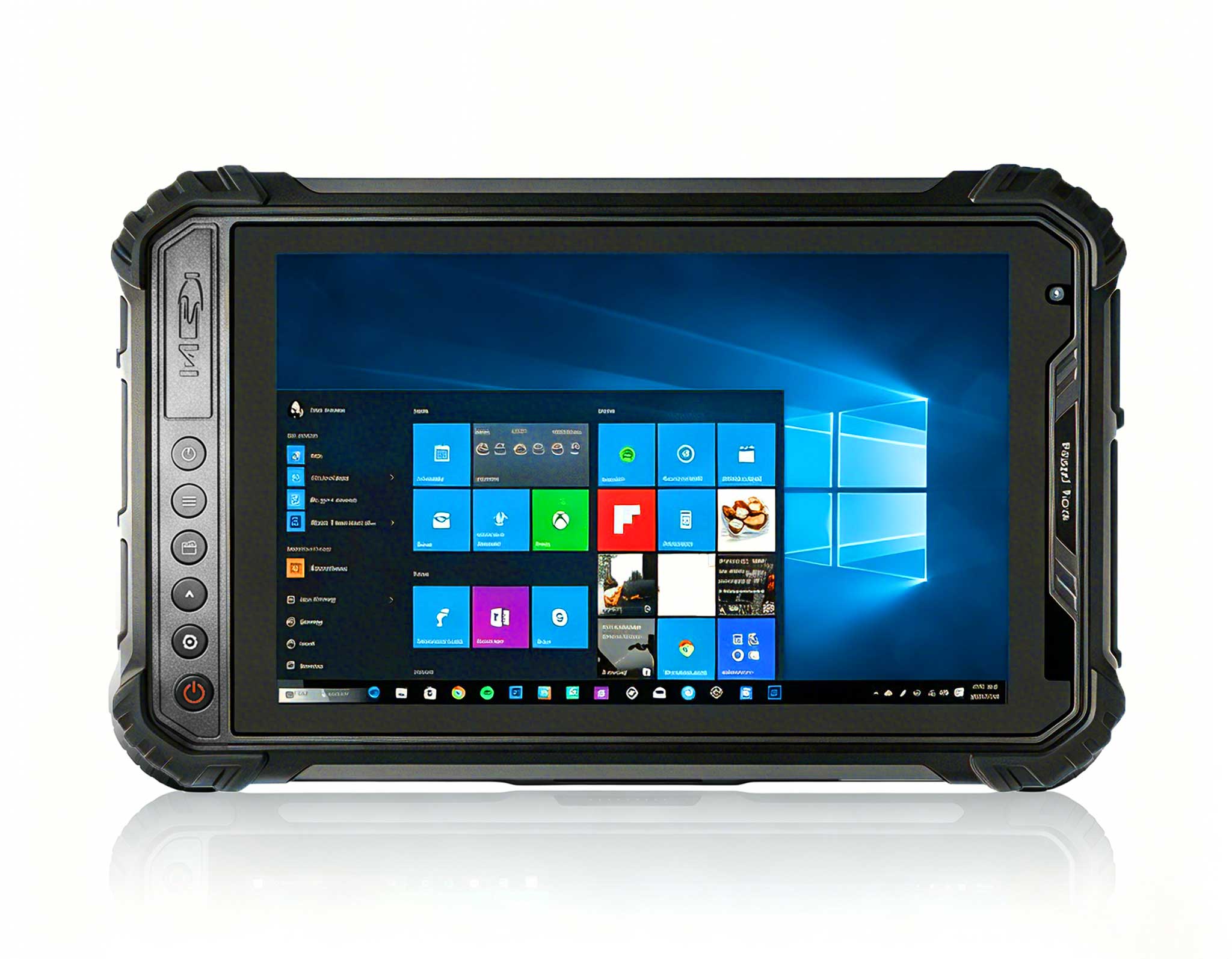
The walking post has the opposite constraint: everything wireless, everything pocketed, everything gloved. The ST9-M rugged industrial tablet is built for exactly this loop. Its i5-8200Y runs the full inspection client — map layers, photo attachments, the form app that refuses to close until every field is filled — while remaining a genuinely handheld 8-inch unit. The 4G module (SLM770A, with a North America variant) uploads each observation from the crest without waiting for the office Wi-Fi that does not exist out there, and GPS, BDS and GLONASS tag every reading with a position, which is how a "wet spot near the left abutment" becomes a coordinate instead of a rumor.
The touch layer takes stylus and wet-hand input, not a luxury where gloves come on and off a dozen times per round, and IP65 sealing with MIL-STD-810G testing covers the ladder-and-grating reality of a gallery route. The 5000mAh cell runs about six and a half hours, matching a double round; longer shifts add a vehicle dock. At 236 × 144 × 17.4 mm it shares a footprint with the ST9-J, so cases and mounts are ordered once.
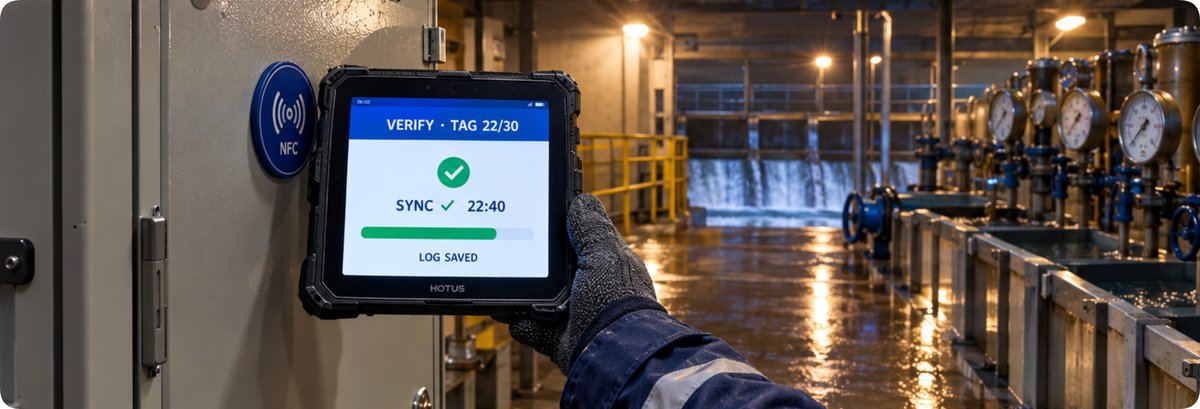
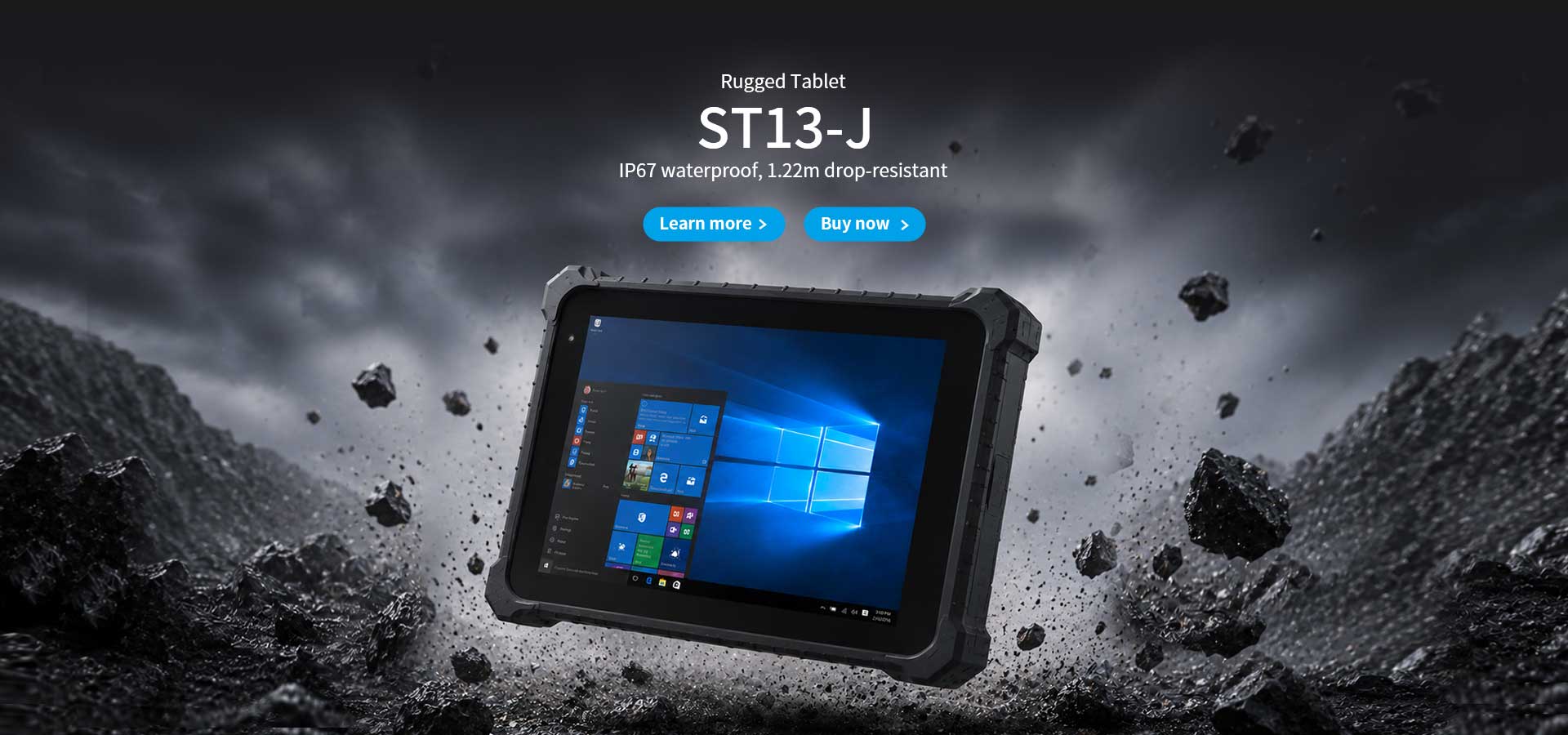
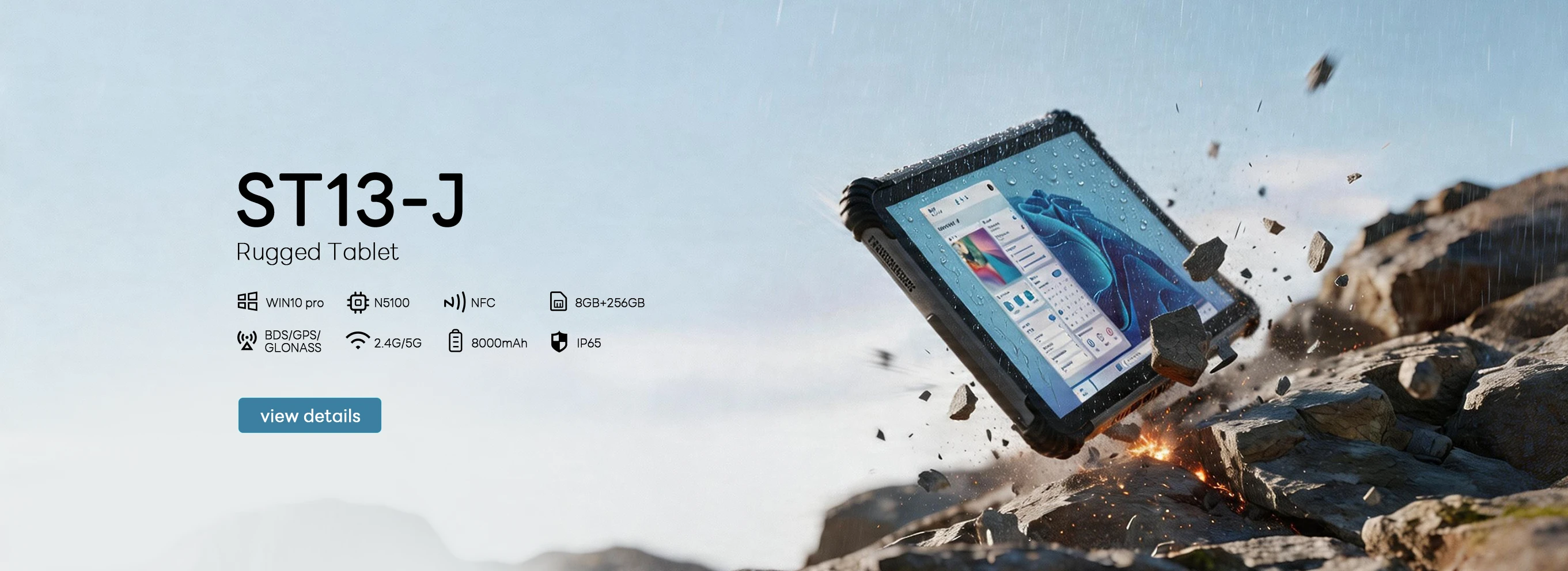
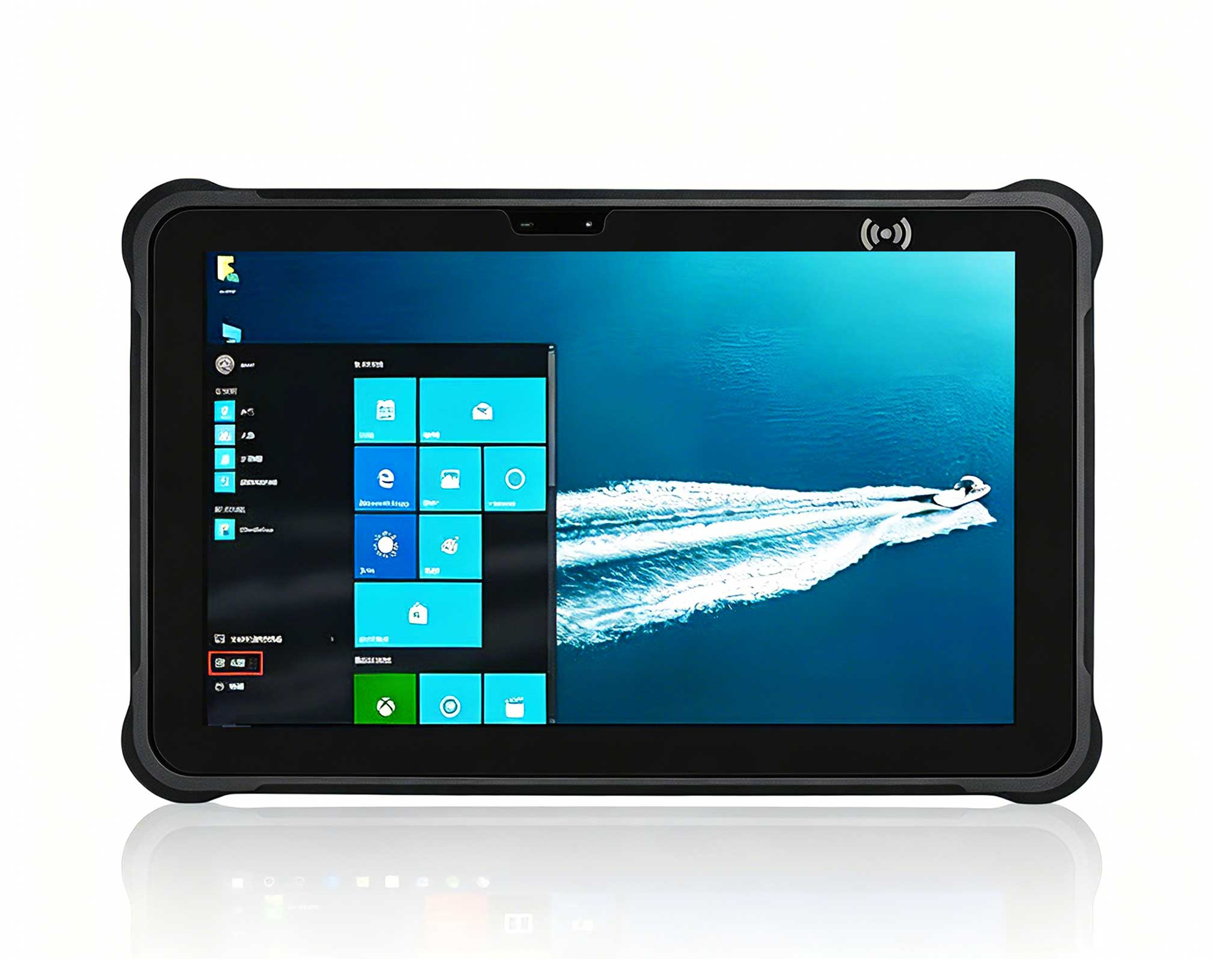
The closing role is the quiet one, and it fails in the boring way: someone skims the batch, initials it, and a wrong gate reading survives until the weekly reconciliation. The ST9-J Windows industrial tablet turns that skim into an actual procedure. Its NFC reader (13.56 MHz, ISO14443A) pairs with the check tags already glued to piezometer covers, gauge housings and gallery doors — the verifier taps each station in sequence and the form will not submit until the tag sequence matches the route. The 700-gram class body matters at 2 a.m., when a heavier slab becomes a reason to verify from the desk chair. The 400-nit panel is deliberately sufficient: night verification happens under lamps.
The N5100 quad-core runs cool and sips power, holding roughly seven hours, and the -20℃ to 55℃ operating window covers winter gallery work where the door has been open for an hour. The rear 13 MP camera handles the "photograph the chart recorder as evidence" step, and the optional high-precision GPS receiver settles disputes about a sensor position. IP65 with 1.2-meter drop rating matches the ST9-M exactly, so the pair shares a single case standard — and where the verification list includes badge checks, the same NFC stack reads the staff cards.
The fleet logic is easier to see in one table, and it is the sheet the roster owner keeps taped inside the charger cabinet:
| Item | HTNJ08B | ST9-M | ST9-J |
|---|---|---|---|
| Station | Gate house desk, wired | Crest and gallery rounds | Night verification pass |
| Processor | Pentium N6000, 4C/4T up to 3.3 GHz | Intel i5-8200Y, up to 3.9 GHz | Intel N5100 quad-core to 2.8 GHz |
| Display | 8" 1200×1920, 560 nits | 8" IPS 1200×1920, 400 nits (1000 optional) | 8" IPS 1200×1920, 400 nits (1000 optional) |
| Protection | IP67, 1.22 m drop | IP65, MIL-STD-810G | IP65, 1.2 m drop, MIL-STD-810G |
| Battery | 7.6V 3500mAh, docked | 7.7V 5000mAh, ~6.5 h | 7.7V 5000mAh, ~7 h |
| Links | RJ45 + WiFi5 + BT 4.2, SIM/TF, POGO | 4G LTE (SLM770A), WiFi5, GNSS triple | 4G LTE, WiFi5, NFC ISO14443A |
| Standout | Brightest panel, wired port panel | Fastest CPU, wet-hand touch | NFC route check, 700±50 g, -20℃ rating |
Read down the "standout" row and the fleet design falls out: no role pays for a feature another role needs more. The desk unit trades battery capacity for brightness and a wired port; the walking unit trades the brightest panel for raw performance; the night unit adds the tap-to-verify loop plus the lightest body. Sites that ran one model for all three roles usually report the same two complaints — a desk tablet dying at hour five, and a walking tablet nobody could read at noon — and both are procurement decisions, not accidents.
Devices set, the roster writes itself in three rules. First, the gate house seat is the training seat: new hires start where the network is wired and the supervisor is ten meters away, then rotate outward with an ST9-M once their forms come back clean for two weeks. Second, the walking round should never be assigned to the person who will also take the verification pass — the point of the third role is independence, and nobody audits their own round. Third, the dock habit is a procedure, not a preference: the HTNJ08B goes back on its POGO cradle at every handover, and the cradle's charge state is part of the shift checklist. Plants that skip the last rule rediscover it during the first flood-season drill. One note on spares: because the ST9-M and ST9-J share footprint and case standard, one spare covers both mobile roles; the desk role is the one worth a dedicated spare.
Three questions close the decision. How does the gate house actually reach the network — is there a switch port free, or does the desk post need the 4G fallback after all? What do the inspection forms demand — if galleries are on the route, wet-hand touch is not optional, and if sensor positions get disputed, order the high-precision GPS option on the night unit. And who physically carries what, because a 700-gram verifier and a heavier walking unit land on different shoulders by design. If any answer is unclear, full specs sit on the product pages linked above, side-by-side detail with competitor units is in our product comparisons and competitor analysis section, the wider handheld lineup is on the our rugged tablet range page, and the brand's full catalog of rugged mobile computing solutions covers the mini PCs and handheld terminals that share the same control room shelf.