- Select Language
R530C 6.0-inch Industrial PDA | Qualcomm Octa-core...
The N60 PDA is a cutting-edge device for inventory...
Technical SpecificationsModel: Palm-sized miniPCTy...
The X501 Handheld PDA combines advanced barcode sc...
The U9000 handheld PDA combines advanced barcode s...
R366-S Thin 5.5-inch Industrial PDA | Qualcomm Oct...
️ X8 Series Handheld Label & Thermal Printing ...
A crew that measures and maps property for a living rarely fails at the measuring. The instruments are mature and the methods are rehearsed. What actually breaks the day is the path the measurements travel afterward: a tablet bolted wherever there happened to be space, a charger grabbed from whatever outlet was free, and files that move by hand because nobody designed the route. For real estate survey and mapping work, the install is not furniture arrangement. It decides whether a measurement recorded at the lot line reaches the office the same evening, or waits in a jacket pocket until someone remembers to copy it.
That is why the install deserves the same attention as the gear list. Three Hotus units divide one route naturally: the RT82 rides the vehicle as the capture and uplink node, the ST9-J works the walk in hand, and the HTNJ08B anchors the desk where the day's work lands. Each one is mounted differently because each sits at a different point on the path, and the ports, power budgets and protection ratings of the three tell you exactly how.
Think of a working day as a route with three stations. Measurement happens at the lot. Upload and backup happen from the vehicle, often while the crew eats lunch. Review, printing and handoff to the title office happen at the desk. Mounting hardware should be placed where each step physically occurs, and nowhere else. The common alternative is the single equipment shelf where everything is parked, charged and passed around. It looks tidy and it quietly breaks two of the three steps, because a unit that lives on a shelf cannot be an uplink node, and a unit that never leaves a vehicle cannot run the walk.
Route logic also decides cabling before the first bracket goes up. A vehicle dock needs a power feed that survives engine-off waiting. A desk dock wants the wired network, not a fight over office Wi-Fi. A walking rig wants nothing trailing from it at all. Settling these three questions on paper takes an hour; discovering them in the field costs a day of remounting.
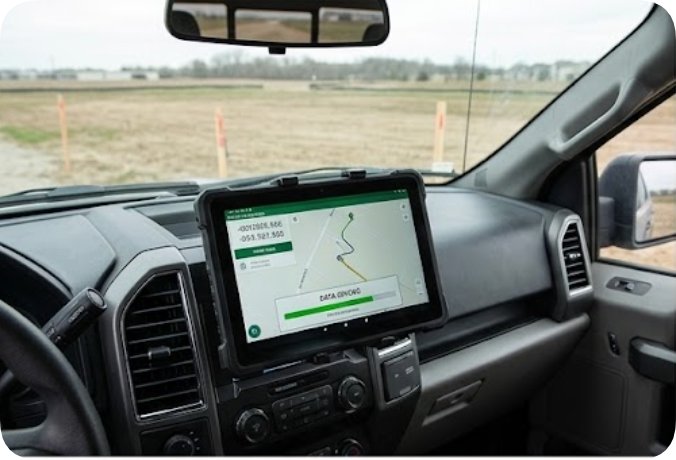
The RT82 earns the front seat because it is the unit that talks to the network while the crew is still on the road. A 10.1-inch panel at 1200x1920 with 400 nits of brightness stays readable at a windshield angle when the driver doubles as the navigator. Inside runs a Qualcomm 5G IoT platform with dual-mode 5G on a long list of bands, 4x4 MIMO downlink and tri-band Wi-Fi 6E, so the vehicle itself becomes the uplink: photos, point clouds and completed forms leave the lot while the crew is still packing the tripods.
The mounting details are unusually friendly for a vehicle install. A 12-pin Pogo Pin on the body means the dock connection is one motion, not a cable fumble, and a Type-C port with OTG and PD support handles power from the vehicle feed. Two Nano-SIM slots let the vehicle carry its own data plan instead of borrowing a phone's hotspot. The enclosure takes IP67 sealing, a 1.2m drop rating and an operating range of -10 to 50 Celsius, so dashboard heat and gravel-road vibration are background noise. A 10000mAh battery bridges the engine-off stretches when the mount goes unpowered, and at under 650g the unit does not demand an industrial bracket to sit safely on a console.
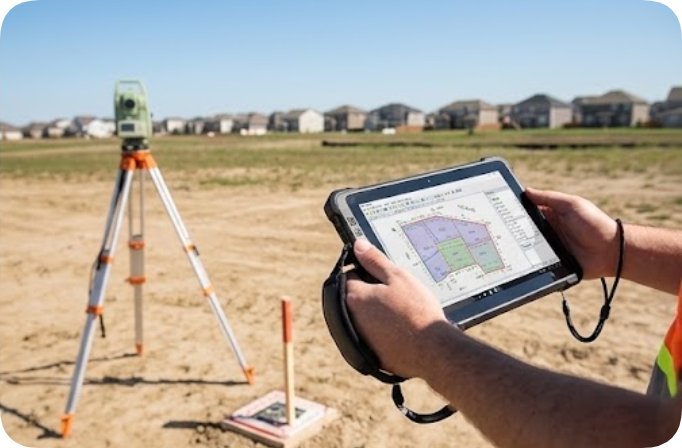
Between vehicle stops, the work moves at walking pace, and the ST9-J carries it. At 700g with an 8-inch screen it is built to be held for hours rather than set down, and the 1200x1920 IPS panel can be ordered up to 1000 nits, which is the difference between reading a plot plan in direct afternoon sun and shading the screen with a forearm. An Intel N5100 quad-core processor runs the same measurement and form software the office uses, and the 10-point touch layer supports both a stylus and wet hands, because morning dew on a railing is not a scheduled event.
Installing a walking unit is mostly about the body of the operator rather than the vehicle: hand strap position, harness points, and which pocket the stylus lives in. Two decisions should be made at order time, because they cannot be retrofitted. The optional modules, including the scanner, UHF RFID, fingerprint reader and high-precision GPS, change the weight and balance of the unit, so the strap layout should be finalized after the configuration is known. The MIL-STD-810G certification and IP65 sealing take care of the knocks and sprinklers, while the 5000mAh battery at 7.7V is rated for roughly seven hours, enough for a walking day with a lunch charge in between.
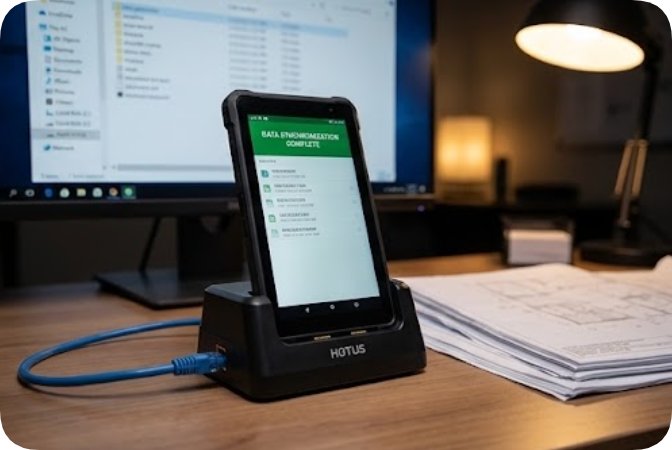
The office end of the route belongs to the HTNJ08B, and its install is the simplest of the three: a 12-pin POGOPIN on the body plus the optional charging dock turns the entire desk station into one motion. Setting the unit down at night charges it, connects it and presents it upright for morning review. An RJ45 port on the body means the sync station can sit on the wired office network, so a day of uploads from the vehicle dock does not compete with everyone else's Wi-Fi.
The desk is a rougher environment than it looks, and the hardware notes read like someone has worked next to a printer. The 8-inch LCD runs at 1200x1920 with 560nit of brightness behind 7H hardness glass, the enclosure carries IP67 with a 1.22m drop rating, and the port selection, from Mini HDMI and full Type-A to TF and SIM, lets the unit drive the review display or a label printer directly. The 3500mAh battery at 7.6V is a desk-sized budget rather than a field one, because the dock does the nightly work.
The install choices become obvious once the three units are read down a single sheet. The rows below take the fields that matter to mounting, power and daily handling, as published on each product page.
| Field | RT82 | ST9-J | HTNJ08B |
|---|---|---|---|
| Role on the path | Vehicle capture and uplink | Walking measurement | Desk sync and review |
| Dock interface | 12-pin Pogo Pin, Type-C PD | Optional docking cradle | 12-pin POGOPIN, optional dock |
| Display | 10.1-inch, 1200x1920, 400nit | 8-inch, 1200x1920, up to 1000nit | 8-inch, 1200x1920, 560nit, 7H |
| Battery | 10000mAh, non-removable | 5000mAh at 7.7V, about 7 h | 3500mAh at 7.6V |
| Protection | IP67, 1.2m drop, -10 to 50 C | IP65, 1.2m drop, MIL-STD-810G | IP67, 1.22m drop |
| Network | 5G SA/NSA, Wi-Fi 6E, BT5.2 | Wi-Fi 5, BT4.2, 4G LTE option | Wi-Fi 5, BT4.2, 4G option, RJ45 |
Read the dock row and the route appears on its own: two Pogo-pin contacts and one cradle, placed exactly where capture, walking and review each happen.
Power is where improvised installs quietly rot, because three devices on three improvised chargers produce three different morning surprises. The route-based install collapses it into one routine. The RT82 charges from the vehicle feed while driving and holds over with its 10000mAh cell during engine-off stops. The ST9-J takes a lunchtime top-up, its seven-hour rating covering a walking day with margin. The HTNJ08B never thinks about power at all, because the dock owns the nights. One rule covers all three: every unit ends the day on its own station, and nothing charges loose in a bag.
The first week decides whether the install sticks. Pair the 5G plan to the vehicle unit and confirm uploads actually leave the lot. Load offline maps onto all three units so a dead zone does not stall the walk. Run one end-to-end test: record at the lot, upload from the dashboard dock, review at the desk dock, and time it. Assign the stations by name, so nobody asks which tablet to grab. After that, the hardware disappears into the routine, which is the entire point of mounting the route instead of the equipment.
When the time comes to put the three units side by side for a purchase decision, the product comparisons and competitor analysis page collects the full set of head-to-head notes, and the wider Hotus range lists the configurations and optional modules for each model.