A bench stops for three reasons, and only one writes anything down. A part is missing, a program is wrong, or a jig is out of calibration. The first two are visible within a minute. The third looks like the second until somebody measures a feature and finds the tolerance has drifted past the drawing.
The failure is rarely a scanning failure. The tag was read correctly, the asset number recorded, the transaction closed. What it could not see was a due date nobody had entered, because the ledger tracks custody rather than fitness. That gap is why a rugged mobile computing solution for the tool crib only helps once the record has a column worth reading.
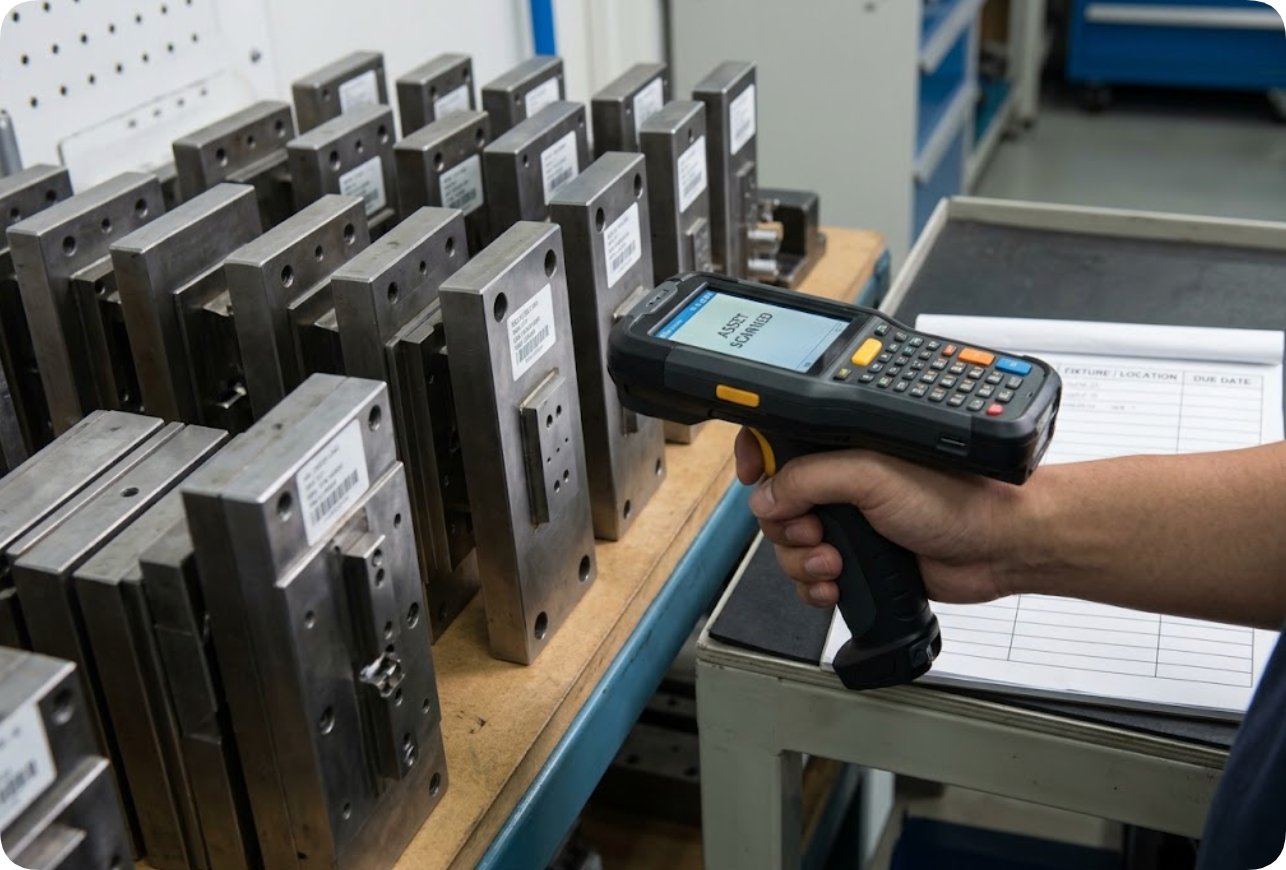
A Logged Jig Can Still Stop the Press
Consider a stamping shop with one hundred jigs on a board, each carrying an asset number. Every morning a clerk scans each label into a handheld, producing a list of what exists and where. That list is accurate, and nearly useless for the question a setter asks at seven: is the jig needed for the first part fit to run?
Existence and fitness are separate conditions, and only one is observable with a barcode. A scan tells you the asset is present, its number legible, its location correct. It tells you nothing about the last calibration, the next one, or whether a shim was replaced three weeks ago without a record.
So the same shop can run a clean audit and still stop a line. The audit checks inventory. The line checks metrology. Two questions, one label, one field everyone assumed covered both.
A Green Tag Says Nothing About the Due Date
Most cribs mark status with colour. A green tag means available, amber in use, red quarantined. Colour is read at three metres by someone walking past, which works well for availability. It fails for expiry, because a due date is not a colour anyone holds in their head for a hundred assets.
So fitness lives in a spreadsheet, maintained by a different person on a different schedule. When the two disagree, the scanner wins, because it is current and the spreadsheet is touched when someone remembers. A jig out of calibration is scanned into service on Monday and runs parts until the measurement fails.
Moving the due date onto the tag itself is the obvious fix and rarely the accepted one. The argument against is that asset labels are printed in batches and reprints require a controlled process. The argument for is simpler: the field has to travel with the object, and the object is what moves between the crib, the bench and the metrology room.
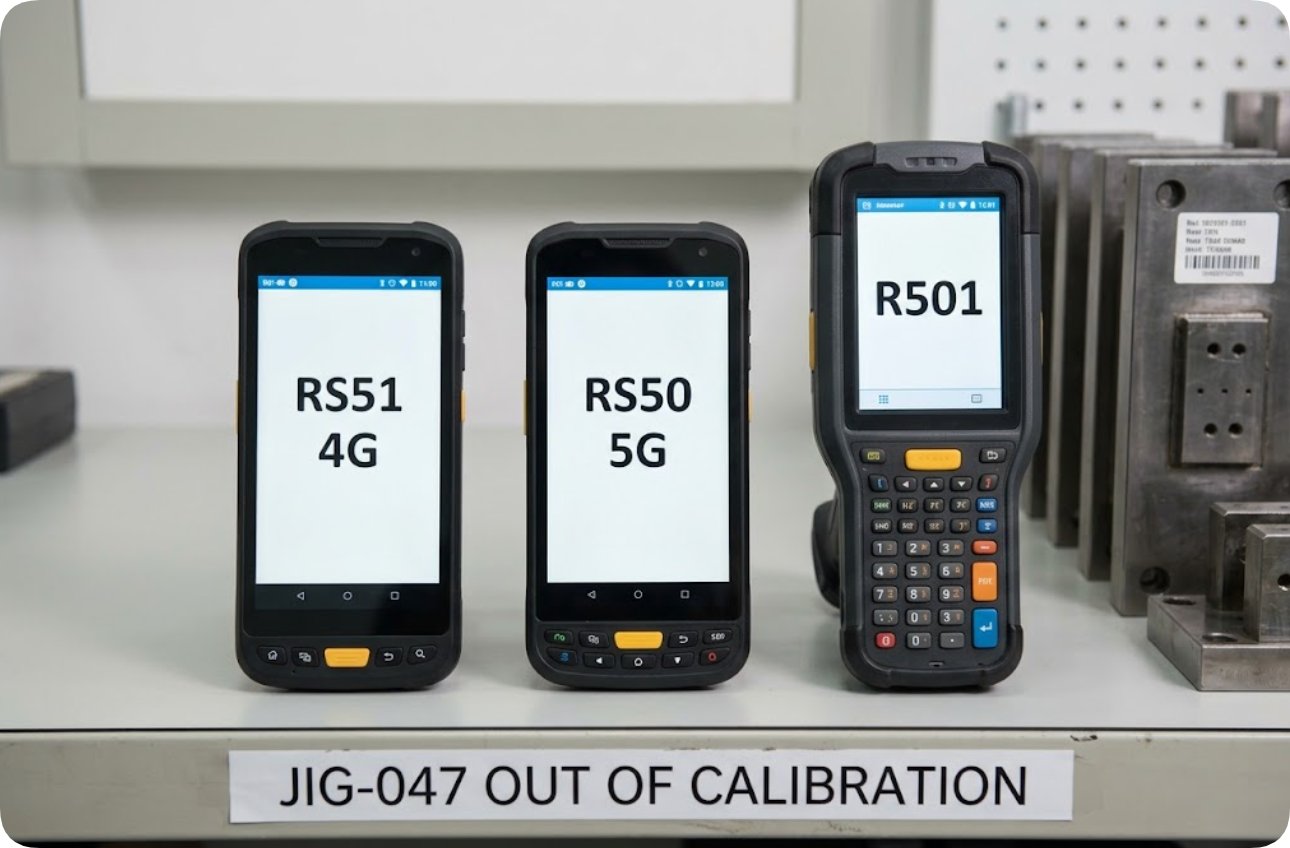
Three Terminals, Three Different Reasons to Carry One
Hardware choice matters less here than in most applications. Any of these three scans a label, records a transaction and survives a shop environment. What differs is what happens when the record needs more than a single string, which is the point of this article.
The R501 Tag RFID is the simplest of the three. It runs an MT6762 octa-core at 2.0GHz on Android 10 or 13, carries an IP65 sealing standard, weighs under 750g including its handle, and uses a Type-C 2.0 interface with OTG. For a clerk scanning a board twice a day that is more than sufficient, and the sealed body tolerates machining dust.
The RS51 Handheld Terminal suits a harsher environment and a richer record. It runs a Qualcomm SM6225 octa-core at 2.4GHz on Android 13, holds IP67 with a 1.2 metre drop specification, and operates from minus ten to fifty degrees. Its screen is a 6.3 inch IPS FHD+ panel with five-point capacitive touch, and the 5000mAh battery is detachable, which matters when a shift outruns a full charge.
The RS50 Handheld Terminal suits work that is data-heavy rather than scan-heavy. A Unisoc UIS7885 octa-core at 2.7GHz with an eight-core NPU, 8GB RAM and 128GB storage hold a month of transactions locally for later reconciliation, and the 48MP rear camera makes a photographic record of a worn fixture practical. It carries the same IP67 rating and drop figure as the RS51.
All three share a 6.3 inch FHD+ display, a physical form factor of 172 by 76.6 by 16.5 millimetres under 500 grams, dual nano-SIM slots, and a Type-C port with OTG and power delivery. Choosing between them is mostly a question of how much data the transaction carries, not how fast it scans.
What Each Part of the Record Actually Proves
| Field recorded | What it proves | What it cannot prove |
|---|---|---|
| Asset scanned | The tagged object is physically present in that location | Whether it is fit to produce a part |
| Issued to | Who took custody and at what time | Whether it was returned before its next booking |
| Last measured | A calibration was performed on that date | Whether the result was inside tolerance |
| Due date | The next scheduled check, if somebody entered it | That the asset was actually locked out after it |
Read a column downwards rather than across a row and the shape of the gap appears. Three of these four fields describe custody. Only one describes fitness, and it is the one most likely to be typed by hand from a calendar rather than copied from a measurement record.
The Check That Belongs at the Cabinet, Not the Bench
The natural place to catch an expired asset is the moment it is issued, when somebody holds the scanner and the record is open. In practice the check is skipped under time pressure, and a shift with forty jigs to hand out will not open a second screen per asset.
A better arrangement inverts the order. The crib lists what is due before the shift, and the terminal shows that short list rather than the whole board. Scanning then confirms identity only, which is fast, and the fitness decision was already made by whoever saw the list. The scan stays cheap because it is not doing two jobs.
This also removes the argument about reprinting labels. A status list generated from existing records needs no new field on the physical tag; it needs the due date to exist in the system at all. Once it does, the list is a query.
💡 Why the Reader Matters Less Than the Habit
There is a persistent belief that better hardware prevents these mistakes. A faster radio, a tighter read range or a more tolerant antenna is assumed to remove the failure. It does not, because the failure was never a misread. Every transaction in this scenario was read correctly.
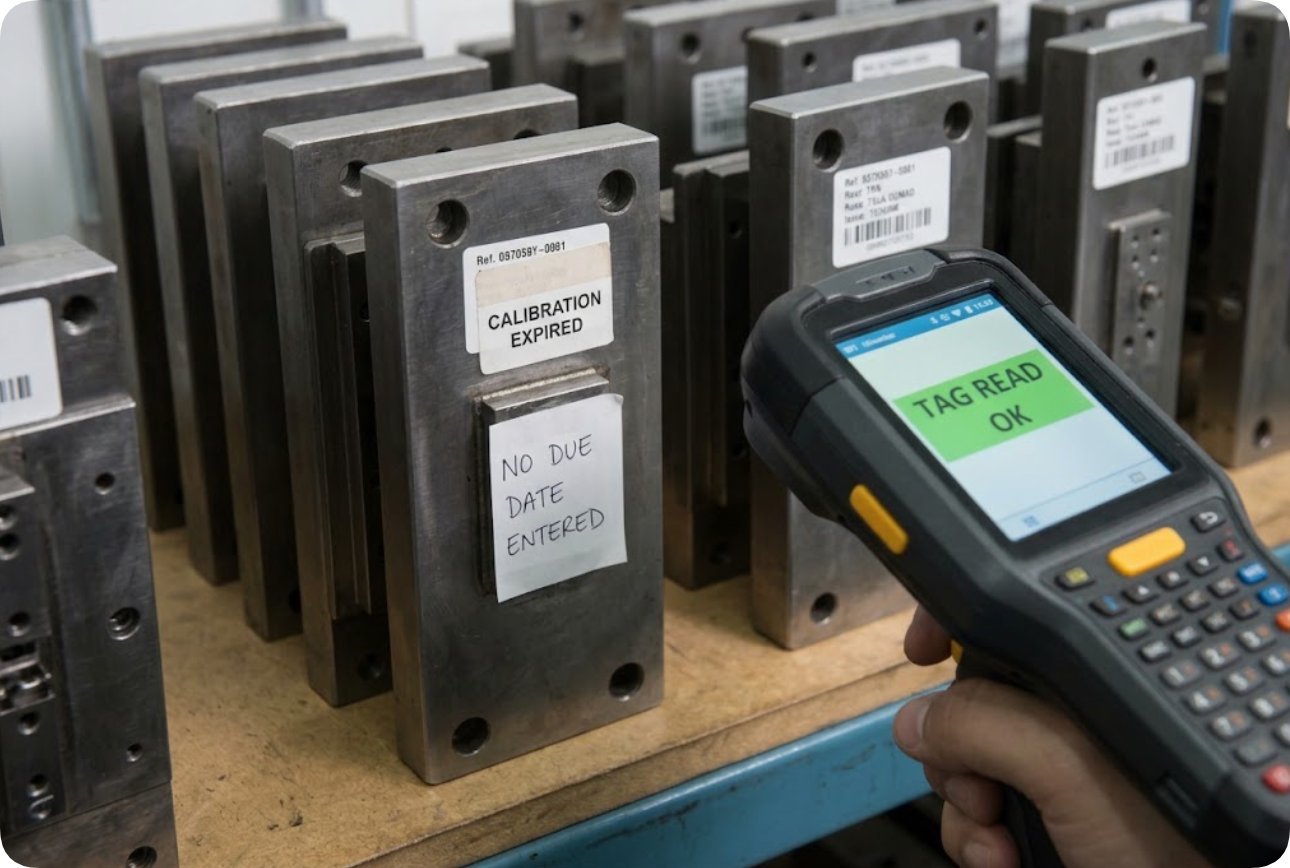
What prevents it is a rule that an asset with no due date cannot be issued. That rule is worth more than any specification here, and it costs one field and one validation. Where it exists, hardware choice is routine and a shop can standardise on one terminal for years.
Specification still decides two practical things. Read reliability on a scratched or oily metal label is worth testing before standardising, and battery behaviour across a full shift decides whether the terminal lives in a charging cradle or a technician's pocket. Everything else is a preference.
Out of Calibration Is a Status, Not a Date
A common implementation mistake is treating the due date as the whole control. A date can be passed. A status cannot, if the system refuses to issue an asset whose status says out of calibration regardless of what the date says. Dates expire quietly at midnight; statuses are checked at the moment of the transaction.
The distinction shows up in recovery. An asset found out of tolerance mid-batch must be recorded as an event with a time and a result, not edited into the last measured field. Editing a date destroys the evidence that the fault existed, which is what tells the quality team how many parts to review.
🔮 What the Next Shift Should See
A handover that works does not describe the shift. It names the assets that changed state, the assets that are now out of service, and the bookings that will fail tomorrow. That is three lines, and it can be generated from the same record the scanner writes.
For a site evaluating terminals, the honest test is not which device reads fastest. It is whether the required transaction can be completed by someone holding a 500 gram device in one hand at the end of a shift, with gloves on, where the screen is the least readable surface in the room.
Read the wider rugged handheld tablet and terminal range before standardising, and treat the ledger design as the deliverable rather than the device. The device is chosen once. The ledger is lived with every morning, and it is the one that decides whether a green tag means anything.
For comparisons against other industrial vendors and a view of how these records are kept elsewhere, see our product comparisons and competitor analysis pages.