Most warehouses discover what their new handhelds can do during the busiest week of the quarter. Units get unpacked at goods-in, the scanner app is sideloaded by whoever is free, and the devices go straight onto the floor. The first week becomes the real acceptance test whether anyone planned one or not, and the failures are quiet: a battery dead at hour nine, a Wi-Fi radio dropping at aisle twelve, a screen washed out under dock lights.
The alternative is boring: a four-day bench-to-floor run in a quiet week, before units are signed into service. Not a certification, just four days of measuring what will matter, written on one sheet, signed by the person who lives with the results. Three models carry the run: a compact Android PDA, an eight-inch Windows tablet, and a full-featured inventory phone. Each day asks one question and ends with a number.
Day One Belongs to the Cart, Not the Bench
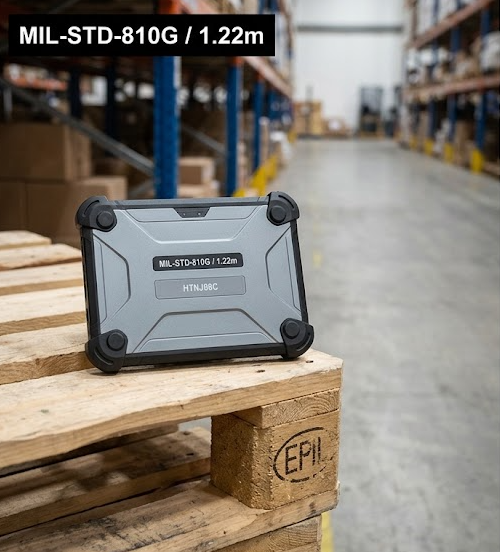
Day one is about survival, starting at the goods-in dock. Every unit gets a drop test at the height it will actually fall from, because the fall that kills a handheld is never from a bench: it is from a pallet top, a raised platform, the edge of a nudged cart. One-point-two metres is the industry number, and the HTNJ08C publishes it — MIL-STD-810G certified, 1.22m drop resistance, double-layer body. That qualifies the tablet for platform work without a case in the negotiation.
The two PDAs publish no drop figure, and the sheet says so rather than assumes. Both carry IP67, which covers dust and immersion and matters on a dock where rain comes sideways. But IP67 is an ingress rating, not a fall rating: the PDAs get a case requirement written into the sheet, the tablet does not. Anything failing day one goes back in the box with an RMA number, not into a drawer.
🔋 Day Two Is a Battery Question With One Shift as the Deadline
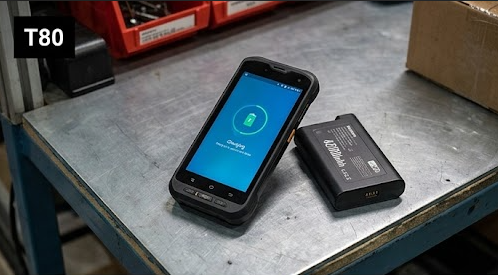
Day two starts at shift end, because a battery spec means nothing until it survives the worst day rather than the average one. Both PDAs publish the same headline: a removable 4200mAh battery, twelve-plus hours. The N60 adds the figure that matters in practice, charging in under 1.5 hours, so a unit turns around in a lunch break. The T80 publishes under four hours for the same capacity, pushing its seats toward a spare-battery pool instead.
The tablet is a different animal. The HTNJ08C runs a 7.6V 3500mAh removable battery and publishes no hourly figure, because a Windows tablet on an eight-inch screen does not pretend to last a shift on one charge. Its question is the swap, not the hours: a removable battery plus a DC 19V 3.42A adapter makes the battery policy a desk policy, and the sheet records how many charged spares each seat needs.
The rounding rule keeps the sheet honest: a twelve-hour claim is a ten-hour plan. One spare per two PDA seats, two per tablet seat, ratios from published figures rather than optimism. Day two also catches quieter failures — the battery door needing a coin, contact pins oxidising in a humid dock, the unit full at 5pm and dead at 9am. That last one is a charging-path problem, and it goes on the snag list with a name against it.
Day Three Reads the Cage Wall, Twice, in the Wrong Light
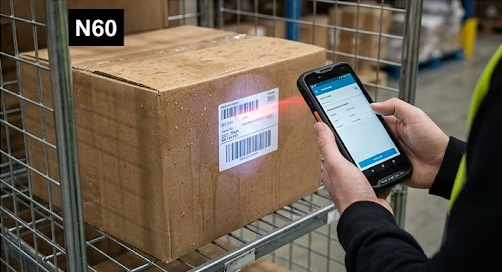
Day three is when the screen earns its place. Every barcode on the cage wall gets scanned twice: under the dock's sodium lights at 6pm, then under high-bay LEDs at 6am, because the two regimes wash out different panels. The T80's 4.5-inch panel at 480×854 behind Gorilla Glass passes the scan test comfortably, because scanning is the imager's job. What the small screen costs is everything around the scan: the exception note, the photo of a damaged carton, the batch text. Those become a scroll-and-squint workflow, and the sheet records them as such.
The larger panels split the decision. The HTNJ08C's 8-inch Full HD touchscreen is specified at 560nits with 10-point capacitive touch, 7H hardness and wet-hand support, and 560nits is the dock number: roughly double a standard panel, the difference between reading a label confirmation and shielding the screen with your body. The N60's 5.99-inch FHD panel with glove and wet-hand support wins on ergonomics instead, because at 164.5mm long and 12.3mm thin it is the unit a picker keeps in a pocket all shift.
The test that settles it is a ten-minute blind run down an aisle of mixed cartons — wet labels, shrink-wrapped bundles, a half-scuffed pallet corner — recording first-pass read rate, not whether a second attempt eventually worked. First-pass rate becomes seconds per pick over a shift, and seconds per pick is the number the floor manager will care about next quarter.
Roaming the Route a Cart Actually Takes
Day four moves the units onto the real route at the real hour when the network is busiest. The question is roaming: what happens when a picker walks from the mezzanine down to the dock, through the concrete column every warehouse has. The T80 connects over dual-band WLAN at 2.4 and 5GHz across 802.11 a/b/g/n/ac; the N60 and HTNJ08C step up to Wi-Fi 6 on 802.11ax. On a modern warehouse network that is not marketing — 5GHz stays usable under load, and ax handles a full floor of carts better than ac.
All three publish full cellular WWAN across 2G/3G/4G/5G plus multi-satellite positioning, covering the yard, the lorry park and the bonded store where no Wi-Fi reaches. Each route segment gets one number: minutes of connected time out of a thirty-minute lap. Anything under twenty-eight goes on the snag list as a coverage question for the network team, not a device question, and that distinction keeps the sheet from becoming a blame document.
Temperature closes the run. Only the HTNJ08C publishes an operating range, minus 20°C to 55°C, qualifying it for the cold store and the unheated dispatch bay where the PDAs go with a case and a time limit. The column answers one question per site: which units are allowed outside the heated envelope, and for how long. Where the answer is none, that is written down too.
The Snag List Closes Before the Units Go Out
Every failure lands on one list with a format that leaves no room for a shrug: serial number, the day it failed, the exact reproducer, the name of the person who saw it, a deadline. An entry without a reproducer is a rumour, and rumours turn a known defect into a fleet-wide mystery three months later. The list closes when every entry is fixed and retested or formally accepted with a workaround in the induction pack, and units do not reach the floor before that.
The defect types are predictable even when the details are not. On the radios: the unit connected everywhere except one corner of aisle nine, a per-unit problem until five units test the same way and it becomes a network question. On the batteries: the door that needs a coin, the contact pin that oxidises after a humid dock week, both small until a gloved picker meets them at hour six. The habit worth keeping is the retest column — marked fixed is not closed; closed means the same steps pass on the same unit, in the same light.
The Sign-Off Sheet, With the Gaps Left In
Four days collapse into one table, deliberately conservative: it records what each manufacturer publishes, marks gaps as gaps, and never fills them with a guess. All three models carry IP67, which is why the ingress column is identical down the rows and the drop column is not.
| Acceptance line | T80 Handheld PDA | HTNJ08C Rugged Tablet | N60 Inventory Management PDA |
|---|---|---|---|
| Operating system | Android 9.0, Cortex-A53 quad-core 2.0GHz | Windows 10 Pro / 11 Pro, Intel N100 quad-core | Android 10.0, Cortex-A76/A53 octa-core 2.0GHz |
| Display | 4.5-inch IPS, 480×854, Gorilla Glass | 8-inch IPS Full HD, 1200×1920, 560nits | 5.99-inch IPS FHD, 1080×2160 |
| Memory and storage | 2GB + 16GB, expandable to 3GB + 32GB | High-speed RAM + SSD, M.2 expansion | 4GB + 64GB, expandable to 6GB + 128GB |
| Battery | 4200mAh removable, 12+ hours | 7.6V 3500mAh removable, no hourly figure published | 4200mAh removable, 12+ hours |
| Ingress rating | IP67 | IP67 | IP67 |
| Drop and military rating | Not published | MIL-STD-810G, 1.22m drop resistance | Not published |
| Wireless | Dual-band Wi-Fi a/b/g/n/ac, 2G/3G/4G/5G | Wi-Fi 6 (802.11ax), global 4G LTE | Dual-band Wi-Fi 6, 2G/3G/4G/5G |
| Operating temperature | Not published | -20°C to 55°C | Not published |
| Dimensions | 166 × 77.5 × 22mm | 238 × 160 × 25mm, 1.8kg gross | 164.5 × 79.4 × 12.3mm |
Read down and the roles assign themselves. The T80 is the sealed scanner for the dock and returns desk, where a small screen is enough because the job is a scan and a count. The HTNJ08C is the platform unit, qualified for height, cold and wet by the only published figures covering those conditions. The N60 is the pocket unit for pickers walking twenty kilometres a shift. Nothing in the table says one is best — that is the point of running four days first.
Sites planning a wider rollout will find the same questions answered at fleet scale in the warehouse operations applications pages, and the T80 Handheld PDA, HTNJ08C Rugged Tablet and N60 Inventory Management PDA product pages publish the full specification each acceptance line is drawn from.
Frequently Asked Questions
1. Is a four-day acceptance run realistic for a site with no test bench?
A: Yes, because none of the four days needs a lab. Day one needs a dock and a pallet, day two a charger and a calendar, day three an aisle of cartons, day four a cart route. The only real requirement is a quiet week and one person writing numbers instead of impressions.2. Two units share the same battery capacity. Why do they behave differently?
A: Capacity is one input among several. Screen size, radio load and operating system draw from the same 4200mAh differently, and the charging times differ as well, under four hours on the T80 against under 1.5 hours on the N60. The run measures the combination, not the headline cell.3. What happens when a unit fails day one?
A: It goes back to the supplier the same week, with the failure written on the RMA. The failure mode that costs money is the one sitting in a drawer for a month while everyone assumes somebody logged it. The snag list exists so nothing waits for memory.4. Should the sheet be redone when new firmware ships?
A: A shortened version, yes. Battery and roaming behaviour can change with a radio stack update, so a one-day rerun of day two and day four after any major firmware change keeps the sheet true. The rest only repeats when the device model changes.Whatever models the site settles on, the HOTUS industrial hardware range publishes the durability, battery and connectivity figures this sheet is built on, and the comparison pages at HOTUS comparison library cover how the same three form factors behave once the floor is allowed to touch them.