U9000, T80 and R350C: Staffing a Courier Sorting Night Around Three Different Scanners
A courier depot's night sort does not have one scanning job. It has a dock where cartons come off a truck two at a time, a conveyor where parcels get sorted into number ranges by hand, and a desk where the problem pieces end up when a label will not read or an address does not resolve. Putting the same scanner in all three roles is how depots end up with tired arms at midnight and a queue at the discrepancy desk. The hardware differs, and so does the staffing logic: each role hires for something different, and each of the three models on this page is built for a different one of them.
Everything below is drawn from what each product page publishes. The U9000 Handheld PDA runs a 5.0-inch 720×1280 display behind Gorilla Glass on Android 9.0, with a Honeywell SE966 scan engine and NFC at 13.56MHz. The T80 Handheld PDA is the compact one: a 4.5-inch 480×854 Gorilla Glass panel, the same Android 9.0 base, the same SE966 engine. The R350C is the keypad unit: Qualcomm QCM2290 quad-core at 2.0GHz on an 11nm process, Android 13.0, a 4.0-inch 480×800 touchscreen with a full physical numeric keypad, and IP67 with 1.5m drop resistance where the two older models publish no drop figure at all.
The Shift Roster Decides the Hardware, Not the Other Way Round
Depots that struggle with scanner assignments usually started from the wrong end: they bought one model in bulk and then tried to fit roles to it. The better sequence is to write down what each station actually does for eight hours, then match the device to the station. A dock scanner spends its night in short bursts with the arm raised. A sortation scanner spends it in continuous one-handed rhythm. A discrepancy scanner spends it reading small text, typing exceptions and waiting for decisions. Those are three different workloads, and they stress different parts of a device.
The roster logic also explains why the depot keeps spares per role rather than per model. A spare unit that lives at the dock is not interchangeable with a spare that lives at the keypad station once the assignments have been tuned, and the sheet below keeps the spares column visible for exactly that reason.
📱 The Unload Dock Runs on the Compact Scanner
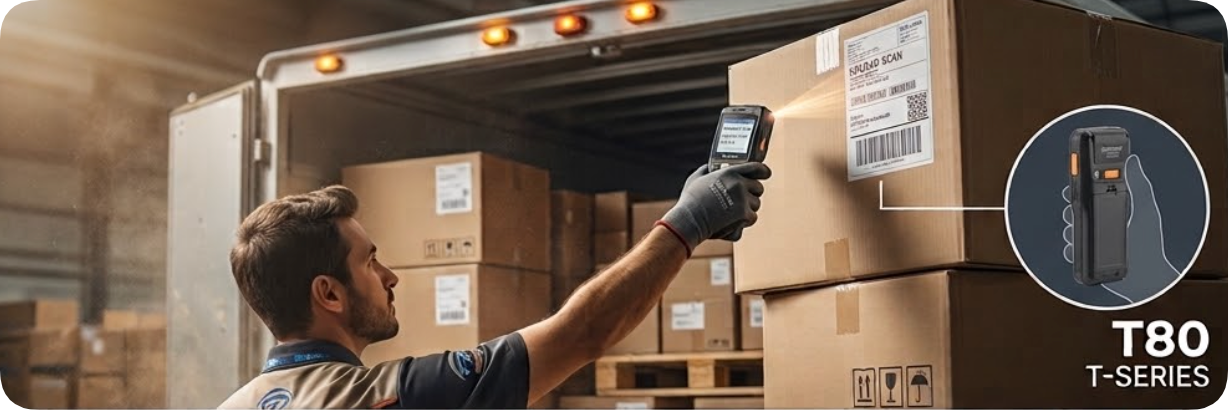
The dock wants a device that disappears between bursts. Cartons come off in waves: two minutes of heavy lifting and scanning, then a pause while the next cage rolls in. The T80 fits that rhythm because it is the smallest of the three and the lightest to carry at hip height for a whole shift, and its 4.5-inch screen is large enough for the only thing a dock scan needs: a green confirmation and a location code. At 480×854, reading a full address on it is not the point; confirming that a carton registered is.
The same smallness matters for the other half of the dock job, which is scanning cartons that are still on the truck bed, sometimes at arm's length overhead. A lighter unit gets there with the elbow instead of the whole shoulder, and across two hundred cartons that difference is measurable in the crew's pace. The T80's 4200mAh removable battery covers the burst-and-pause profile comfortably; the dock does not run the device continuously, so the battery spends the night in credit rather than in deficit.
Sorting by Number Range Belongs to the Keypad Unit
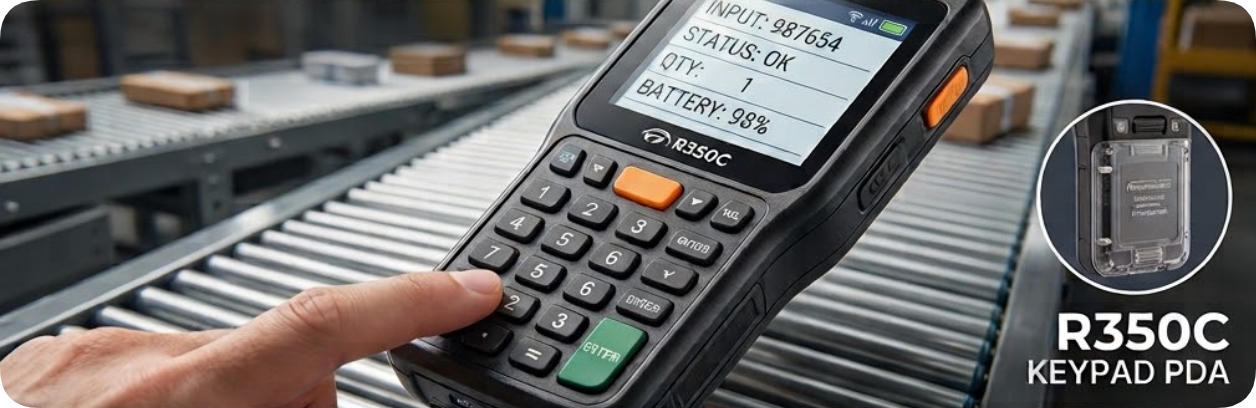
The conveyor station is the one job where typing is constant. Sorters work a number range: anything ending in 4 goes to lane twelve, anything in the 7-range to lane fifteen, and the exceptions get typed in by hand. A touchscreen keyboard slows exactly the people who do this fastest, because they type blind, mid-motion, dozens of times an hour. The R350C exists for this seat. Its physical numeric keypad with dedicated SCAN, ENT and function keys lets a sorter key a range entry without looking down, and at under 300g with a slim 155×70×20.5mm body it is the unit a sorter can hold all night without the grip cramping.
The battery story matches the workload. The R350C's 3.8V 4000mAh pack is removable with hot-swap support, which means a sorter mid-block does not power down to change it, and on the 11nm QCM2290 platform the page's own figures put mixed scanning and transmission at 10-12 hours. A night sort runs six to eight hours; one pack covers it with the spare riding in the holster as insurance rather than as a scheduled swap.
There is also a durability argument specific to this station. Conveyors are where scanners get dropped, onto steel rollers, from waist height, several times a season. The R350C is the only one of the three that publishes a figure for exactly that event: IP67 dust and water protection with 1.5m drop resistance. The U9000 and T80 carry IP67 as well, but neither page publishes a drop height, and a depot that has seen what a conveyor does to a scanner will weight that published number.
🖥️ The Discrepancy Desk Needs the Bigger Screen
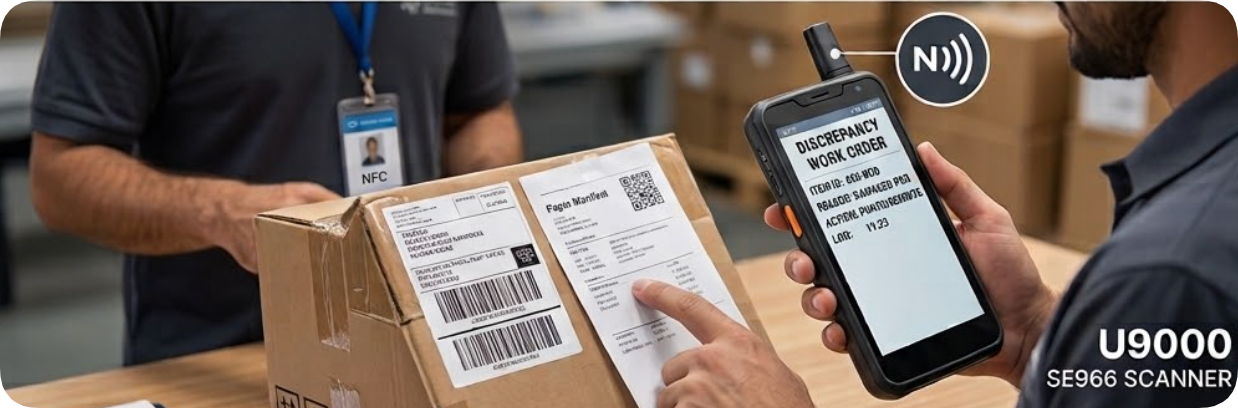
Every problem parcel in the building walks to one desk: the label that will not scan, the address that half-resolves, the shipment whose barcodes have been through rain. The person working that desk is not scanning in rhythm; they are reading, comparing and typing, which is why the U9000 ends up there. Its 5.0-inch 720×1280 display is the largest of the three, and at that resolution a damaged waybill's text is readable without passing the parcel to a monitor. The Honeywell SE966 engine handles the compromised labels, and NFC at 13.56MHz covers the identity checks where a card or tag replaces the barcode entirely.
The U9000's 3.7V 4800mAh battery is the largest cell on the page, and its published working figure of 12 hours matters at this desk for a different reason than at the dock: the discrepancy station is the last position to power down, often an hour after the last truck leaves, and it is the station that cannot send a dead unit to a charger mid-verification. The removable pack plus roughly four-hour charging means a fresh cell swaps in without the desk going dark.
🔋 Battery Math Across a Split Shift
Staffing and charging share a table, because the depot's real constraint is not how long a battery lasts but when the chargers are free. The three published profiles: the T80's 4200mAh charges in under four hours; the U9000's 4800mAh delivers 12 working hours and charges in about four; the R350C's 4000mAh hot-swaps in seconds and tops up on Type-C between shifts. A depot running one night shift charges everything at dawn and never thinks about it. A depot running split shifts, sort in the evening and first-mile pickup at dawn, needs the rotation written down: which cells go into the dock units, which into the keypad holsters, and which charger slot each one occupies.
The arithmetic worth doing once per season is spare-cell count per role. Dock units can share a charging rack because their duty cycle is bursty. Keypad units want a spare cell in the holster because their duty cycle is continuous. The discrepancy desk wants its own charger because it is the last to close. That is three different charging arrangements for three different roles, and the model mix above is what makes each arrangement cheap instead of improvised.
The Staffing Table, With Figures the Pages Publish
Condensed for the shift supervisor, this is the assignment sheet: which model rides with which role, and the published figures behind the decision. Where a page does not publish a figure, the cell says so rather than guessing.
| Assignment line | U9000 Handheld PDA | T80 Handheld PDA | R350C PDA |
|---|---|---|---|
| Best-fit station | Discrepancy desk | Unload dock | Sortation conveyor |
| Operating system | Android 9.0, Cortex-A53 quad-core 2.0GHz | Android 9.0, Cortex-A53 quad-core 2.0GHz | Android 13.0, Qualcomm QCM2290 quad-core 2.0GHz (11nm) |
| Display | 5.0-inch IPS 720×1280, Gorilla Glass | 4.5-inch IPS 480×854, Gorilla Glass | 4.0-inch IPS 480×800 + physical numeric keypad |
| Scan engine | Honeywell SE966 | Honeywell SE966 | Optional Honeywell / Zebra / CMOS engine |
| Battery | 3.7V 4800mAh removable | 4200mAh removable | 3.8V 4000mAh removable, hot-swap, Type-C |
| Published endurance / charging | 12h working, ~4h charge | Charge<4h | 10-12h mixed use per charge |
| Ingress rating | IP67 | IP67 | IP67 |
| Drop resistance | Not published | Not published | 1.5m drop resistance |
| NFC | 13.56MHz, UHF RFID optional | Yes | 13.56MHz (ISO14443A/B, ISO15693) |
| Dimensions | Not published on page | 166 × 77.5 × 22mm | 155 × 70 × 20.5mm, under 300g |
Read down the first row and the staffing decision makes itself: three stations, three workloads, three published hardware profiles that happen to fit them. Nothing in the table says one model is better; the 12-hour cell and the 1.5m cell answer different questions, and a depot that knows which question its night asks is the depot that staffs it correctly.
Depots planning the wider rollout will find the fleet-level questions on the courier scanning product family page, and the full published specifications behind each line on the U9000 Handheld PDA, T80 Handheld PDA and R350C PDA product pages.
Frequently Asked Questions
1. Can one depot run all three models at once?
A: That is the intended pattern. The three roles stress different hardware: burst lifting at the dock, continuous one-handed keying on the conveyor, and reading plus typing at the discrepancy desk. Mixing models per station costs little at purchase time and pays back in pace, because no single device is comfortable in all three workloads.2. Why does the keypad matter so much for sortation?
A: Because sorters type number ranges blind, dozens of times an hour, mid-motion. A physical numeric keypad with a dedicated SCAN key accepts that input without the sorter looking down or hunting for the right touch region. It is the one station where a touchscreen is the slower interface, and the R350C is built around that fact.3. The T80 and U9000 pages do not publish a drop height. Is that a problem?
A: It is a fact to manage rather than a defect. Both carry IP67, so dust and water are covered by published figures, but drop resistance is not published for either. Depots handle it the practical way: the dock and desk units get lanyards and holster discipline, while conveyor duty, where drops onto steel are routine, goes to the R350C with its published 1.5m rating.4. How many spare batteries should a split-shift depot hold?
A: Per role, not per model. Dock units share a charging rack because their duty is bursty; keypad units keep one hot-swappable cell in the holster because the conveyor never pauses; the discrepancy desk keeps its own charger because it closes last. The published figures that drive the count are 12 working hours on the U9000, sub-four-hour charging on the T80, and hot-swap on the R350C.Comparing these assignments against other hardware or other depots is easier with the wider context: the range behind all three models sits on the HOTUS industrial hardware catalog, and product comparisons and competitor analysis cover how each model holds up once the shift assignments get contested by real volume.