A highway maintenance survey crew does not lose time to dramatic breakdowns. It loses time to small faults that surface mid-shift: a panel nobody can read at noon, a unit that dies three kilometers from the truck, a drawing that will not open at the shoulder. Each fault costs the same thing, a walk back to the vehicle and a row of re-measured points, and each one has a hardware answer that can be settled before the crew leaves the depot.
This article walks one shift with three Hotus rugged tablets and traces the faults each one is built to absorb. The ST11-J handles the noon glare problem on the standard survey route. The HTYJ08A turns a dead battery from a shift-stopper into a two-minute stop. The ST13-U keeps the wide plan sheets legible back at the cab. Read together, they show why crews that carry a mixed kit spend less time standing at the roadside.
Three Faults a Road Crew Meets at Kilometer 43
The first fault shows up in the sky, not in the device. A panel calibrated indoors washes out completely once the sun climbs past the guardrail, and an operator holding it at arm's length starts tapping coordinates by memory. The second fault is power: a compact tablet rated for a full day indoors arrives at the afternoon segment with fifteen percent left, because cold morning air and a screen at maximum brightness both take their share. The third fault is the drawing itself, opened on a screen too small to read a culvert detail without zooming four times.
None of these faults announces itself in the depot. All three appear between kilometer posts, where the cost of every mistake is measured in walked meters and re-shot points. For crews assembling a kit around rugged tablets, the rugged tablet range is best read not as a size ladder but as a fault map: each model concentrates its engineering on the failure that actually costs the shift.
ST11-J Recovers a Washed-Out Panel
The ST11-J attacks the glare fault with brightness headroom. Its 10.1-inch IPS panel runs 1200 by 1920 at 420 nits typical, rising to 450 nits maximum, and a 1000-nit option exists for crews that work long summer days in open terrain. When the noon segment washes a lesser screen into a mirror, the surveyor bumps brightness instead of hunting for shade, and the morning's point layout stays on screen.
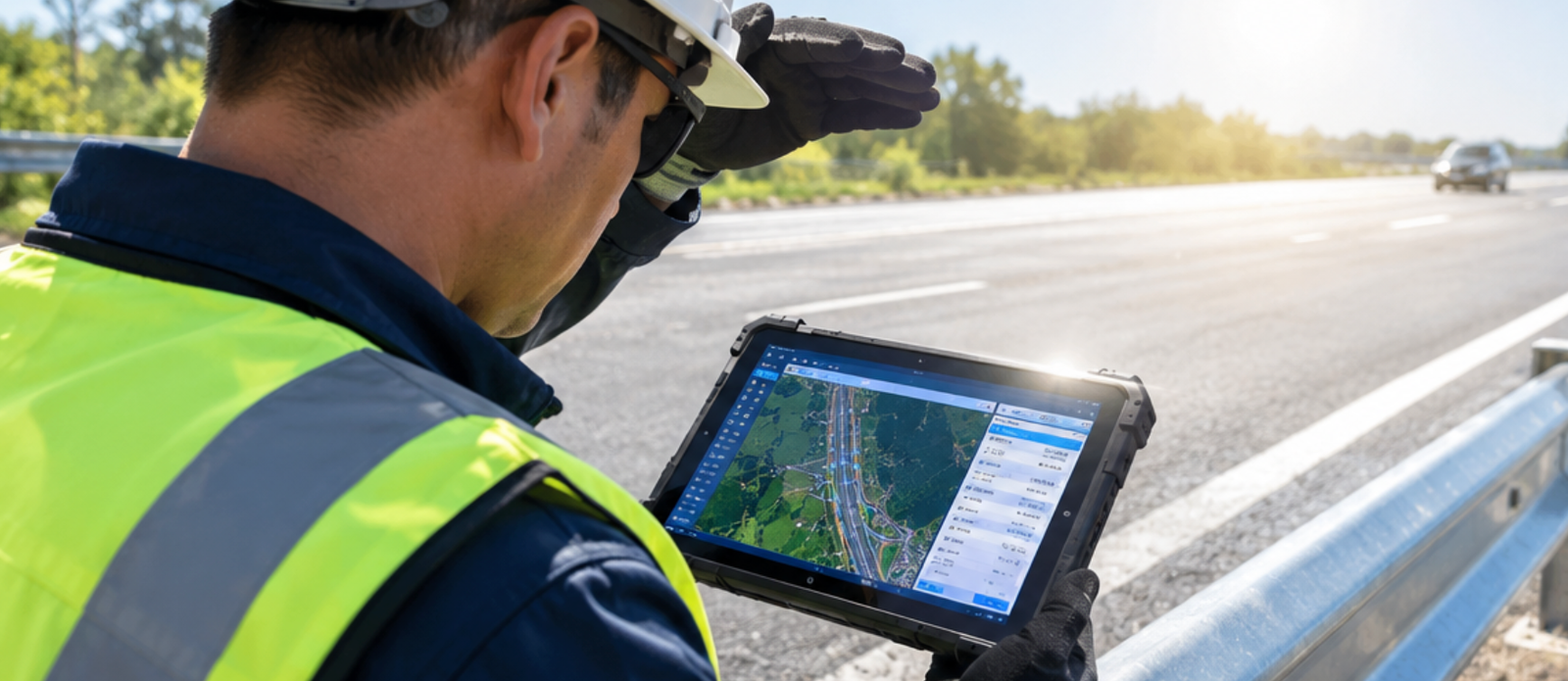
The platform underneath is built for the same environment. An Intel N5100 quad-core processor runs Windows 10 Pro or Windows 11 Pro with 8GB of RAM and a 256GB SSD, and the 6000mAh 7.6V battery is rated for roughly eight and a half hours of use, which covers a standard survey shift without a midday charge. Positioning runs on GPS, BDS and GLONASS, with 4G LTE on the SLM770A module keeping the day's points synced before the truck reaches the depot.
Roadwork punishes hardware in other ways, and the ST11-J carries IP65 protection with MIL-STD-810G certification against dust, water, vibration and drops. Expansion stays optional and modular, including UHF RFID, a barcode scanner, fingerprint login and TPM2.0 security, which lets a fleet standardize on one chassis while adding modules per crew. The full configuration list sits on the ST11-J rugged industrial tablet page.
HTYJ08A Trades a Dead Cell at the Shoulder
Power faults have a simple taxonomy: either the crew stops for the battery or the battery stops the crew. The HTYJ08A is built around the first option. Its 7.6V 3500mAh cell is removable, so the exchange happens at the shoulder in the time it takes to log the last point, and the shift continues on a fresh cell instead of a tethered charge from the truck's inverter.
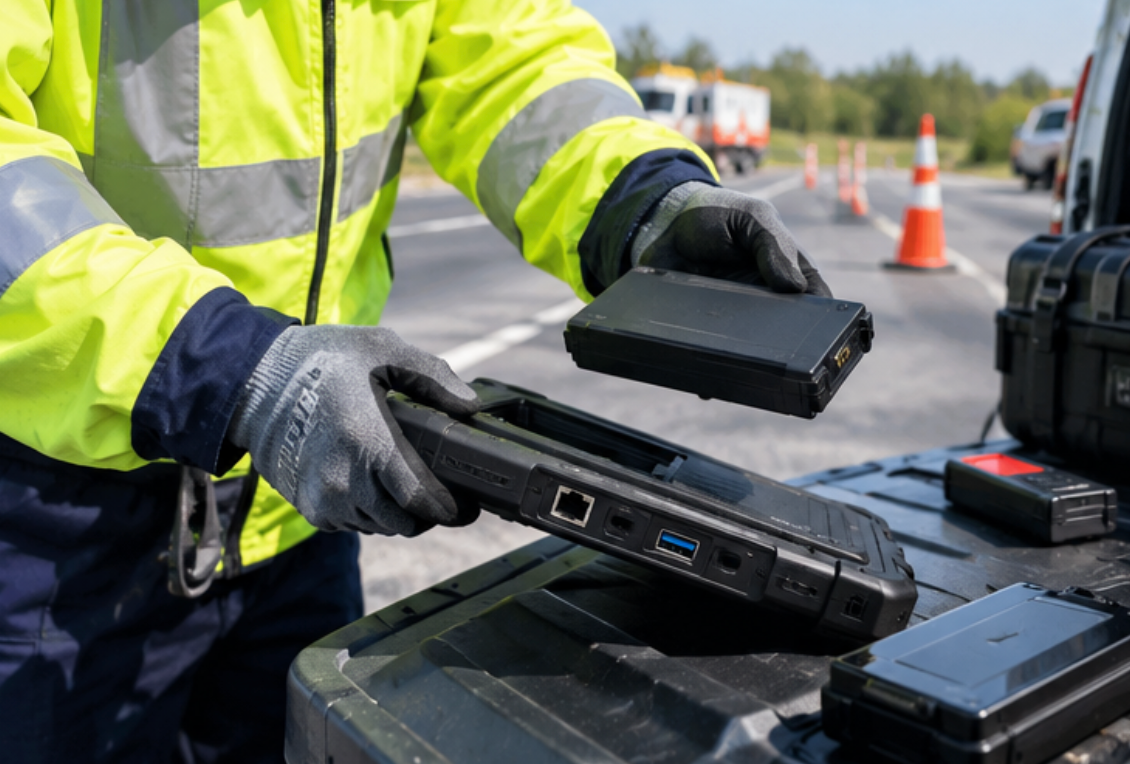
The compact 8-inch body hides an unexpectedly large port selection for its class: RJ45 Ethernet, Mini HDMI, USB Type-A, USB Type-C, DC input, a TF slot, a SIM slot and a 12-pin pogo connector. That selection matters on survey jobs where the tablet must talk to total stations, vehicle docks or field routers without adapters. Wireless runs Wi-Fi 6 and Bluetooth 5.0 alongside global 4G LTE.
Protection is where the HTYJ08A separates itself from the rest of the case: IP67 dustproof and waterproof, MIL-STD-810G certified, rated for 1.22-meter drops, with a double-layer solid body and an operating span of -20 to 55 degrees Celsius. The 8-inch panel holds 1200 by 1920 resolution at 560 nits with 7H hardness glass, so the compact unit keeps working in the same sun and grit as its larger stablemates. Configuration options, including the scanner and UHF modules, are listed on the HTYJ08A Rugged Tablet page.
ST13-U Keeps the Wide Plans Legible
The third fault is not about survival but about reading. A culvert detail on an A3 plan sheet opened on an 8-inch window becomes a guessing game of zoom and pan, and every extra zoom is a chance to miss a note. The ST13-U answers with a 13.3-inch IPS panel at 1920 by 1080, large enough to show a plan sheet's width in one pass and bright enough at 400 to 450 nits to hold it in cab light or open air.
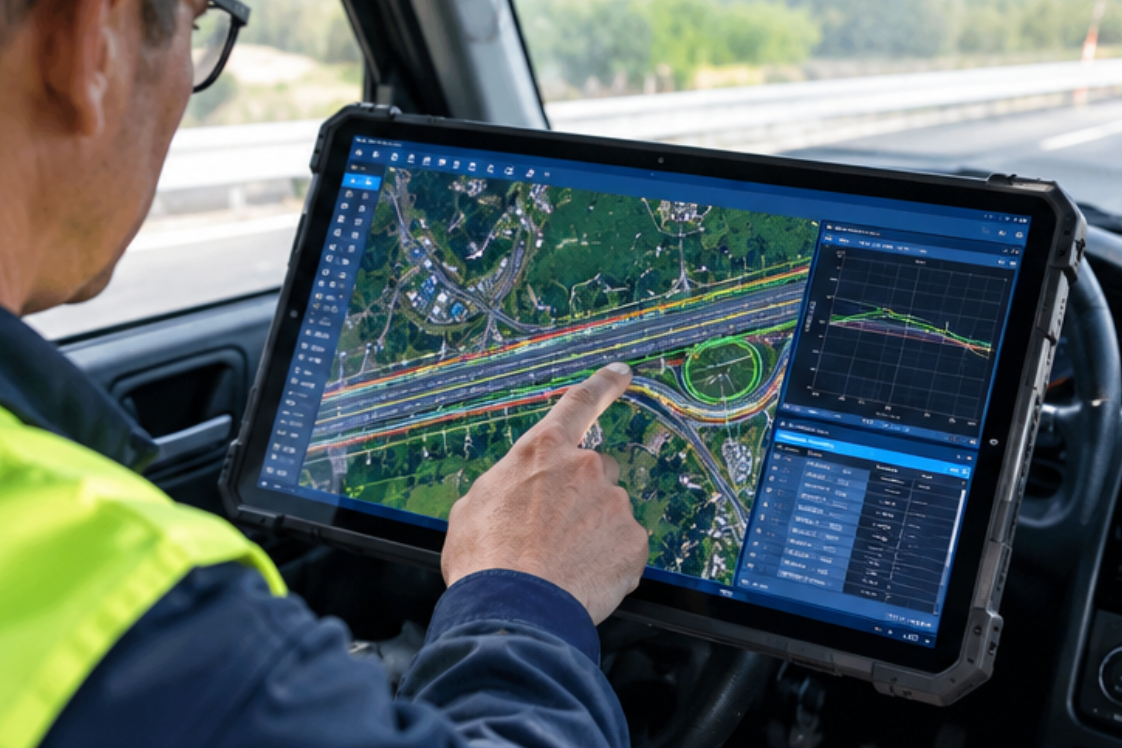
Processing power matches the drawing load. An Intel Core i5-1235U with ten cores reaches 4.4GHz on boost, with an i7-1255U option, running Windows 11 Pro on up to 64GB of RAM and M.2 SSD storage from 128GB to 512GB. CAD viewers, GIS packages and the office suite open together without the swap-and-wait that smaller field tablets impose. The 7.6V 8000mAh removable battery, rated at 60.8Wh, carries the review sessions through a full shift, and a 6000mAh option exists for lighter kits.
The large chassis still meets the road environment: IP65 rating, 1.2-meter drop resistance, MIL-STD-810G certification and an operating range of -20 to 55 degrees Celsius. Data capture expands with an optional Honeywell N4680 1D/2D scanner, NFC and TPM2.0, and connectivity runs Wi-Fi 6, Bluetooth 5.2 and global 4G LTE. The complete specification is on the ST13-U rugged Windows tablet page.
🔍 What the Spec Table Says About Each Fix
| Dimension | ST11-J | HTYJ08A | ST13-U |
|---|---|---|---|
| Display | 10.1" 1200×1920; 420-450nits (1000nits opt) | 8" 1200×1920; 560nits; 7H glass | 13.3" 1920×1080; 400-450nits |
| Processor | Intel N5100 quad-core, to 2.8GHz | Intel i5-10210Y / i7-10510Y | Intel i5-1235U (i7 opt), to 4.4GHz |
| OS | Windows 10/11 Pro | Windows 10/11 Pro | Windows 11 Pro |
| Battery | 6000mAh 7.6V; about 8.5h use | 3500mAh 7.6V; removable | 8000mAh 7.6V; removable; 60.8Wh |
| Protection | IP65; MIL-STD-810G | IP67; MIL-STD-810G; 1.22m | IP65; MIL-STD-810G; 1.2m |
| Wireless | 4G LTE; WiFi ac; BT 4.2; NFC | 4G LTE; WiFi 6; BT 5.0 | 4G LTE; WiFi 6; BT 5.2 |
| Standout hardware | Opt. UHF, scanner, fingerprint | RJ45, Mini HDMI, pogo, opt. UHF | Opt. N4680 scanner, NFC |
The table reads cleanly as a fault-to-fix index. Brightness and battery endurance per charge sit in the middle column and the left column; raw drawing performance and screen area sit on the right. Protection floors are high across all three, so the choice is never whether the unit survives the shoulder, but which fault it removes from the shift.
When the Fault Is Not in the Tablet
Not every roadside stop traces back to hardware. The most common false fault is a survey file that will not open because it never synced, which is a connectivity problem rather than a screen or battery one. This is where the port story matters more than the spec sheet suggests: the HTYJ08A's RJ45 jack lets a crew pull the day's data over a wired link at the depot in seconds, and the 4G modules across all three units keep the sync running from the field so the fault never reaches the evening review.
The second false fault is thermal. Devices left on the dashboard through a lunch stop in summer arrive sluggish, and crews log it as a hardware defect. All three tablets here are rated to 55 degrees Celsius in operation, so the fix is procedural, not a purchase: shade the unit during stops and let the rating do its job. For teams comparing rugged platforms against ordinary commercial tablets before a fleet decision, the breakdown on the comparisons page covers those trade-offs in detail.
🔮 Packing the Case Before the Next Callout
The kit decision collapses to three questions asked at the depot door. Does the route run through open noon sun for more than an hour? Then the case carries an ST11-J for the brightness headroom. Does the schedule run past eight hours without a reliable vehicle charge? Then the HTYJ08A rides along with a spare cell in the door pocket. Does the crew review plan sheets at the cab or sign off drawings on site? Then the ST13-U goes in last, screen up.
Crews that assign each tablet to the fault it eliminates stop treating roadside failures as bad luck. The three models cover the same road from different directions, and the wider Hotus product catalog extends the same logic to PDAs and mini PCs where the job calls for them.