Retail and food-service buyers are no longer satisfied with traceability that resolves a recall three days later. The pressure now lands at the receiving dock, the first moment a pallet of leafy greens or stone fruit changes hands and enters a batch record. This article looks at the industry shift toward batch-level produce traceability and the handheld tools, the HOTUS T80, U9000, and F502, that are quietly rewriting how receiving teams weigh, scan, and link every crate.
💡 🧊 Why Receiving Docks Are Rewriting the Traceability Rulebook
The old model treated receiving as a paper step: a supplier invoice, a scribbled lot number, and a pallet rolled into the cooler. Regulators and large buyers have moved past that. Farm-to-shelf programs now expect each supplier lot to carry a unique batch identity the moment it is accepted, tied to weight, origin, and a timestamp. For perishable goods, that identity is also a cold-chain clock: the longer a lot sits unidentified, the more risk it carries. A rugged handheld built for produce receiving turns the dock from a bottleneck into the first trustworthy node in the traceability chain.
What changed is not the hardware alone but the expectation of immediacy. Auditors want evidence that a batch was received, weighed, and linked before it left the dock, not a spreadsheet reconciled at close of business. That single requirement is what pushes receiving teams toward purpose-built PDAs instead of consumer phones in zip-lock bags.
⚖️ The Weigh-Scan-Link Gap That Costs Perishable Margin
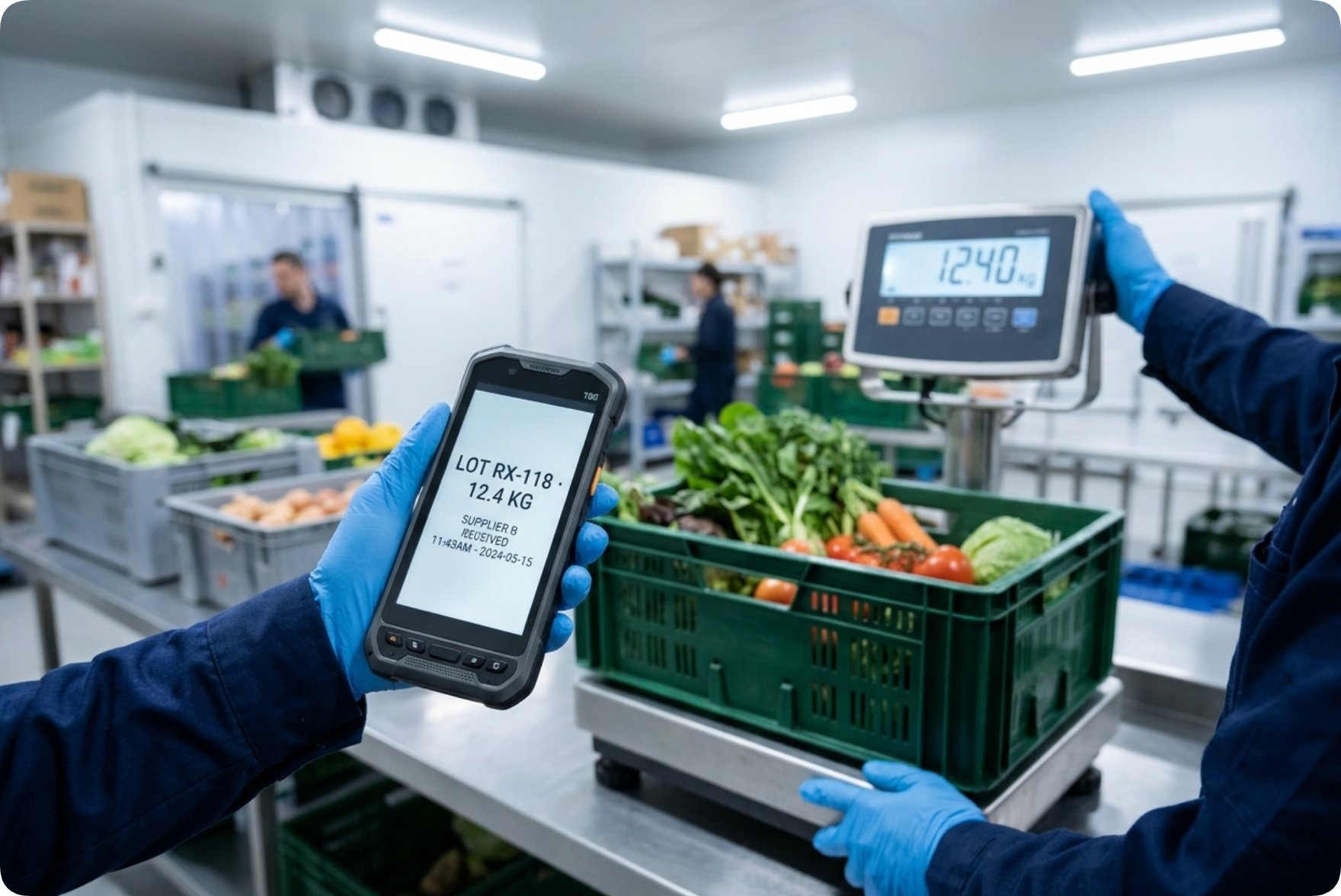
At a busy receiving door, three actions have to happen fast: weigh the crate on the scale, scan the supplier barcode or RFID tag, and link both to the correct batch record. When those steps live in three different tools, the chain breaks. A worker writes a weight on a sticky note, scans with one device, and types the lot into a separate tablet, and the margin for error multiplies with every pallet.
The cost is quiet but real. A mislinked lot means a whole shipment gets pulled during a recall, or worse, a bad lot slips through because its record points to the wrong supplier. Batch traceability only works if the link is made at the point of receipt, by the person holding the crate, with one device that does all three jobs.
Picture a Monday morning at a regional distributor: twelve supplier pallets arrive in ninety minutes, each with its own origin, grade, and temperature log. A receiver who must set down a scanner, pick up a scale readout, and retype a lot number for every one of them will drift, and the drift shows up later as a mismatched batch during a customer complaint. Collapsing weigh, scan, and link into a single wet-hand motion is what keeps that morning honest.
📱 T80 at the Dock: One Hand, Three Jobs
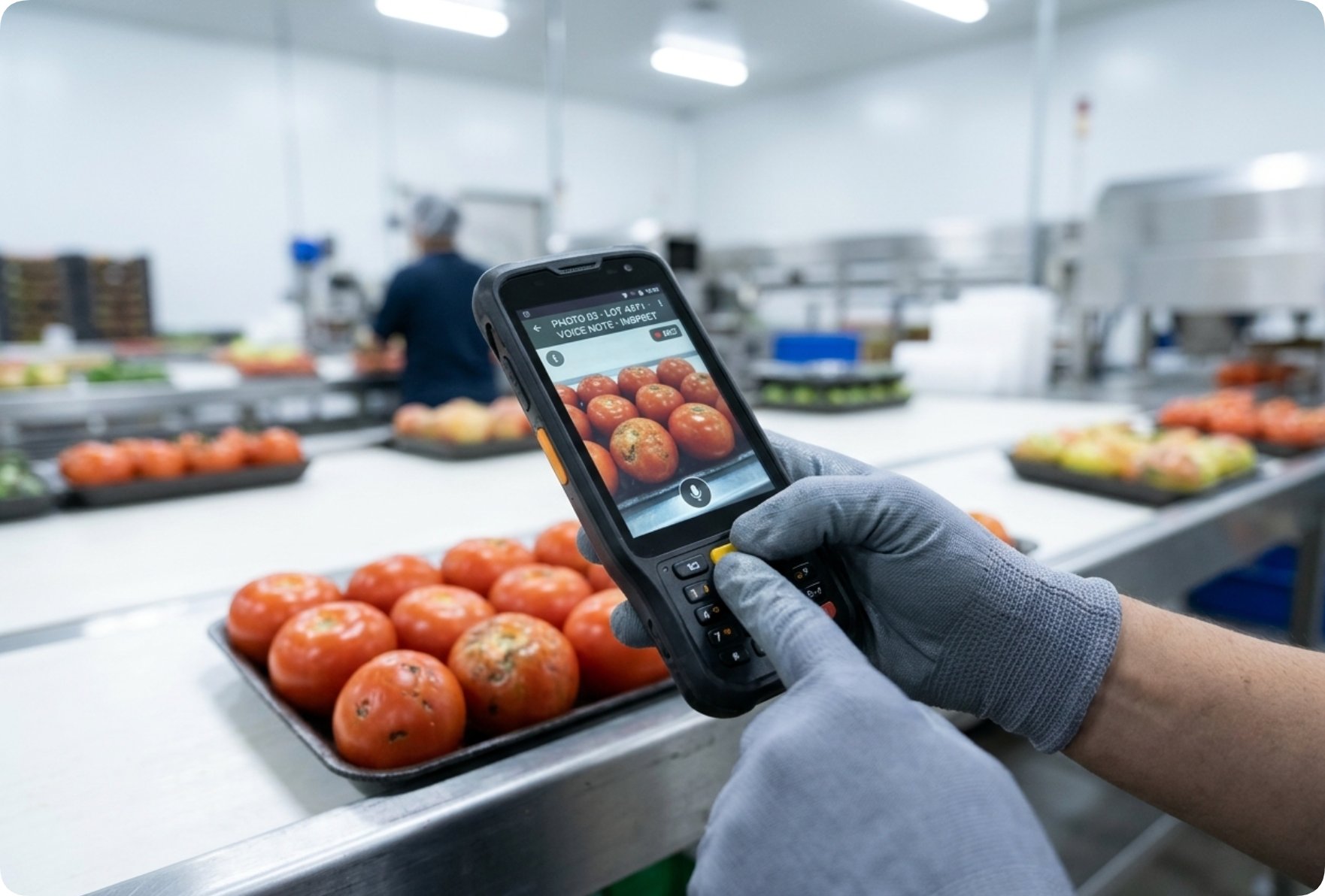
The HOTUS T80 Handheld PDA is built around exactly that dock workflow. Its 4.5-inch IPS screen uses Corning Gorilla Glass and stays touch-responsive with gloves or wet hands, which matters when a receiver is handling damp cardboard and cold plastic wrap. The 8MP rear camera with macro and anti-shake capture is the quiet workhorse here: a quick photo of the supplier label, the crate stamp, or a damaged item becomes part of the batch record without a second device.
Under the hood, a Cortex-A53 quad-core 2.0GHz processor on Android 9.0 keeps the weigh-scan-link flow smooth, and dual-band Wi-Fi plus full 2G/3G/4G/5G cellular means the record can sync to the warehouse system the instant a lot is accepted. Quad-satellite GNSS (GPS, Galileo, Glonass, Beidou) stamps each receipt with a location, so a batch is not just identified but placed.
🖥️ 🖥️ U9000: More Screen for Multi-Supplier Receiving
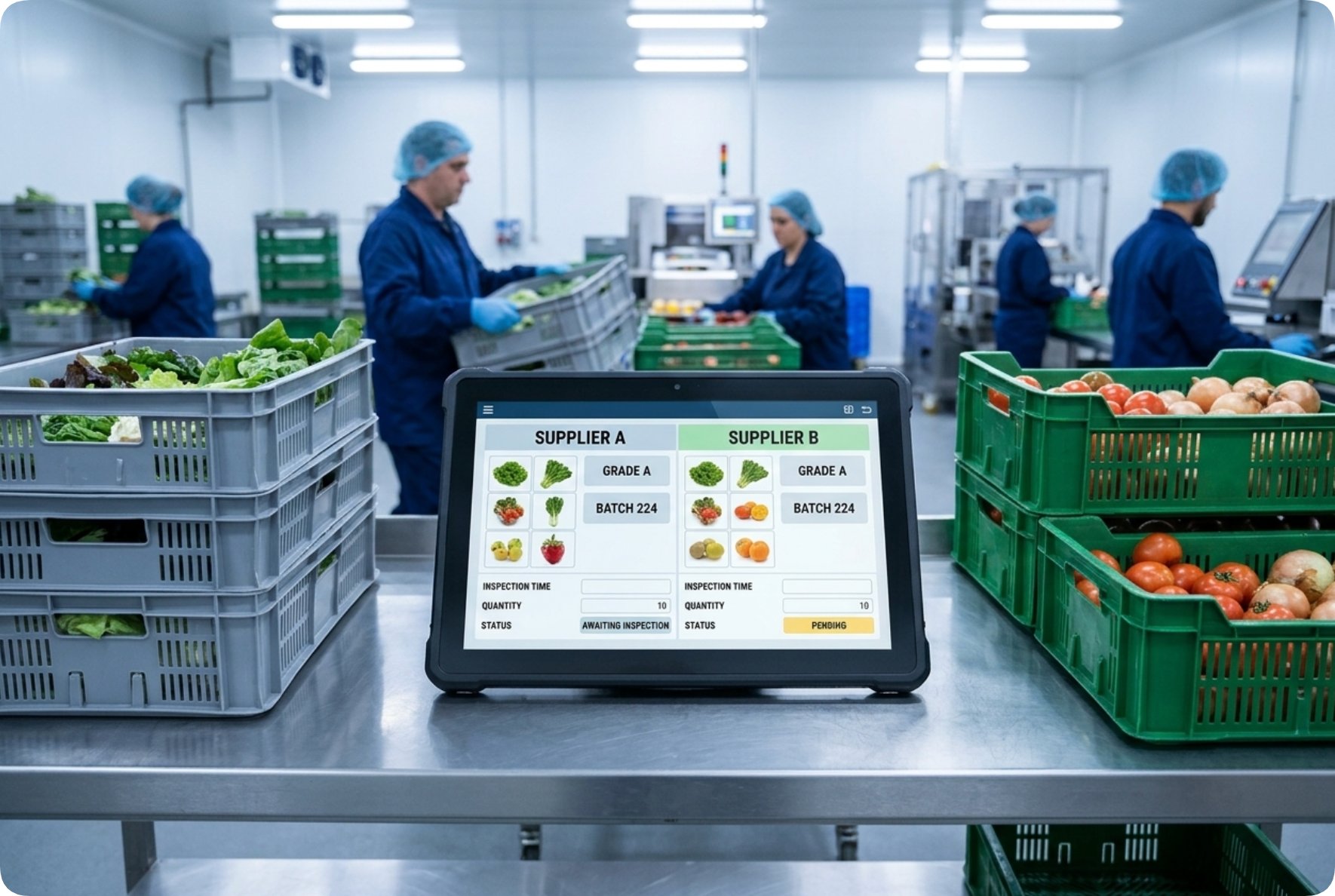
The HOTUS U9000 Handheld PDA runs the same proven engine as the T80, a quad-core 2.0GHz platform on Android 9.0 with 2GB plus 16GB storage expandable to 3GB plus 32GB, but stretches the display to 5.0 inches at 720 by 1280 HD. That extra screen real estate earns its keep when a receiver is comparing two supplier lots side by side, or working through a long acceptance list without constant scrolling.
For teams that receive from many growers in a single morning, the larger view reduces mis-taps and makes the batch list readable in bright outdoor light at the dock door. The 8MP macro camera and glove-and-wet-hand touch are carried over, so the core receiving routine does not change, only the comfort of the operator who lives in the list all shift.
📷 F502: Octa-Core Headroom for Photo-Heavy Lots
Some receiving lines need more than a quick label snap. Lots that arrive with condition disputes, mixed grades, or inspection notes generate a stream of photos and voice memos. The HOTUS F502 Handheld Terminal answers that with an MT6762 octa-core 2.0GHz processor and RAM options up to 4GB plus 64GB, the headroom that keeps a photo-heavy receiving session from stuttering.
At 5.5 inches and a net weight under 300 grams, the F502 stays comfortable for all-day single-handed use, and a Type-C port with OTG lets a receiver attach a peripheral or pull photos off quickly. Dual noise-canceling microphones make voice notes in a noisy dock actually legible, which is often the difference between a usable inspection record and one nobody reads.
🛰️ Connectivity Is the Real Traceability Backbone
The specification that matters most for traceability is rarely the screen size. It is the link. All three PDAs carry dual-band Wi-Fi and full 2G through 5G WWAN alongside quad-satellite GNSS, which means a batch record can be tied to a location and a time at the moment of receiving rather than reconstructed later in the office. A broader rugged handheld range may offer variations, but the receiving use case lives or dies on this always-on, always-placed link.
When the record syncs immediately, a buyer can answer a traceability question before the pallet reaches the cooler. That is the practical payoff of the industry shift: traceability stops being a report and becomes a live state of every lot on the floor.
🧭 What a 2026-Grade Receiving PDA Should Promise
Looking at the trend, a receiving PDA worth deploying in 2026 should promise a glove-and-wet usable screen, a macro camera for label and condition capture, global cellular so it works at any dock, and quad-satellite GNSS so every receipt is placed. Expandable storage matters when photo logs grow through a season. Battery endurance and ingress protection ratings are not published for the T80, U9000, and F502, and we do not infer them; buyers should confirm those figures with the vendor before a cold, damp deployment.
For total cost of ownership, the comparison is not against a cheap consumer phone but against the labor and recall exposure a broken chain creates. A purpose-built PDA that survives the dock for years usually costs less per received pallet than the rework it prevents.
The direction is clear. Batch traceability is moving from a back-office report to a dock-side act, and the handheld that does weigh, scan, and link in one wet-hand motion is the tool that makes the promise real. For teams comparing options across brands, a side-by-side comparison of rugged receivers helps separate marketing from the workflow that actually ships.
| Model | Screen | Processor | RAM + ROM | Camera | Connectivity | Weight |
|---|---|---|---|---|---|---|
| T80 | 4.5" IPS 480×854, Gorilla Glass | Cortex-A53 Quad-core 2.0GHz, Android 9.0 | 2GB + 16GB (up to 3GB + 32GB) | 8MP AF, macro, anti-shake | 2G-5G WWAN, dual-band Wi-Fi, quad GNSS | Not published |
| U9000 | 5.0" HD 720×1280, Gorilla Glass | Cortex-A53 Quad-core 2.0GHz, Android 9.0 | 2GB + 16GB (up to 3GB + 32GB) | 8MP AF, macro, anti-shake | 2G-5G WWAN, dual-band Wi-Fi, quad GNSS | Not published |
| F502 | 5.5" IPS 720×1440 | MT6762 Octa-core 2.0GHz | 2GB + 16GB / 4GB + 64GB | Not specified | Quad GNSS, Type-C OTG, dual mics | <300g |
Note: battery capacity and ingress-protection ratings are not published for these three models, so they are omitted rather than estimated. Confirm with the vendor for cold-chain and wash-down environments.