A forklift is one of the least forgiving places to put a computer. The cab shakes through every pallet pick, diesel dust settles on every surface, drivers wear gloves all shift, and a dead screen in the middle of a put-away run sends the whole aisle back to paper. That is why warehouses that move from clipboards to vehicle terminals treat the purchase as an infrastructure decision, not a gadget buy. This checklist walks through the criteria that actually decide whether a forklift terminal survives its first year, using three Hotus rugged tablets that cover the usual roles: the HOTUS HTNJ08B 8-inch rugged Windows tablet as the compact cab unit, the HOTUS HTYJ10A 10.1-inch rugged tablet as the full-Windows workstation on wheels, and the HOTUS RT80 rugged tablet as the 5G Android option for fleets that live inside a WMS app.
🛡️ 🏭 Why Forklift Fleets Standardize on Rugged Tablets
Once a warehouse passes a few dozen vehicles, mixed terminals become an operations problem. Spare units, cradles, chargers and screen protectors multiply per model, drivers swap trucks mid-shift and expect their session to follow, and the IT team ends up supporting three operating systems instead of one. Standardizing on rugged tablets across the fleet turns the terminal into a fixed line item: one image to maintain, one cradle standard, one spare pool. Sites running material handling equipment at scale usually start from a warehouse operations reference like HOTUS warehouse operations solutions and then narrow down by cab space, host system and shift length.
📋 The Criteria That Matter Inside the Cab
Deployments fail on details that never show up in a showroom demo. The screen has to stay readable against high-bay lighting and afternoon sun through the mast window. Touch has to register through work gloves and with wet or dusty fingers. The unit has to shrug off constant vibration and the occasional dropped scanner. And because the terminal usually draws power from the truck, the electrical path matters as much as the silicon. The sections below break those criteria into eight checkpoints, then map each one against the three models.
📶 RT80: A 5G Android Tablet for Live Fleet Data
The RT80 is the model to shortlist when the WMS runs as a cloud or mobile app and the fleet needs data moving in real time across the yard, not just inside the building. It runs Android 13 (with a HarmonyOS 6.1 option) on a UNISOC UIS7885 octa-core 2.7 GHz processor with a built-in 8T NPU, and carries 8 GB of RAM with 128 GB of storage, expandable up to 512 GB by TF card. The 10.1-inch IPS FHD screen (1200 x 1920, 400 nits, G+G 10-point capacitive touch) stays usable in a bright cab, and 5G SA/NSA plus 4G full netcom, Wi-Fi 6 and dual-band positioning keep pallet and yard data live. Durability is rated IP67 with an operating range of -10°C to 50°C, and the 3.8V 10000 mAh built-in battery supports power delivery fast charging, which matters when trucks return to the dock only between shifts. An optional 2D barcode engine with at least 3 mil precision and 13.56 MHz NFC let drivers scan without leaving the seat.
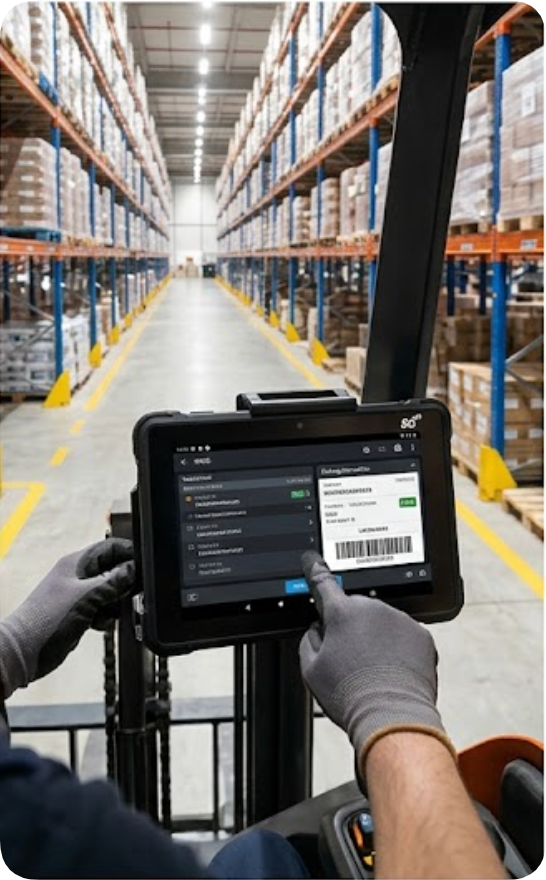
Yard operations are where this model pulls ahead. If transfers hand off between outdoor yard trucks and indoor clamp trucks, the same unit follows the load across both, which is exactly the workflow described in this RT80 rugged tablet overview for mixed warehouse fleets.
📱 🖥️ HTNJ08B: The Compact Windows Option for Cabs
Narrow cab posts and undersized dash panels are the usual excuse for keeping paper on a reach truck, and the HTNJ08B is the answer to that objection. It is an 8-inch tablet (1200 x 1920, 560 nits, 7H hardness glass, stylus and wet-hand touch) built around an Intel Pentium Silver N6000 quad-core processor that bursts up to 3.3 GHz, running Windows 10 Pro or Windows 11 Pro. Durability is the strongest in this trio on paper: IP67 sealing, MIL-STD-810G certification, 1.22 m drop resistance, a double-layer solid body and a -20°C to 55°C operating range. Connectivity covers Wi-Fi 5, Bluetooth 4.2 and global 4G LTE, and the port selection is unusually complete for an 8-inch unit: built-in RJ45 Ethernet, USB Type-A and Type-C, and HDMI, with optional 1D/2D barcode scanner, UHF RFID and fingerprint modules for drivers who also handle gate or load checks.
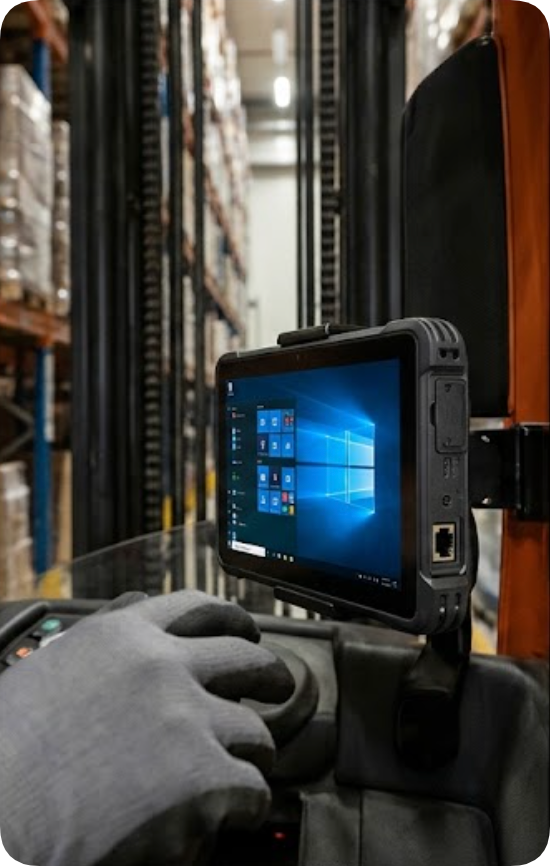
Power logistics are straightforward. The 7.6V 3500 mAh battery is removable, so a cab unit can run from truck power through a cradle while a charged spare sits in the charging cabinet. The 1.8 kg gross weight keeps the mount load reasonable on lighter trucks. For narrow-cab details and mount options, the HTNJ08B 8-inch rugged Windows tablet page lists the current configuration choices.
🔋 🏋️ HTYJ10A: Full Windows Power in a 10.1-Inch Frame
When the terminal has to do more than display tasks, such as running a legacy WMS client, local report exports or occasionally a CAD view of a storage layout, the HTYJ10A is the model to spec. It uses an Intel Core 10th-generation i5-10210Y processor (four cores, eight threads, turbo up to 2.20 GHz) with an i7 option, 16 GB of RAM (4 to 16 GB configurable) and a 256 GB drive (128 to 512 GB configurable) on Windows 10 Pro or Windows 11 Pro. The 10.1-inch screen runs at 1920 x 1200 with 560 nits brightness and 7H hardness touch, and the housing is rated IP67 waterproof and dustproof with 1.22 m drop resistance and a -20°C to 60°C operating range, which covers unconditioned depots and cold-chain docks. The 7.6V 6000 mAh polymer battery delivers about seven hours of working time, enough to bridge a double pick wave before returning to the dock.
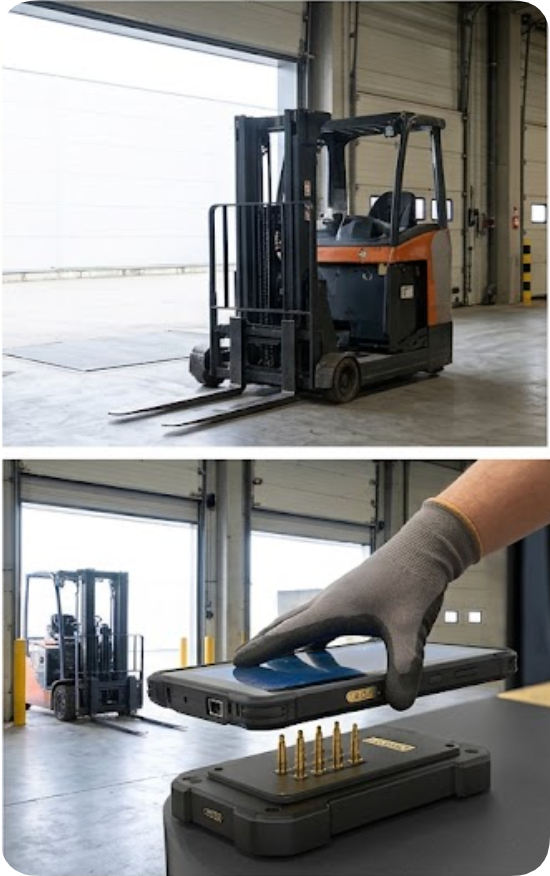
The docking story is the same as the HTNJ08B: a 12-pin Pogo-pin connector supports dedicated desktop cradles and vehicle-mounted charging docks, so the terminal snaps into truck power without fumbling cables in gloves. Optional modules include a 1D/2D barcode scanner, UHF RFID, fingerprint reader, 13.56 MHz NFC and TPM 2.0 hardware security for fleets that must lock down who can boot which truck terminal. Full current specifications are on the HTYJ10A 10.1-inch rugged tablet product page.
📊 Side-by-Side Specification Reference
| Attribute | RT80 | HTNJ08B | HTYJ10A |
|---|---|---|---|
| Display | 10.1" IPS FHD 1200 x 1920 | 8" IPS 1200 x 1920 | 10.1" LCD 1920 x 1200 |
| Brightness / touch | 400 nits, G+G 10-point | 560 nits, 7H, stylus and wet-hand | 560 nits, 7H, 10-point |
| Processor | UNISOC UIS7885 octa-core 2.7 GHz + 8T NPU | Intel Pentium Silver N6000 quad-core, burst 3.3 GHz | Intel Core i5-10210Y (i7 optional), turbo 2.20 GHz |
| OS | Android 13 / HarmonyOS 6.1 option | Windows 10 Pro / 11 Pro | Windows 10 Pro / 11 Pro |
| Memory and storage | 8 GB + 128 GB, TF to 512 GB | Per configuration sheet | 16 GB (4-16) + 256 GB (128-512) |
| Battery | 3.8V 10000 mAh built-in, PD fast charge | 7.6V 3500 mAh removable | 7.6V 6000 mAh polymer, about 7 h |
| Sealing and drop | IP67 | IP67, MIL-STD-810G, 1.22 m | IP67, 1.22 m |
| Operating range | -10°C to 50°C | -20°C to 55°C | -20°C to 60°C |
| Docking | 12-pin Pogo Pin interface | Pogo-pin vehicle and desktop docks | 12-pin Pogo-pin vehicle docks |
| Wireless | 5G SA/NSA, 4G, Wi-Fi 6 | Wi-Fi 5, BT 4.2, 4G LTE | Wi-Fi 6, BT 5.0, 4G LTE |
| Weight as listed | Under 650 g (251 x 170 x 14.6 mm) | 1.8 kg gross | About 2.1 kg gross (28.4 x 19 x 2.5 cm) |
| Data capture options | 2D engine (3 mil), NFC, fingerprint, RTK Beidou | 1D/2D scanner, UHF RFID, fingerprint | 1D/2D scanner, UHF RFID, fingerprint, NFC, TPM 2.0 |
🔋 ⚡ Docking, Power and Battery Logistics
Most forklift terminal failures traced back to hardware are actually power failures. A cab unit that boots at the start of a shift and dies before the last put-away creates the exact paper fallback the project was meant to remove. All three models here solve it through a dock-first design: the RT80 charges through its 12-pin Pogo Pin interface with PD fast charging on a 10000 mAh cell, while the HTNJ08B and HTYJ10A snap into Pogo-pin vehicle docks that draw truck power and top the removable batteries in place. The practical checklist is simple: confirm the truck's voltage output and idle behavior, mount the dock where the driver can dock one-handed in gloves, and keep at least one charged spare per shift overlap if trucks rotate drivers without returning to the depot.
💰 🧾 Warranty, Service and Total Cost of Ownership
Hotus backs the HTNJ08B and HTYJ10A with a 3-year limited warranty, and the company positions itself as a factory-direct manufacturer with OEM and ODM configuration, which matters when a fleet needs a custom image, a specific scanner module or pre-installed WMS software shipped in the box. Budget the total cost honestly: the tablet and dock are only part of the spend, and the rest is spare batteries, screen protection in gritty cabs, and the labor cost of a swap when a unit fails. Buyers comparing this trio against other models usually find it useful to scan the wider set of rugged Windows tablets before locking a standard, and Hotus keeps model-to-model comparisons under its news section for exactly that purpose: HOTUS product comparisons and buying guides. If the fleet standard is still open, the full Hotus rugged device range shows where each of these three models sits.