HTNJ08C and F505: A Compliance Guide for the Cycle Count Floor
A cycle count program only works when the records behind it survive scrutiny. Financial auditors, ISO 9001 assessors and customer stock auditors all ask the same question: can you prove that the quantity in the system reflects what is on the shelf, counted by a named person, on a named date, with a device that cannot quietly edit history? Paper tallies and shared logins fail that test. This guide maps three Hotus devices to the roles a compliant count program needs: the HOTUS ST13-U 13.3-inch rugged industrial tablet as the supervisor station, the HOTUS HTNJ08C 8-inch rugged Windows tablet at dock doors and fixed checkpoints, and the HOTUS F505 5.5-inch data collection PDA on the count floor.
💡 🏭 Why Cycle Count Programs Live Under Audit Rules
Cycle counting replaced the annual wall-to-wall inventory in most warehouses because it spreads the workload and surfaces variances while they are still explainable. But the moment counts feed financial reporting, the process inherits controls: counters must be authorized, blind counts must prevent peeking at expected quantities, variances must be recounted and approved before adjustment, and every record must carry a device identity and timestamp. Most programs that formalize these controls begin at a warehouse operations reference such as HOTUS warehouse operations solutions before pinning hardware to each control point. The three checkpoints below answer nearly every finding an auditor raises.
🖥️ ST13-U: The Supervisor Station for Count Records
Every count program needs one place where counts are scheduled, variances are approved and adjustment postings are signed off. The ST13-U fills that role from a fixed desk or a rolling cart. Inside sits an Intel Core i5-1235U (ten cores, twelve threads, boosting to 4.4 GHz) under Windows 11 Pro, with memory configurable up to 64 GB and M.2 SSD capacity up to 512 GB — headroom a full desktop WMS client needs to run its adjustment workflow natively. The 13.3-inch IPS panel (1920 x 1080, 400 to 450 nits) takes stylus input and gloved, wet fingers alike — useful the moment a supervisor has to sign a recount task on the dock. Sealed to IP65 with a 1.2 m drop rating and cold-store-grade electronics down to -20°C, the station moves from office to chilled and dock zones without a handover, while the 8000 mAh (60.80 Wh) removable pack outlasts a full shift off the charger.
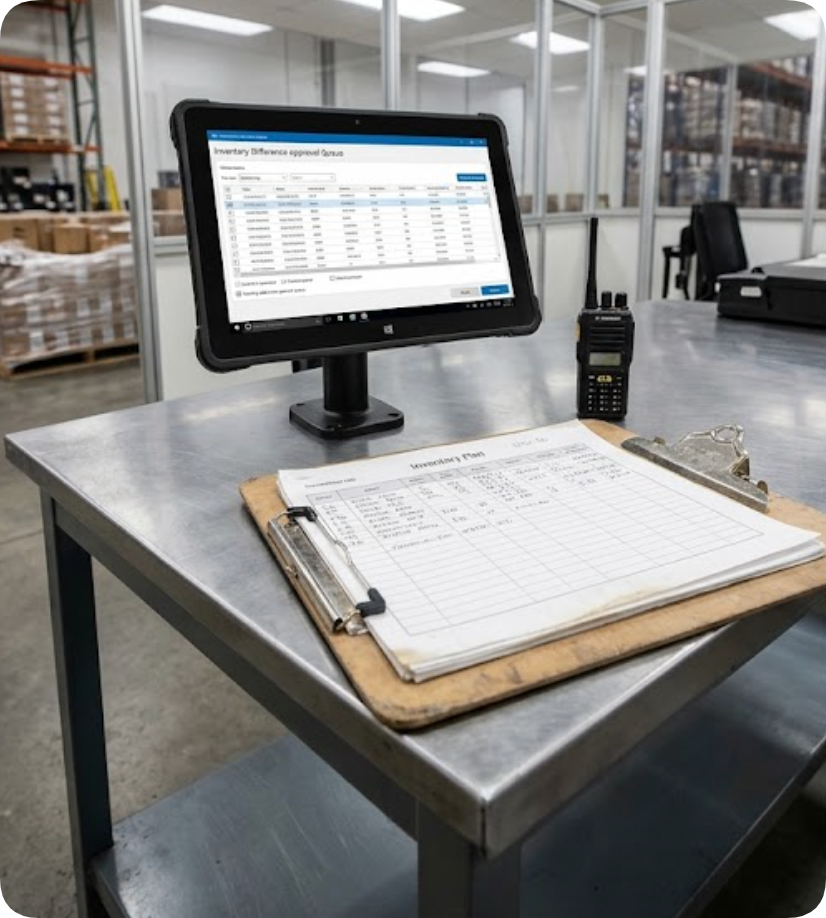
For the audit trail, per-user Windows accounts keep approval rights away from counting rights, and the optional TPM 2.0 module plus a Honeywell 2D scanner turn the station into something that authenticates both people and labels. The current build options sit on the ST13-U product page.
📱 F505 Scanning Discipline for Clean Count Data
The device in the counter's hand decides whether the record is trustworthy. The F505 exists for that loop: a 5.5-inch IPS HD display (720 x 1440) that reads gloved and wet fingers, a hardware 1D/2D engine with Honeywell, Zebra or professional CMOS variants, dual side scan buttons placing the trigger under the thumb in either grip, and Android 14 (or Android 12) on an octa-core 2.0 GHz chip with 4 GB of RAM, 64 GB of storage and microSD growth to 256 GB. At 160 x 76 x 16.5 mm and roughly 285 g with Corning Gorilla Glass and a 1.5 m drop rating behind IP67 sealing, it survives a full count shift in rack aisles, and its 3.8V 5000 mAh cell hot-swaps over Type-C fast charging, so a counter never has to pause a blank count to plug in.
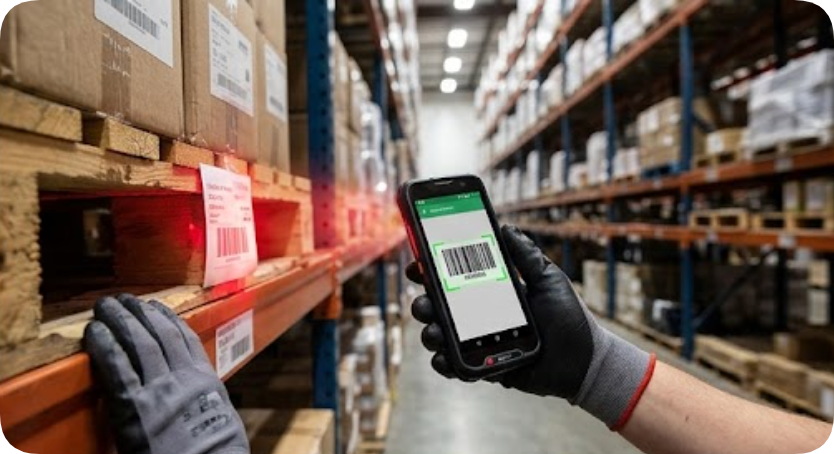
Where it earns its compliance slot: dual SIM with 4G/5G holds a live sync to the WMS even across outdoor yards, and optional NFC, UHF RFID and PSAM modules let one unit verify license plates, pallet tags and sealed totes without carrying anything else. Scan engine options are itemized on the F505 product page.
🛡️ HTNJ08C at the Dock Door and Checkpoint
Between the count floor and the supervisor desk sit the fixed points where stock changes status: dock doors, returns benches and cycle-count kiosks. The HTNJ08C anchors those posts. An 8-inch panel drives 1200 x 1920 at 560 nits through 7H glass that takes stylus and wet-hand input; the compute side is an Intel N100 quad-core on Windows 10 Pro or 11 Pro. Around it sits IP67 sealing on a MIL-STD-810G-certified double-layer body, good for 1.22 m drops and for working from -20°C to 55°C. A physical RJ45 port wires the checkpoint straight into the WMS — the kind of latency-free, Wi-Fi-independent record auditors want exactly where goods change custody — with USB Type-A/C and HDMI behind it for local peripherals. With the optional 1D/2D scanner, UHF RFID, fingerprint reader, 13.56 MHz NFC and TPM 2.0 modules fitted, a single kiosk pass verifies the counter, the label and the pallet tag together.
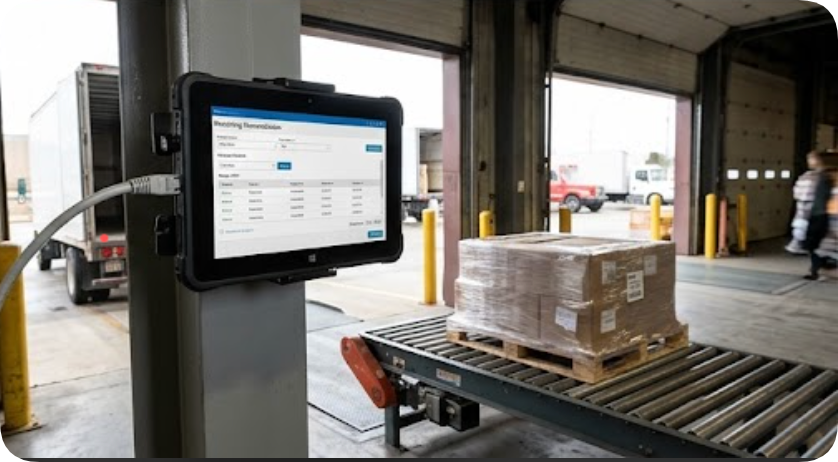
Mounting needs no improvisation: the Pogo-pin connector takes dedicated cradles and in-vehicle charging docks, holding the kiosk at full charge between count windows while the 7.6V 3500 mAh removable battery covers the walk-between. Current module and dock options are itemized on the HTNJ08C product page.
📊 Side-by-Side Specification Reference
| Attribute | ST13-U | HTNJ08C | F505 |
|---|---|---|---|
| Display | 13.3" IPS FHD 1920 x 1080 | 8" IPS 1200 x 1920 | 5.5" IPS HD 720 x 1440 |
| Brightness / touch | 400-450 nits stylus wet-hand | 560 nits 7H stylus wet-hand | Glove and wet-hand operation |
| Processor | Intel Core i5-1235U (i7-1255U option) | Intel N100 quad-core | Octa-core 2.0 GHz |
| OS | Windows 11 Pro | Windows 10 Pro / 11 Pro | Android 14 / Android 12 |
| Memory and storage | 8/16 GB RAM (to 64 GB), SSD to 512 GB | Per configuration sheet | 4 GB + 64 GB, microSD to 256 GB |
| Battery | 7.6V 8000 mAh removable (60.80 Wh) | 7.6V 3500 mAh removable | 3.8V 5000 mAh quick-swap, Type-C fast charge |
| Sealing and drop | IP65 1.2 m | IP67 MIL-STD-810G 1.22 m | IP67 1.5 m Gorilla Glass |
| Operating range | -20°C to 55°C | -20°C to 55°C | Industrial rated |
| Scanning and ID | Honeywell 2D option, TPM 2.0 option | 1D/2D, UHF RFID, fingerprint, NFC, TPM 2.0 options | Honeywell/Zebra 1D/2D engine, NFC, UHF RFID, PSAM options |
| Wireless | Wi-Fi 6 BT 5.2 4G LTE GPS | Wi-Fi 6 BT 5.0 4G LTE | 4G/5G Wi-Fi 6 Bluetooth GPS/Beidou |
| Ports | Docking station and vehicle mount support | RJ45, USB Type-A/C, HDMI | Pogo-pin docking, dual SIM |
| Weight | 1450 g | 1.8 kg gross | Approx. 285 g (160 x 76 x 16.5 mm) |
🧾 Audit Trail and Record Integrity Requirements
Hardware only satisfies an auditor when the workflow around it does too. Three controls carry most of the weight. First, identity: counters log into their own device account, so the F505 record and the ST13-U approval can never come from a shared login. Second, segregation of duties: the person who counts on the F505 should not hold approval rights in the ST13-U adjustment workflow, and the HTNJ08C kiosk at the dock should record transfers without edit rights on master data. Third, variance discipline: blind counts on the handheld, automatic recount tasks when the first pass deviates beyond threshold, and a signed adjustment trail that names the device, the user and the timestamp. Windows on the ST13-U and HTNJ08C makes account separation straightforward, and the F505's per-user Android profiles keep the count app locked to one identity per shift.
🔋 🔋 Battery and Shift Logistics for Count Events
Count events fail quietly when devices die mid-aisle, because the half-finished count either gets abandoned or, worse, reconstructed from memory. All three units are designed against that failure. The F505's 5000 mAh cell changes over in seconds and refuels on Type-C, so every counter opens a count event at full charge. The HTNJ08C drinks from its Pogo-pin dock between count windows, and the ST13-U's 8000 mAh pack carries a supervisor through an entire blind-count round with no wall socket in sight. One rule worth adopting for audit season: stage a charged spare battery per counter per shift and log the exchange, so even the power path leaves a record.
🧮 Training, SOPs and Common Audit Findings
The findings auditors raise most often are procedural, not technical: counters using another person's login, recount tasks closed without a second scan, adjustment approvals batched at month-end, and devices shared between shifts without a handover record. Each maps to a hardware habit worth training: one identity per device, a mandatory rescan before any recount closes, same-day approvals on the ST13-U, and a written device handover line in the shift SOP. Every unit here ships under a three-year main-unit warranty with lifetime technical support, and the factory-direct team pre-installs count software or custom images before a fleet rollout leaves the line. Teams comparing these units against other options usually shortlist from the wider Hotus rugged device range and sanity-check the final pair with the model-to-model notes under HOTUS product comparisons.