High e-commerce throughput, tight labor windows, and strict real-time inventory requirements have forced warehouses to retire paper pick lists and stationary scanning stations. Modern logistics floors rely on rugged handhelds that unify barcode scanning, field communication, and RFID tracking into a single workflow. Three distinct hardware architectures—the F505 handheld PDA, the RS51 4G rugged terminal, and the R501 RFID handheld—directly address these shifting operational demands.
Replacing Legacy Batch Systems with Real-Time Data Capture
Legacy warehouse workflows relied on pickers carrying printed sheets and returning to stationary docks for batch data entry. This delay repeatedly introduced picking errors into WMS inventory logs. Current operations collapse that loop by validating every item at the bin face. Immediate scan verification prevents mis-picks from propagating down the fulfillment line to the end customer.
This shift has transformed deployment strategy: warehouses no longer evaluate handhelds merely as standalone scanners, but as essential primary interfaces for connected workers across warehouse operations.
Why Enterprise Android Dominated the Warehouse Floor
Legacy Windows CE and Windows Mobile terminals have hit end-of-life, leaving sites vulnerable to unpatched security flaws, limited SDK support, and complex application maintenance. Industrial Android PDAs resolved these bottlenecks by offering intuitive user interfaces, rapid app deployment cycles, and standardized enterprise security management.
Standardizing on enterprise Android provides a consistent software baseline across diverse form factors. Operating within the HOTUS rugged handheld lineup allows IT teams to manage a single MDM profile and app build while deploying specialized hardware tailored to specific warehouse roles.
Hot-Swappable Batteries for Continuous Multi-Shift Operations
In 24/7 fulfillment centers, hardware tethered to charging cradles causes mid-shift operational delays. High-volume environments require terminals that remain on the floor throughout full shifts. Both the F505 and RS51 feature 5000mAh high-capacity cells designed for rapid field replacement.
Establishing a two-battery rotation per device—one active in the handheld and one charging on the dock—eliminates battery life concerns and maintains continuous device availability across extended shifts.
Integrating RFID and Barcode Scanners in a Single Handheld
Standard 1D/2D barcodes remain cost-effective but require a direct line-of-sight for every line item. UHF RFID technology overcomes this limitation for unexposed items, shrink-wrapped pallets, hanging apparel, and returnable assets by enabling bulk tag reads without manual alignment.
Modern operations favor dual-capability handhelds over carrying separate barcode scanners and RFID readers. Evaluating deployment options in our hardware comparison library helps operations managers balance barcode picking with targeted RFID auditing across different storage zones.
High-Volume Picking: The F505 Handheld PDA
The F505 handheld PDA is engineered for high-frequency scan environments. Weighing approximately 285g, it features an IP67-rated enclosure and a 1.5-meter drop spec to withstand daily warehouse drops. Its 5.5-inch HD display (720x1440) supports wet-touch and gloved operation.
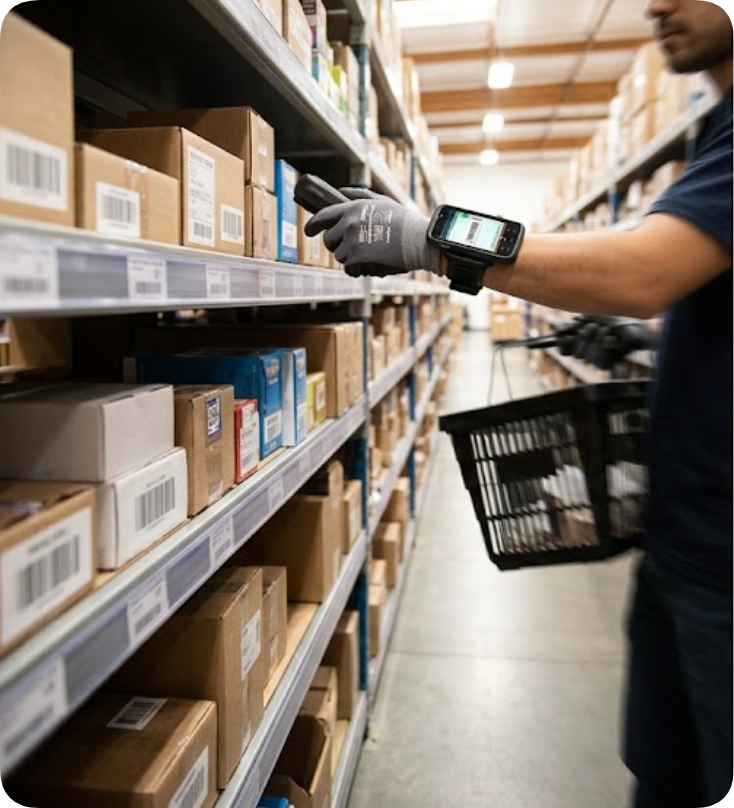
Powered by a Honeywell or Zebra 2D scan engine, the F505 rapidly decodes damaged or poorly printed barcodes. Its 5000mAh swappable battery supports Type-C fast charging, while optional NFC, UHF RFID, and PSAM modules allow easy expansion as facility requirements evolve.
Loading Dock & Fleet Management: The RS51 4G Handheld
Designed for dock doors and outdoor yard logistics, the RS51 rugged terminal features a 6.3-inch FHD+ display (1080x2340) protected by Corning Gorilla Glass, providing ample screen real estate for complex WMS apps, dock maps, and real-time messaging.
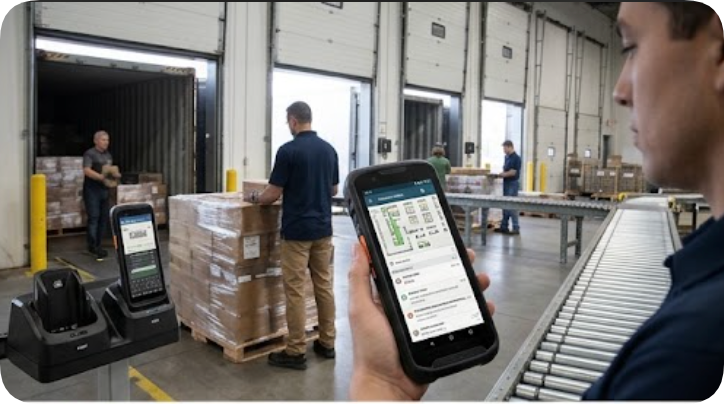
Equipped with a Qualcomm SM6225 Octa-Core processor (2.4GHz) running Android 13, the RS51 supports 4G LTE, dual-band Wi-Fi, and optional RTK centimeter-level positioning. Featuring an IP67 rating, 1.2-meter drop resistance, and a 5000mAh detachable battery, it functions as a comprehensive mobile workstation for outdoor logistics.
Bulk Inventory Audits: The R501 Long-Range RFID PDA
Built for rapid stock counts, the R501 RFID PDA features an integrated pistol-grip handle with an embedded UHF antenna, enabling high-speed bulk tag reads without requiring line-of-sight barcode alignment.
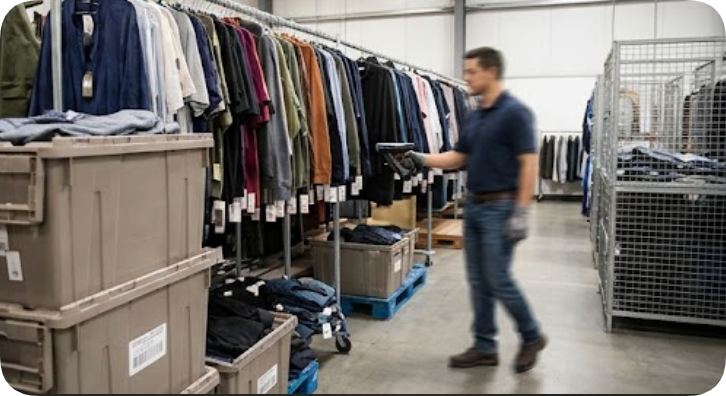
Driven by an MT6762 Octa-Core 2.0GHz processor on Android 10/13, the R501 features an IP65-rated body weighing under 750g (including the handle). It is ideally suited for cycle counts, apparel stocktaking, and high-density asset tracking.
Warehouse Terminal Hardware Specification Matrix
The F505, RS51, and R501 serve complementary roles across warehouse operations: high-volume piece picking, dock-door communications, and long-range RFID inventory auditing.
| Capability | F505 Handheld PDA | RS51 4G Handheld | R501 Tag RFID PDA |
|---|---|---|---|
| Display | 5.5-inch IPS HD (720x1440) | 6.3-inch IPS FHD+ (1080x2340) | Color Multi-Touch Display |
| Operating System | Android 12 / 14 | Android 13 | Android 10 / 13 |
| Battery System | 5000mAh Removable (Quick-Swap) | 5000mAh Detachable | Vendor-Rated High-Capacity Pack |
| Rugged Rating | IP67, 1.5m Drop Resistance | IP67, 1.2m Drop Resistance | IP65 Protection |
| Unit Weight | Approx. 285g | Under 500g | Under 750g (with Handle) |
| Data Capture | 1D/2D Imager; Optional UHF RFID, NFC | Optional 2D Imager & NFC | Integrated Long-Range UHF RFID Handle |
For further analysis of operational troubleshooting and wave execution, refer to our outbound picking wave troubleshooting guide.
Frequently Asked Questions
1. Do all three terminals run the same Android version?
No. The F505 runs Android 12 or 14, the RS51 runs Android 13, and the R501 runs Android 10 or 13. However, all three share the core Android enterprise application framework, allowing IT administrators to manage the fleet using a single MDM platform and software build.2. Which terminal is best suited for high-density picking operations?
The F505 is optimal for picking workflows. At 285g, it features a glove-compatible touch screen and a 5000mAh quick-swap battery. Optional RFID support allows facilities to introduce tag reading without replacing their baseline scanning hardware.3. When should a facility upgrade from barcode scanning to RFID?
RFID provides significant efficiency gains for bulk inventory audits, high-density apparel stocktaking, and unexposed line-item counting. The R501’s integrated RFID handle allows workers to perform rapid pass-by counts, while traditional barcodes remain standard for item-level validation at the packing station.Both the F505 and RS51 utilize 5000mAh swappable battery packs. Implementing a two-battery rotation strategy per device maintains continuous terminal operation across 12-hour shifts. Battery requirements for the R501 should be verified against daily shift length and read-cycle intensity.