Street-level identity verification used to be judged entirely at the moment of the stop: screen legibility under direct sunlight, touch response with gloved hands, or document capture speed before traffic moved on. While operational ergonomics still matter, they no longer dictate how fleets evaluate equipment. Today, a curb-side check creates a digital record that outlives the encounter, transfers to a station terminal, and may be audited months later by reviewers who were never on scene. Comparing models like the SH6, HTNJ08B, and HTNJ10B strictly by screen size misses the broader procurement shift: mobile hardware must produce a verifiable chain of custody that secondary reviewers can trust.
This analysis focuses on record integrity across the data lifecycle: what data points must survive three distinct review stages, what hardware specifications actually guarantee, and why traditional comparison metrics often obscure operational risk. For deployment leads planning identity verification deployments, the critical question is no longer which screen looks best in a showroom demo, but whether a record can withstand forensic audit long after the officer has left the scene.
Data Integrity Beyond the Field Stop
The operational shift occurred as paper logs transitioned into centralized database records. A physical form used to end its lifecycle when turned in at shift completion. Today, an electronic record is indexed, appended, exported, and audited by units with zero context regarding the initial field encounter. Consequently, field terminals are no longer simple input devices—they serve as the primary link in an evidentiary chain of custody. The highest vulnerability occurs during off-grid operations when a terminal logs entries locally prior to server synchronization.
Timestamp sequencing is critical for data integrity. An entry logged offline at 09:10 and synced at 11:40 generates two distinct timestamps; retaining only the upload time creates compliance ambiguities that software processing cannot resolve. Modern procurement evaluations prioritize data synchronization architecture over raw processing speed—specifically examining local timestamp preservation, database record deduplication, and device hardware ID tracking during batch uploads. These core data safeguards depend directly on terminal storage stability and local hardware execution during network outages.
Station-Level Audit and Record Verification
Secondary reviewers examine identity checks without environmental context. They lack visibility into weather conditions, reasonings behind unpopulated fields, or whether a field correction represents a real-time typo fix or a post-shift modification. Auditing officers rely strictly on stored terminal data, making audit legibility a core system requirement rather than an administrative afterthought.
This audit requirement elevates three hardware-assisted data fields during acceptance testing: hardware clock synchronization sources, unique terminal identifiers, and immutable change logs tracking value modifications. Standard sales materials rarely highlight these parameters, which is why standard product comparisons and competitor analysis often fail to address long-term operational needs. A display panel may excel under field demonstration yet generate records requiring extensive manual reconciliation at the station.
Append-Only Logging and Data Revision Control
The SH6 rugged handheld is designed for active mobility and single-handed field operation, placing it right at the primary data entry point. It also highlights why technical evaluations require strict verification against official documentation. Published technical literature includes two distinct configuration variants for the SH6 series: a 6.0-inch Android platform with IP67 sealing and a 1.5 m drop rating, alongside a 6.5-inch Windows variant with IP65 sealing and a 1.2 m drop rating. Rather than merging contradictory specifications, enterprise buyers should evaluate core architectural workflows.
From an operational perspective, a compact handheld enables immediate note entry during a stop, reducing reliance on end-of-shift memory recall. Notes should follow an append-only structure: preserving original entries while appending subsequent corrections as distinct, timestamped records rather than overwriting existing fields. Enforcing this policy requires terminal storage capable of maintaining chronological log structures throughout extended offline operations.

Field notes logged at the curb require persistent local storage prior to network sync.
Export Logging and Secure Data Transfer
The HTNJ08B Windows tablet operates primarily at the data transfer and station verification layer. Its physical I/O interface includes audio output, Mini HDMI, USB Type-A, USB Type-C, DC input, RJ45 Gigabit Ethernet, TF slot, SIM slot, and a 12-pin pogo-pin docking connector, complemented by Wi-Fi 5, Bluetooth 4.2, and global 4G LTE. Dedicated physical interfaces enable deterministic wired data offloading at station docks, mitigating packet loss and sync retry issues common to congested cellular networks.
Comprehensive export logging requires capturing five core metadata points: export session ID, terminal ID, timestamp range, modified entry count, and user authorization credentials. These parameters ensure batch integrity during administrative audits. Physical Ethernet and docking interfaces provide hardware-level reliability for high-volume batch transfers, avoiding sync duplication risks associated with unstable wireless links.
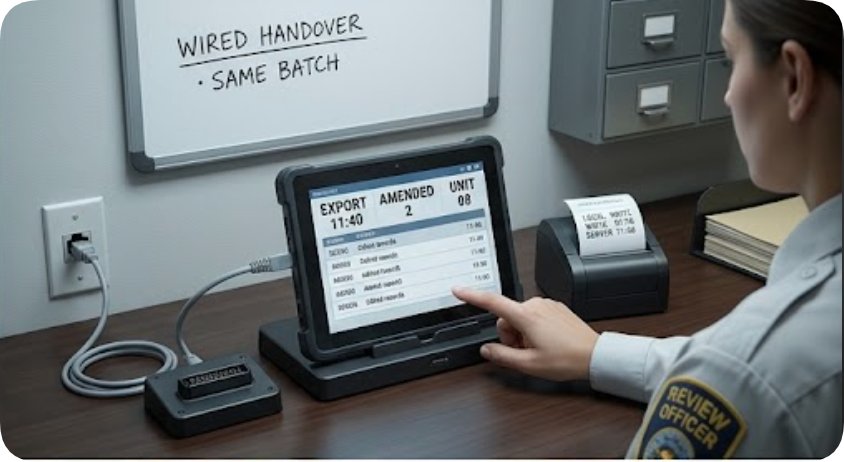
Wired docking handovers establish verifiable batch boundaries for station export logs.
Optimizing Hardware Roles across Field and Station Operations
The HTNJ10B 10.1-inch panel expands on the Windows architecture with a 10.1-inch IPS touchscreen (1200 x 1920 resolution, 560 nits brightness), 10-point capacitive glass with 7H surface hardness, Windows 10 Pro / Windows 11 Pro OS options, and shared 7.6 V 3500 mAh swappable battery modules and I/O options matching the 8-inch series. Larger displays function primarily as review terminals, providing clear visibility across multi-column audit logs, entry version histories, and batch approval workflows without excessive interface scrolling.
Matching device form factors to specific operational roles yields higher efficiency than standardized single-device deployments: compact handhelds excel at field capture, while larger desktop-docked tablets optimize administrative review. Both form factors must integrate into a unified, append-only database scheme to maintain end-to-end data integrity across the fleet.
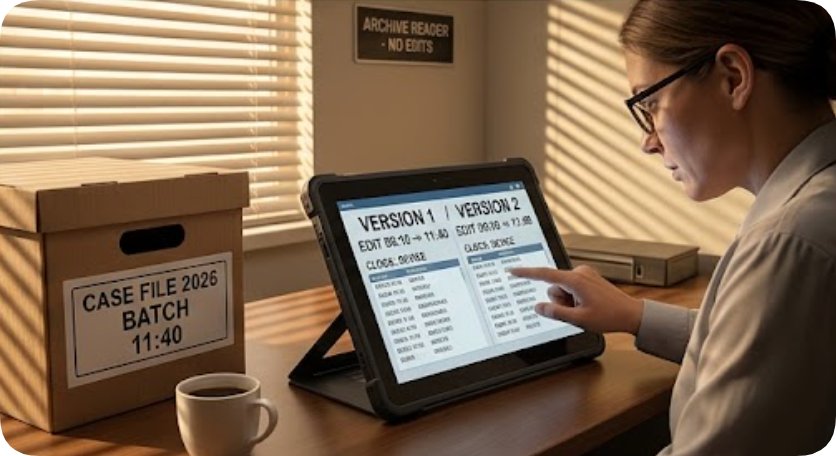
Larger screen real estate improves readability during complex record audits and version comparisons.
Technical Specification and Workflow Mapping
The following matrix maps terminal data requirements across record lifecycle stages, isolating hardware capabilities from integration requirements.
| Record Lifecycle Stage | Terminal Data Output | Integration Scope | Primary Hardware Role |
|---|---|---|---|
| Curb-Side Capture | Local timestamp, device ID, append-only notes | Offline sync behavior and deduplication logic | Rugged Handheld (SH6) |
| Station Audit | Clock sync source, audit trail, batch status | User permission matrices and edit policies | Docked Tablet (HTNJ08B / HTNJ10B) |
| Long-Term Archive | Export session ID, requester ID, change logs | Database retention policy and archival rules | Central Management System |
The table below compiles verified, common hardware specifications directly referenced across product documentation. Unverified or variable parameters have been excluded to ensure data accuracy.
| Model | Battery Specification | Environmental Testing | Touch Input Support | Cellular Radios | Expansion Interface |
|---|---|---|---|---|---|
| SH6 | 5000 mAh swappable | MIL-STD-810G compliant | Glove & wet-finger touch | 4G LTE Full Netcom | Pogo-pin interface |
| HTNJ08B | 7.6V 3500 mAh swappable | MIL-STD-810G, 1.22m drop | Stylus & wet-hand touch | Global 4G LTE | 12-pin pogo-pin dock |
| HTNJ10B | 7.6V 3500 mAh swappable | MIL-STD-810G, 1.22m drop | Stylus & wet-hand touch | Global 4G LTE | 12-pin pogo-pin dock |
Variable fields such as physical dimensions, weight metrics (bare unit vs. gross shipping weight), and specific ingress ratings are omitted where source documentation contains configuration-dependent values. Procuring agencies should require written technical confirmation for specific hardware builds during formal tender submissions.
Procurement Validation and Deployment Guidelines
Fleet acceptance protocols should prioritize data validation drills over basic hardware testing. Key evaluation steps include:
- Extracting test logs from offline units to verify dual-timestamp capture (local write time vs. server ingest time).
- Inspecting audit logs for modified records to confirm proper append-only formatting and change history preservation.
- Executing duplicate batch uploads to verify database deduplication rules.
- Verifying hardware clock synchronization sources and export encryption keys during network reconnection.
Evaluating hardware within full deployment workflows ensures reliable performance. For complete ecosystem hardware configurations, review our broader rugged mobile computing solutions. For deployment protocols, mounting frameworks, and network provisioning routines, refer to our detailed guide on street-level identity check deployment.