Highway toll plaza cabinets are rarely gutted and rebuilt in a single night. Instead, aging hardware fails piecemeal—a recorder drops drives, a booth tower overheats, or a lane controller lags behind modern Automatic License Plate Recognition (ALPR) models—forcing systems integrators to drop new compute nodes into tight DIN-rail or shelf spaces alongside legacy wiring.
Standardizing replacements from a single Windows Industrial Mini PC Wholesale Manufacturer streamlines power supplies, thermal envelopes, and spare-parts inventory across an entire corridor. While none of these three platforms was built exclusively for highway tolling, plaza engineers routinely specify the WTR PRO AMD, the Palm-sized miniPC (MQi12), and the HCAR5000 MI to take over storage archiving, booth terminal duty, and lane-side processing inside one shared enclosure.
1. Legacy Cabinet Architecture: Why Old Three-Box Stacks Fail
Open a roadside toll cabinet commissioned in the mid-2010s and three bulky enclosures typically occupy every square inch of shelf space. A dedicated digital video recorder (DVR) with an internal drive cage captures lane camera feeds. A full-height ATX desktop tower runs the collector's point-of-sale terminal, pulling road dust through large chassis fans that clog every season. Beside them, a separate consumer router, a network-attached storage (NAS) unit, and multiple external power bricks handle back-office routing and local video archiving. Maintaining three separate hardware vendors, power rails, and failure schedules inside an unconditioned roadside cabinet creates recurring maintenance bottlenecks.
2. Storage & Routing Consolidation: WTR PRO AMD
The sharpest footprint reduction happens in the storage and networking corner. The WTR PRO AMD Mini PC Router Hardware combines high-capacity storage with multi-gigabit routing inside a single 228 × 150 × 185 mm enclosure. Powered by an AMD Ryzen R3 5450U processor with Radeon Graphics and a DC 19V / 6.32A (120W) power adapter, it houses dual M.2 2280 NVMe slots alongside four 3.5-inch SATA drive bays—eliminating the need for separate DVR and NAS enclosures.
Its dual 2.5GbE RJ45 LAN ports physically isolate high-bandwidth IP camera traffic on the lane side from back-office toll-clearing servers without adding an external managed switch. With native support for Linux, iStoreOS, Windows, and Feiniu OS, network engineers can run lightweight virtualized routing on iStoreOS while keeping Windows-based video management software (VMS) running locally on the same storage array.
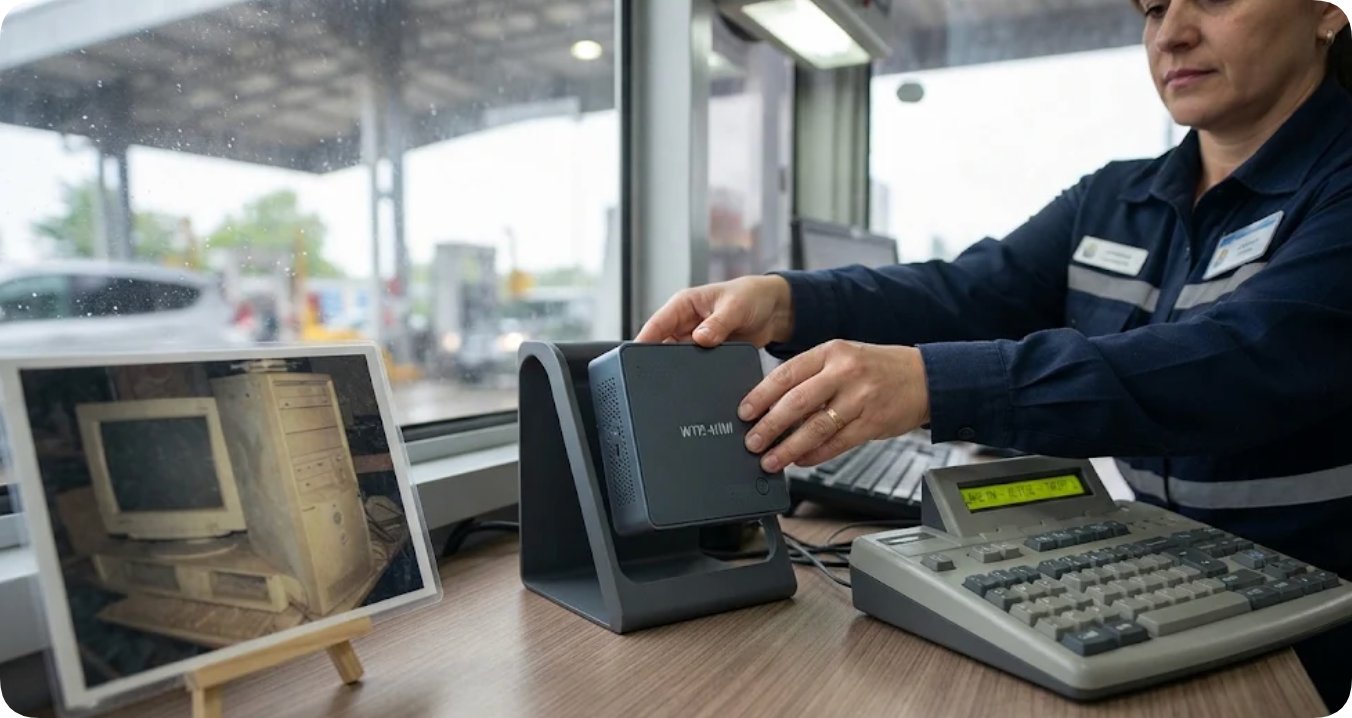
3. Booth Workstation Shrink: Palm-Sized Mini PC (MQi12)
Inside tight tollbooths where knee room and counter depth are scarce, replacing a legacy desktop tower with the Palm Sized Mini PC Windows Computer Manufacturer model—the MQi12—frees almost the entire under-desk shelf. Measuring just 113 × 113 mm and weighing 800 g, the unit scales up to an Intel 12th Gen Core i9-12900HK processor paired with either dual SO-DIMM DDR4 (up to 64 GB) or onboard LPDDR5 (12 GB, 16 GB, or 24 GB).
Despite its pocket-sized chassis, the MQi12 preserves full peripheral I/O for receipt printers, barcode scanners, NFC readers, and dual operator monitors via five USB 3.2 Type-A ports, dual HDMI 2.1 outputs, a full-function Type-C port (8K display and Power Delivery), and a 2.5G Ethernet port. Crucially for unattended toll lanes, its BIOS supports Auto Power-On after AC loss, RTC scheduled startup, UEFI PXE diskless boot, and integrated TPM 2.0 hardware security—ensuring booth terminals recover automatically after grid brownouts without manual technician intervention.
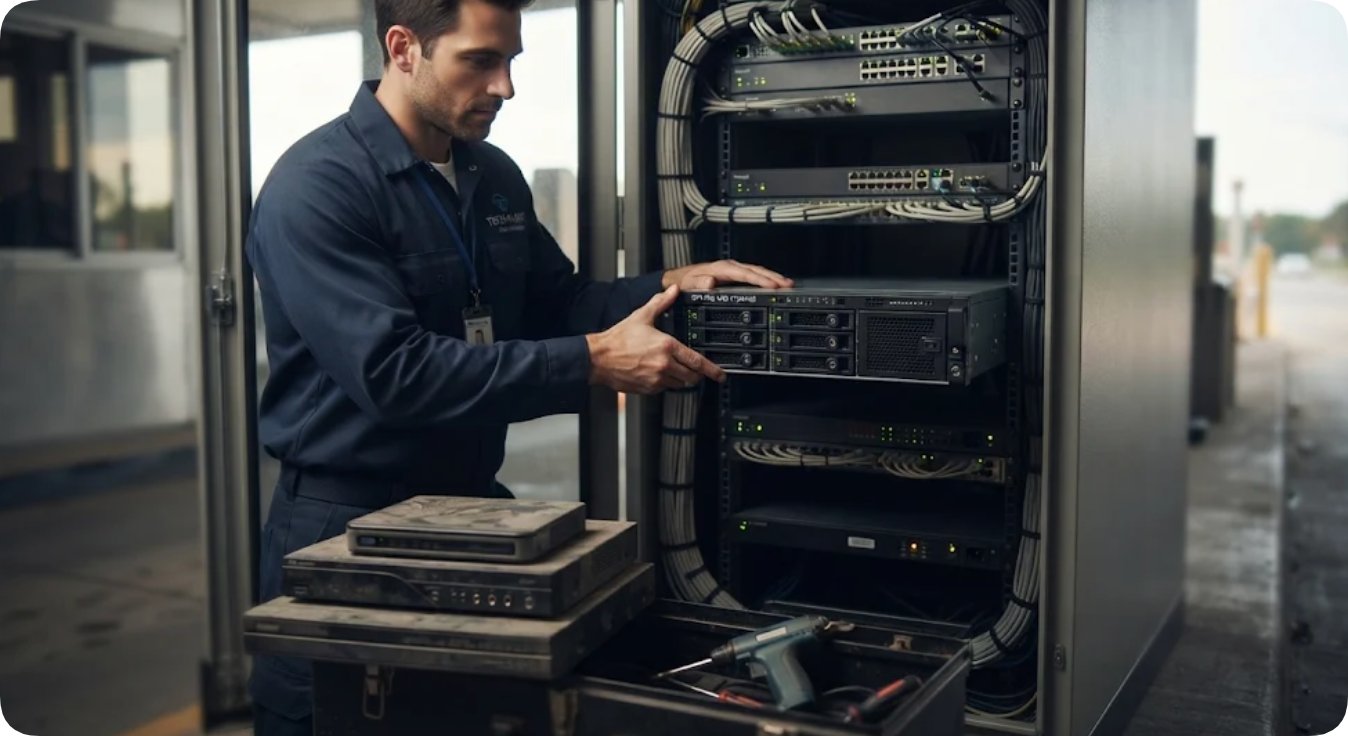
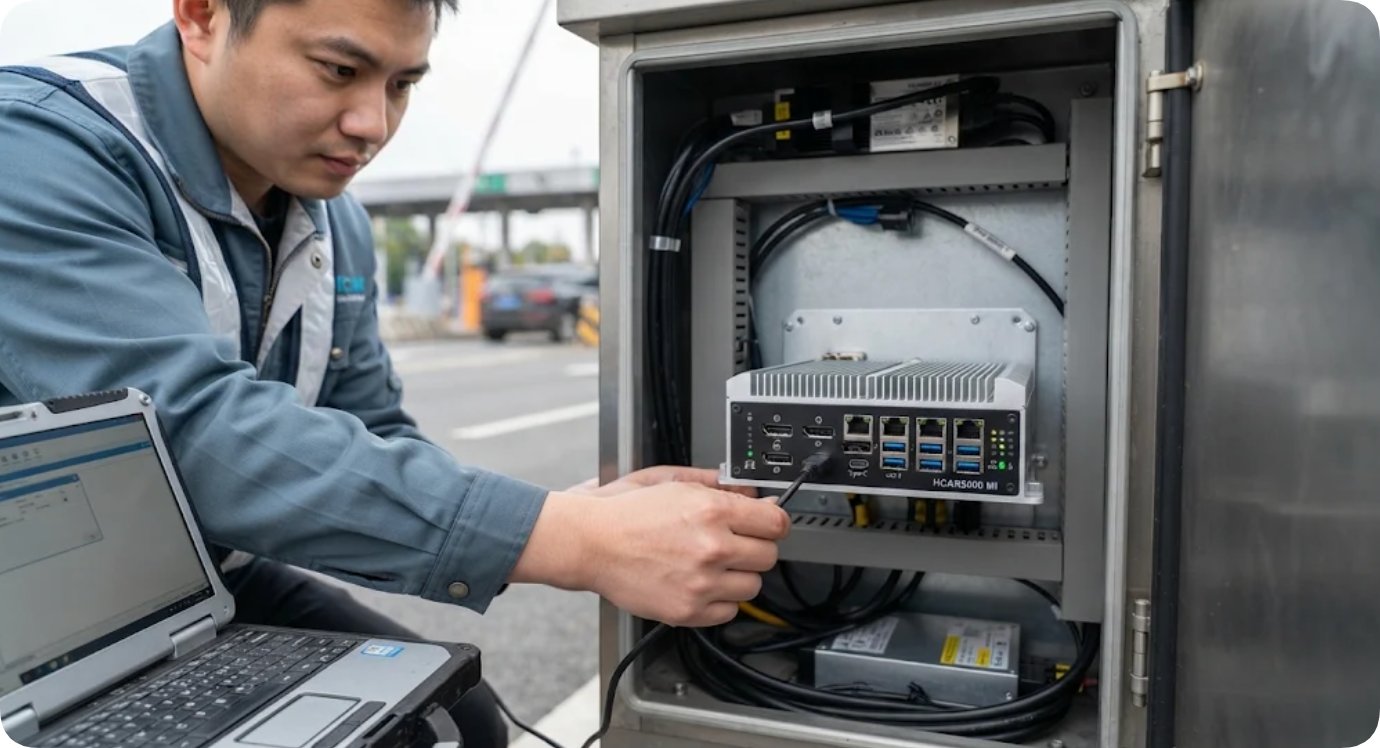
4. High-Throughput Lane Controller: HCAR5000 MI
Lane-side controllers carry the heaviest real-time compute load—processing inductive loop triggers, axle-count sensors, barrier gate relays, and high-frame-rate plate recognition simultaneously. Built around the HCAR5000 Industrial Mini PC Motherboard, the HCAR5000 MI delivers workstation-class multi-threaded performance with AMD Ryzen 5000H-series processors (5900HX, 5800H, or 5600H), Radeon graphics, and up to 64 GB of DDR4-3200 memory inside a solid 202 × 212 × 65 mm (2,455 g) chassis.
Local buffering relies on a hybrid drive layout: one M.2 2280 NVMe SSD (128 GB to 1 TB) for low-latency OS and transaction databases, paired with a 2.5-inch 7200-RPM HDD (500 GB or 1 TB) for local transaction logs when fiber uplinks drop. One critical engineering detail belongs in every tender checklist: the published specification includes a single RJ45 LAN port and omits onboard Wi-Fi, so integrators must provision a wired Ethernet drop or USB-to-LAN adapter before deployment on Windows 10, Windows 11, or Linux.
5. Side-by-Side Hardware Comparison for Procurement Tenders
The matrix below aligns published technical specifications across all three control hosts so procurement engineers can verify compute headroom, drive bays, and physical clearances on a single sheet.
| Specification Parameter | HCAR5000 MI (Lane Host) | Palm-Sized Mini PC MQi12 (Booth) | WTR PRO AMD (Storage & Router) |
|---|---|---|---|
| Processor Options | AMD Ryzen 5000H series (5900HX / 5800H / 5600H) | Intel 12th Gen Core, up to i9-12900HK | AMD Ryzen R3 5450U |
| Maximum Memory | DDR4-3200, up to 64 GB | DDR4-3200 up to 64 GB, or onboard LPDDR5-5200 (12/16/24 GB) | DDR4-3200 SO-DIMM, up to 32 GB |
| Storage Expansion | 1× M.2 2280 NVMe SSD + 1× 2.5-inch 7200-RPM HDD | M.2 2280 + M.2 2242 NVMe slots (up to 4 TB in spec table) | 2× M.2 2280 NVMe slots + 4× 3.5-inch SATA drive bays |
| Wired Ethernet Interfaces | 1× RJ45 LAN port | 1× 2.5GbE RJ45 Ethernet | 2× 2.5GbE RJ45 LAN ports |
| Display Outputs | DP 2.0b + full-function Type-C | Dual HDMI 2.1 + full-function Type-C (8K) | HDMI + DP + Type-C (triple display) |
| Chassis Dimensions | 202 × 212 × 65 mm | 113 × 113 mm | 228 × 150 × 185 mm |
| Supported Operating Systems | Windows 10 / 11, Linux soft-route OS | Windows 11, Linux | iStoreOS, Windows, Feiniu OS, Linux |
Engineering Verification Notes: When drafting Bill of Materials (BOM) sheets, quote the 4 TB expansion ceiling listed in the MQi12 technical specification table rather than higher multi-drive marketing estimates. Likewise, compare chassis mounting loads carefully: the MQi12 (800 g) and HCAR5000 MI (2,455 g) publish net unit weights, whereas the WTR PRO AMD lists a 5 kg shipping/gross weight figure.
6. Power Budgets and Cabling Changes Inside the Enclosure
Swapping three legacy boxes for compact mini PCs reshapes DC power distribution and patch-panel routing inside the cabinet. The WTR PRO AMD draws from a 19V / 6.32A (120W) brick to spin four 3.5-inch drives cleanly during simultaneous write bursts. The MQi12 runs on a compact 19V / 3.42A (65W) supply while consolidating five USB 3.2 ports and dual HDMI runs right behind the operator monitor. Meanwhile, the HCAR5000 MI provides three USB 3.0 ports, two USB 2.0 ports, DP 2.0b, Type-C, and audio jacks, requiring installers to label its single RJ45 uplink explicitly on patch schedules. Systems engineers scoping full cabinet retrofits from the Hotus Smart Hardware Products Manufacturer Catalog document these voltage rails and port maps before dispatching field crews.
7. Three-Phase Cutover Sequence Without Closing a Lane
Toll authorities rarely grant full-plaza shutdowns for hardware upgrades. Sequencing the migration across three non-disruptive steps keeps traffic flowing continuously:
- Phase 1 — Migrate Storage & Routing First: Rack the WTR PRO AMD during an off-peak overnight window. Use its dual 2.5GbE ports to bridge legacy camera VLANs and back-office uplinks in parallel before retiring the old DVR and NAS boxes.
- Phase 2 — Swap Booth Terminals Between Shifts: Mount the 113 × 113 mm MQi12 behind the collector monitor during a scheduled shift handoff. Pre-configure Auto Power-On and RTC startup in BIOS so the terminal boots unattended on the next morning's power cycle.
- Phase 3 — Cut Over Lane Controllers Last: Deploy the HCAR5000 MI after verifying wired RJ45 patch runs against lane loop and ALPR drawings, keeping the legacy box on warm standby until live transactions clear cleanly.
Following this sequence ensures the cabinet never loses video archiving, collector POS access, or real-time gate control—avoiding unplanned lane closures while matching the benchmark standards outlined in Hotus Product Comparisons & Technical Insights. For another field look at how compact edge terminals streamline manual verification workflows, review which parts of a date check are still typed.
Frequently Asked Questions
1. Can a single WTR PRO AMD chassis replace both a dedicated DVR and a network router inside a toll cabinet?
Yes. The WTR PRO AMD combines dual M.2 2280 NVMe slots and four 3.5-inch SATA drive bays with dual 2.5GbE LAN ports and support for iStoreOS, Linux, Windows, and Feiniu OS, allowing one enclosure to handle both multi-camera video archiving and segmented lane-to-back-office routing.
2. Which mini PC is best suited to replace a full-size desktop tower inside a cramped tollbooth?
The Palm-sized miniPC (MQi12) is the ideal booth replacement. Measuring 113 × 113 mm at 800 g, it delivers up to Intel 12th Gen Core i9-12900HK performance, five USB 3.2 Type-A ports, dual HDMI 2.1 outputs, TPM 2.0 security, and BIOS Auto Power-On recovery after grid outages.
3. Does the HCAR5000 MI provide enough compute headroom for real-time lane-side ALPR and sensor processing?
Yes. Equipped with AMD Ryzen 5000H-series processors (5900HX, 5800H, or 5600H), up to 64 GB of DDR4-3200 memory, and dual NVMe plus 2.5-inch HDD storage, the HCAR5000 MI easily handles concurrent ALPR inference and barrier telemetry, provided installers connect its single RJ45 port via wired Ethernet.
4. Are the published weight specifications across all three models measured on the same basis?
No. The MQi12 (800 g) and HCAR5000 MI (2,455 g) list net chassis weights, whereas the WTR PRO AMD datasheet publishes a 5 kg figure without a net-weight designation, so structural cabinet load calculations should treat the 5 kg figure as a conservative upper bound.