Every PLC cabinet has one screen that everyone trusts and nobody can move. It is bolted to the door, wired to 24 VDC, and it has answered the same four questions for ten years. The moment a question falls outside those four — a parameter the panel was never configured to show, a fault code buried three menus deep in the drive, a wiring check the panel has no page for — the work stops being a screen problem and becomes a hardware problem.
That is where the real decision sits: not which panel to buy, but what walks up to the cabinet when the panel runs out of answers. Three screens compete for that job, and they could not be more different in what they promise.
A Panel Wired to the Wall, Blind to the Aisle
The Weintek MT8102iE is a competent fixed HMI, and its paper numbers explain exactly why it stays on the door. A 600 MHz Cortex-A8 CPU with 128 MB of RAM runs a project file, not a program. The 10.1-inch display resolves 1024 x 600 through a resistive touch layer. Three RS-485 ports and one 10/100 Ethernet port talk to PLCs beautifully — from the wall it is bolted to. There is no battery and no mobility story; the unit draws 650 mA from a 24 VDC supply, weighs about 1 kg of plastic, and its IP65 rating covers only the front panel. Its operating window of 0°C to 50°C assumes the door stays closed in winter.
An Engineering Tablet Frozen in 2016
Siemens answers with the SIMATIC ITP1000, a 10-inch Windows industrial tablet that weighs 1.6 kg and means business. The i5-6442EQ build reaches 2.7 GHz with vPro manageability, backed by up to 16 GB of DDR4 and a 512 GB M.2 SSD. Then the fine print starts: the base configuration is a 2-core Celeron at 1.6 GHz, the standard image shipped with Windows 10 IoT Enterprise 2016 LTSB, the brightness specification reads 250 cd/m², and the ports it advertises — gigabit Ethernet, two USB 3.0, one RS-232 — all live under a service flap that must be opened each time. The product documentation was last revised in May 2018.
The Software the Panel Cannot Run
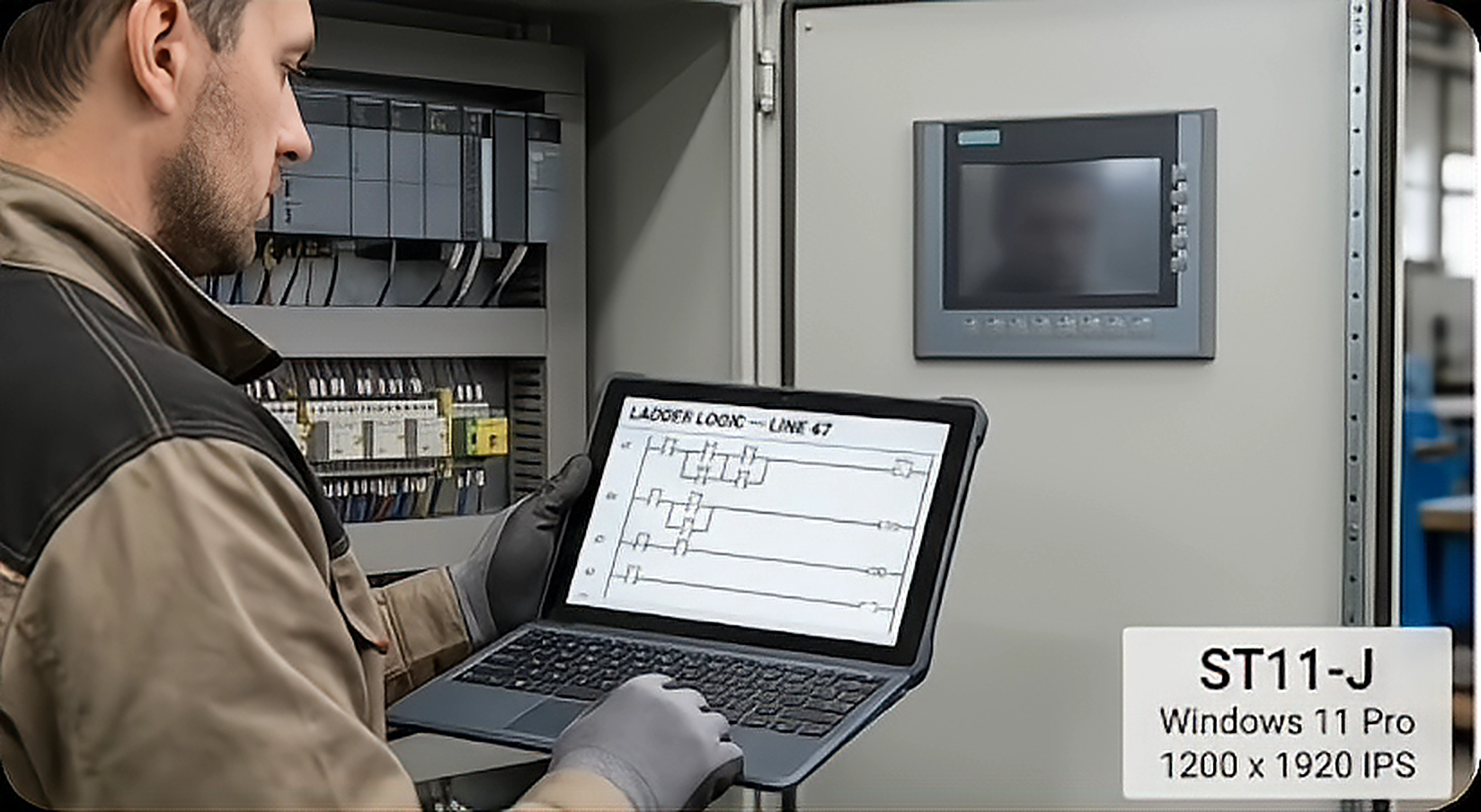
The ST11-J carries that engineering workload forward by a decade. Its Intel Celeron N5100 is a quad-core part clocked 1.10 to 2.80 GHz, with 8 GB of RAM and a 256 GB SSD as the standard build, running Windows 10 Pro or Windows 11 Pro — the same desktop Windows that PLC engineering suites expect, with no LTSB archaeology required. The 10.1-inch IPS panel resolves 1200 x 1920, which is where ladder logic earns its keep: the display shows the rung the 800-pixel tablet crops and the 600-pixel panel never drew. A 7.6 V 6000 mAh removable battery sustains roughly 8.5 hours of that work, and the pack swaps in seconds at the cabinet instead of tethering the tablet to its charger. ST11-J Rugged Industrial Tablet publishes the full configuration on one page.
Ethernet at the Cabinet, Not Behind a Flap
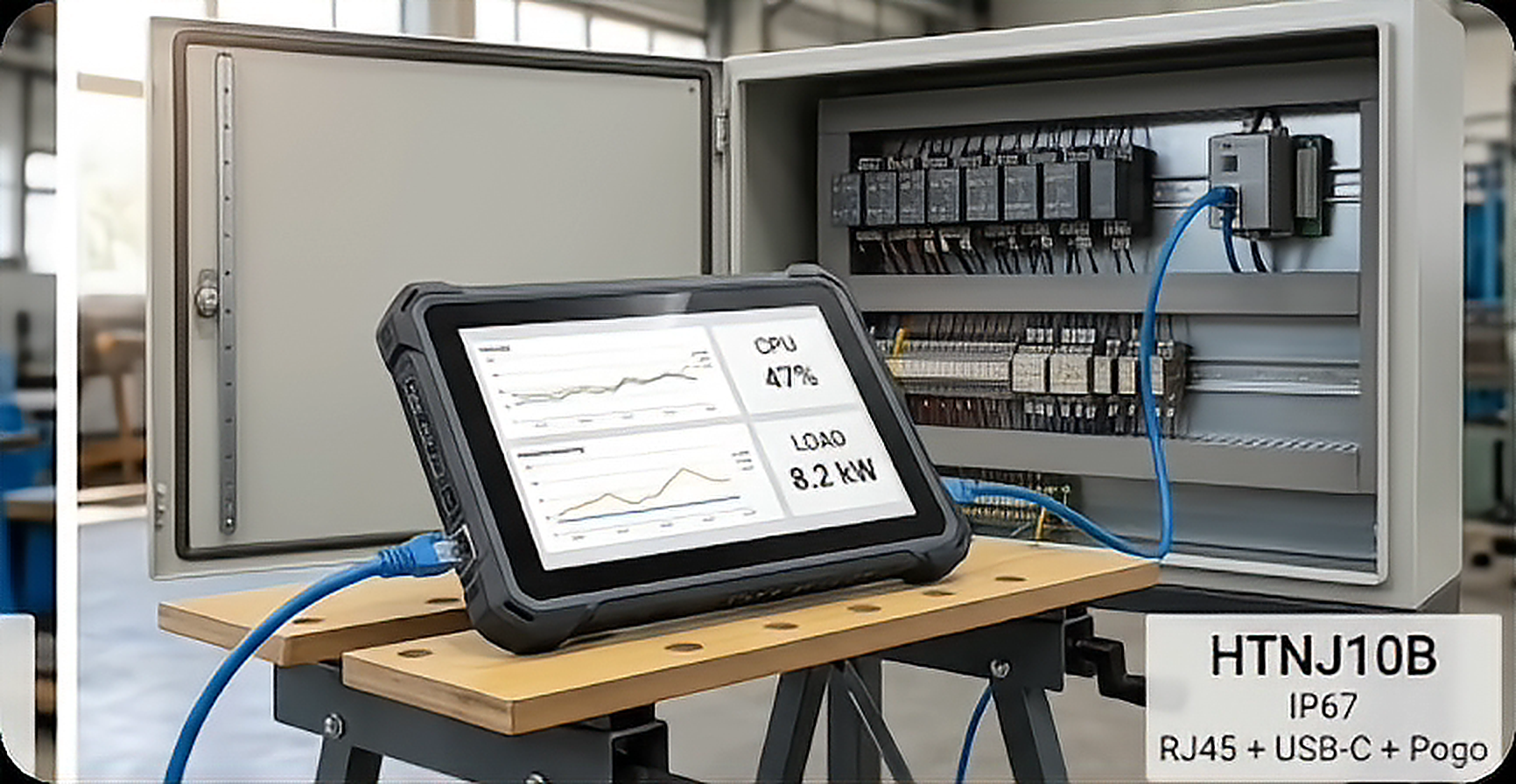
Wiring checks are the HTNJ10B's territory, and the difference is physical. Where the ITP1000 hides its gigabit port behind a service flap, the HTNJ10B leaves RJ45 Ethernet, USB Type-A, USB Type-C, Mini HDMI, a TF slot, a SIM slot and a 12-pin Pogo array permanently exposed on the body. Hanging the tablet on the cabinet door and patching straight into the PLC network is a one-handed job. The same double-layer body holds IP67 against washdown and carries MIL-STD-810G certification with a 1.22 m drop rating, and its Pentium N6000 bursts to 3.3 GHz for the moments a trend view recalculates. HTNJ10B Industrial Rugged Tablet lists every port with the counts.
One Hand for the Scanner Round
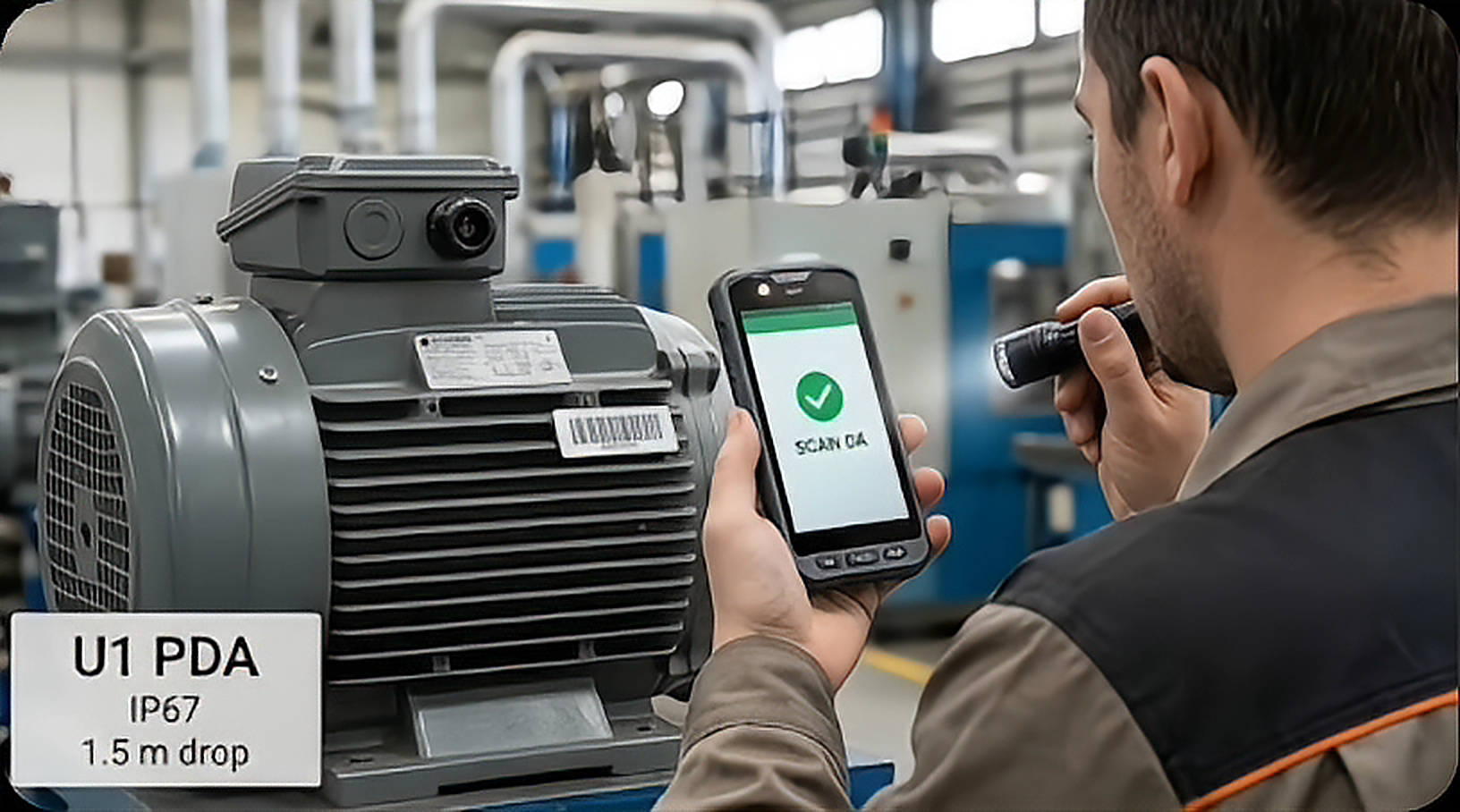
The third job belongs to the U1, and no tablet wants it. During a point-check round the engineer holds a flashlight in one hand and a component list in the other; a 10-inch device is a third object that needs a surface. The U1 is a 5.5-inch Android handheld with a Gorilla Glass touchscreen that accepts wet-hand and glove input, a 13 MP rear camera with autofocus for nameplate capture, and IP67 sealing with a 1.5 m drop rating for the round-trip across the floor. Its 3.8 V 4700 to 5000 mAh battery is removable and charges over Type-C, and the series spans twelve sub-models — UHF RFID, fingerprint, RTK surveying and a medical variant among them — so the scanner round can carry exactly the module it needs. U1 Series Handheld PDA lays out all twelve variants side by side.
Daylight on the Enclosure Door
Plant lighting decides which of these screens stays readable. The ITP1000's 250 cd/m² panel was specified for indoor engineering benches, and the MT8102iE's 350 cd/m² serves the same room it is mounted in. The HTNJ10B pushes 560 nits — enough to keep fault tables legible under skylights and floodlights near loading doors — while the ST11-J offers an optional 1000-nit high-brightness build for the same reason. Neither Weintek's spec sheet nor Siemens' datasheet mentions an IP rating for the whole unit; the HTNJ10B and U1 both hold IP67 on the body, and both Hotus tablets publish a -20°C to 55°C operating window that covers the unheated corner of a plant in January, where the MT8102iE's 0°C floor does not.
What the Three Hotus Units Cover on Paper
| Dimension | ST11-J | U1 PDA | HTNJ10B |
|---|---|---|---|
| OS | Windows 10/11 Pro | Android 12/14 | Windows 10/11 Pro |
| Display | 10.1in IPS, 1200 x 1920 | 5.5in, 720 x 1440, Gorilla Glass | 10.1in IPS, 1200 x 1920 |
| CPU | N5100 quad-core, 1.10-2.80 GHz | MTK6765/6769 octa-core, 2.3 GHz | Pentium N6000 quad-core, burst 3.3 GHz |
| RAM & storage | 8GB + 256GB SSD | 3GB+32GB to 4GB+64GB | Not published (M.2 expansion) |
| Battery | 7.6V 6000 mAh | 3.8V 4700/5000 mAh | 7.6V 3500 mAh |
| Protection | IP65, 1.2 m drop, MIL-STD-810G | IP67/IP66, 1.5 m drop | IP67, 1.22 m drop, MIL-STD-810G |
| Camera | 5MP front + 13MP rear | 13MP rear + 5MP front | 5MP front + 8MP rear |
All three ship with removable batteries and wet-hand capable touchscreens; brightness grades and physical port counts live on the respective pages. For teams comparing hardware across a whole inspection program, the Industrial Inspection Solutions page groups the lines by deployment role.
Where the Siemens Tablet Still Wins
Honesty keeps this comparison useful. The ITP1000's i5-6442EQ build out-computes the N5100 by a visible margin, its gigabit RJ45 is specified where the HTNJ10B's Ethernet speed is not published, and its 8 physical side keys give gloved operators shortcuts a capacitive slab cannot. Buying it with SIMATIC software bundles ties the whole engineering environment together, and the Made-in-Germany lineage still matters to audit-driven plants. What it does not offer is a modern OS image, a published IP rating, or a weight under 1.6 kg — and the 2016 LTSB baseline ages more each year. The MT8102iE wins nothing mobile by design; its value is being a panel, and the moment work leaves the door it has nothing to say.
Sending Each Job to the Right Device
The fixed panel stays on the door doing what it was commissioned to do — that is not a defect, it is a job description. When a task walks, the walking tools decide the outcome: the ST11-J carries engineering software at the resolution the work needs, the HTNJ10B patches into the cabinet without opening flaps, and the U1 finishes the round one-handed. Plants that map each task to one of those three roles stop asking any single screen to do everything. The Factory Inspection walkthrough shows the same split applied on the floor.