The trucks arrive when they arrive. A steel delivery shows up at the site gate at 7:40 in the morning, the driver wants a signature, the site engineer wants proof that what is on the flatbed matches what was ordered, and the storekeeper wants labels on the bundles before they get carried off to the second floor. None of these people are going to walk back to a site office with a desktop PC and an A4 printer. Everything has to happen in about twenty minutes, in the dust, next to an idling truck, usually while wearing gloves.
Three categories of hardware get dragged out to the gate for this job: a rugged tablet that can actually open the ERP system, a handheld scanner for counting, and something that prints a label on the spot. A lot of sites solve this with a mobile printer in one hand and a phone in the other. Others hand the storekeeper a dedicated keypad terminal and hope the paperwork can wait. This article walks through the gate-hour workflow against one integrated kit from Hotus — the HTNJ08A rugged tablet, the R350C keypad PDA, and the X8 printing PDA — and against two devices that approach the same hour from very different directions: the Brother RuggedJet 4 mobile printer and the Denso BHT-1700 keypad terminal.
The Paper Trail Starts at the Gate
Material acceptance is a paperwork problem wearing a hard hat. The delivery note has to be matched against the purchase order, quantities have to be counted, damage has to be photographed, and every bundle needs a label that will still make sense three weeks later when the steel is buried in a wall. The receiving workflow is the same on a construction site as it is in a warehouse; the difference is that a construction gate has no bench, no shade, and no power outlet.
That constraint shapes every device choice that follows. A laptop on a tailgate works until it rains. A consumer tablet works until it is dropped on gravel at 7:45 in the morning. And a phone camera scanning a smudged barcode from two metres away works until it doesn't, which is roughly every third bundle.
The Tablet That Opens the Drawing
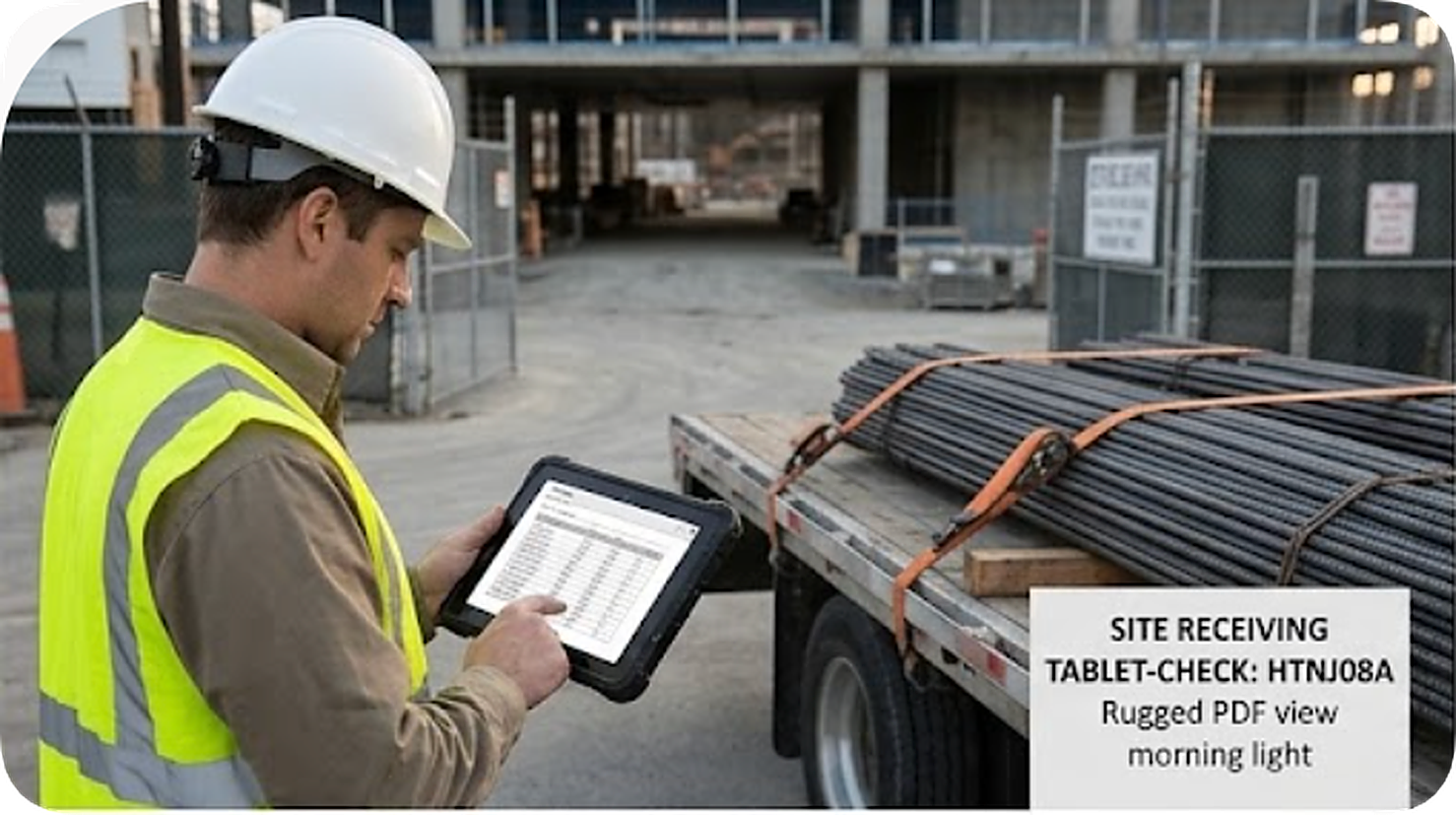
The first thing the site engineer needs at the gate is not a scanner — it is the purchase order, the delivery note, and occasionally the structural drawing that shows where this shipment is supposed to go. That is a Windows job. The HTNJ08A runs an Intel Celeron N5100 quad-core processor (burst up to 2.8GHz) with Windows 10 or 11 Pro, so the desktop ERP client, the PDF set, and the site's drawing viewer all open the way they do in the office. The 8-inch IPS screen runs at 1200 x 1920 with 560 nits of brightness, which is enough to read a delivery note PDF in direct sunlight — the same panel spec Hotus uses on its larger tablets.
It is also built for the ground it is standing on: IP67 dust and waterproofing, MIL-STD-810G certification, a 1.22 metre drop rating, and a double-layer body that survives the gravel and rebar environment of an active site. The port selection matters more than it looks at a gate — full RJ45 Ethernet means the tablet can be docked in the site office at the end of the day and sync the day's receipts over wire, and the 7.6V 3500mAh removable battery means a charged spare lives in the glovebox rather than a charger.
Gloves, Keypad, One Hand
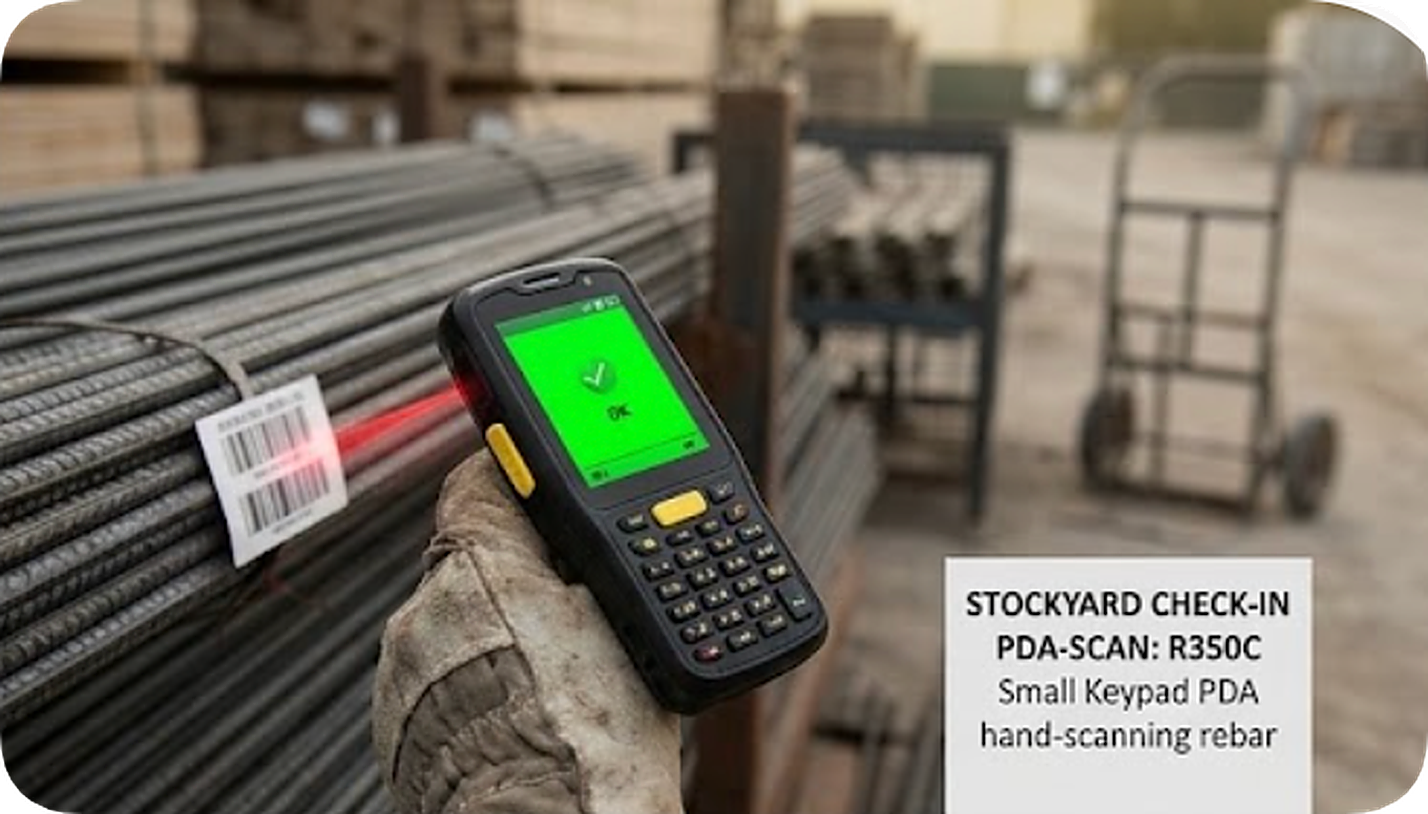
Counting is the storekeeper's job, and the storekeeper is wearing gloves. The R350C is a 4-inch PDA built around this exact constraint: a full physical numeric keypad (0-9, delete, back, enter, function, star, hash, and a dedicated scan key) that works whether or not the touchscreen registers a gloved finger. The whole unit weighs under 300 grams, which sounds like a spec-sheet vanity number until you have been holding a terminal in one hand for the twentieth bundle of the morning.
Inside there is a Qualcomm QCM2290 quad-core processor running Android 13, with an optional 2D barcode engine rated at 3 mil precision for the shrink-wrapped and weather-beaten labels that come on construction materials. The 3.8V 4000mAh removable battery covers a full shift of scanning, and dual SIM slots with 4G LTE mean the count can sync to the ERP in real time from a site where Wi-Fi has never reached. Hotus does not publish an IP rating for the R350C on its product page, and that is worth saying plainly — for open-gate work in dry weather it is the right tool, but a site that needs submersion-grade sealing should look at the HTNJ08A for the same tasks.
A Printer Without a Brain
The Brother RuggedJet 4 is, by any measure, an excellent printer. It prints 4-inch-wide labels (104mm) at up to 5 inches per second at 203 dpi, it survives 2.1 metre drops with an IP54 rating, and its 7.2V 3000mAh battery is rated for a full shift. Brother backs it with a two-year warranty that extends to five. If the job at the gate were only printing, the RuggedJet would be the honest answer.
But the RuggedJet has no screen, no scanner, and no data connection to the ERP — it is an output device that needs a phone, a tablet, or a laptop paired over Bluetooth 4.2 to tell it what to print. At the site gate that means two devices to carry, two batteries to track, two things to charge overnight, and a pairing dance at 7:40 in the morning. It also means roughly $1,159 for the linerless model before adding the device that controls it. The X8 printing PDA collapses that pairing into one body: a built-in 58mm thermal label printer running at 70mm/s, a 2D barcode scanner on the back, and a 5.5-inch Android 14 touchscreen, all in a unit under 500 grams. The label is narrower — 58mm covers a bundle tag or an asset label, not a full-page shipping document — but the tag that says "COLUMN REBAR, LOT 12, FLOOR 3" does not need four inches of width.
An Android From 2016 Shows Up to Work
The Denso BHT-1700 is the other direction: a dedicated keypad terminal with real scanning pedigree. Its magnesium alloy body is IP67 sealed, survives 1.2 to 1.5 metre drops repeated sixty times, and its long-range variant reads barcodes at up to ten metres — genuinely useful for scanning a bundle still on the truck bed. The two-CPU architecture, where one processor handles scanning and decoding independently of the application, keeps the trigger responsive even under load.
Then there is the software side. The BHT-1700 runs Android 7.1.2 — an operating system released in 2016 — on a 1.3GHz quad-core chip with 2GB of RAM and 16GB of storage. For a pure scan-and-upload workflow that remains functional today, and Denso's device management system keeps fleets updated honestly. But the site's acceptance app, the ERP web client, or anything modern that expects a current Android runtime will either not install or run poorly, and 2GB of RAM is the floor of what current mobile browsers tolerate. The R350C runs Android 13 on a Qualcomm QCM2290 with 4GB of RAM — the same keypad-first philosophy, on a stack that will still accept app updates in 2027.
Four Inches of Label, Two Devices to Carry
Put the printing question side by side. The Brother wins on paper: 104mm of print width against 58mm, 127mm per second against 70, a 2.1 metre drop rating against the X8's IP54 sealing, and an accessory ecosystem that includes vehicle docks and four-bay chargers. A logistics hub printing full-width shipping labels all day should buy the Brother and a controlling device, because that is precisely what it is built for.
The gate hour is a different problem. The storekeeper needs to scan, count, photograph the damaged pallet, print a bundle tag, and sign the delivery note — in one hand, in one device, in twenty minutes. Carrying the Brother plus a phone means the printer gets set down on a pallet, walks away, or stays in the truck. An integrated printing PDA does not print as wide or as fast, but it is always in the hand that is already there, and its 7.6V dual-cell battery (2750mAh, expandable to 5300mAh for 12-16 hours of operation) is removable the same way the tablet's and the scanner's are.
Where the Denso Wins, Honestly
Three things the BHT-1700 does better than anything in the Hotus trio deserve plain acknowledgement. Its long-range scan head reads at distances the R350C's standard engine does not reach. Its IP67 rating is published, tested, and matched only by the HTNJ08A in this comparison. And its battery life is exceptional — 22 to 34 hours on the standard cell, up to 51 hours on the high-capacity one, against the R350C's solid but unremarkable 4000mAh shift. A warehouse running Denso's ecosystem with Denso's software should not rip it out for this article's sake.
The argument is narrower: a construction gate is not a warehouse aisle. It is a mixed job — documents, counting, labelling, photographing — done by people who carry one device. A terminal that only scans leaves the printing and the paperwork to whatever else is in the truck.
Who Does What at the Gate
| Specification | HTNJ08A | R350C | X8 |
|---|---|---|---|
| OS | Windows 10/11 Pro | Android 13 | Android 14 |
| Display | 8" IPS 1200x1920, 560nits | 4" IPS 480x800 | 5.5" IPS 1440x720 |
| Processor | Intel N5100 quad-core, 2.8GHz burst | Qualcomm QCM2290 quad-core | Octa-core 2.0GHz |
| RAM & storage | SSD, M.2 expansion | 4GB + 64GB | 4GB + 64GB, up to 512GB |
| Input | Capacitive touch, stylus, wet-hand | Physical keypad + touch | Touch, wet-hand & glove |
| Integrated printer | — | — | 58mm thermal, 70mm/s |
| Camera | 5MP front + 8MP rear AF | 8MP rear AF | 5MP front + 13MP rear AF |
| Battery | 7.6V 3500mAh removable | 3.8V 4000mAh removable | 7.6V 2750mAh dual-cell removable |
| Protection | IP67, MIL-STD-810G, 1.22m drop | Not published | IP54 |
| Weight | approx. 1.8kg | under 300g | under 500g |
| Network | Wi-Fi 5, BT 4.2, 4G LTE, RJ45 | Wi-Fi, BT 5.0, 4G LTE, dual SIM | Wi-Fi, BT 5.0, 4G LTE, dual SIM |
The division is by task, not by rank. The HTNJ08A owns the documents: purchase orders, delivery notes, drawings, and the ERP client, because only Windows runs them natively. The R350C owns the count: one-handed, keypad-first scanning that syncs over 4G the moment the number is keyed. The X8 owns the label: scan the bundle, type the lot, print the tag, stick it on, move to the next bundle. One person can carry all three — 2.6 kilograms total — or two people can split them without a charging cart.
Splitting the Gate Hour
A site that already runs a full rugged ecosystem — Denso terminals, Brother printers, a separate tablet — can absolutely keep it, and for operations at warehouse scale there are good reasons to. The integrated argument matters most where the crew is small, the gate is temporary, and the devices live in a truck cab between deliveries: one kit that opens the ERP, scans with gloves on, and prints the tag in the same hand. The receiving and inventory workflow does not get shorter — the twenty minutes just stop being spent on pairing, charging, and walking back to the office. The truck, as always, does not wait.