Chlorine, H2S and a Paper Logbook Don't Mix
A wastewater treatment plant runs three shifts a day, every day of the year, and each shift is legally expected to prove that it happened. The operator walks the aeration basin, checks the dissolved oxygen readout, eyeballs the chlorine residual at the dosing cabinet, notes the sludge blanket level, and signs a sheet of paper that will live in a binder until the regulator asks for it. The plant manager in a recent retrofit project described the routine honestly: two hours of every shift is walking and writing, and the binder is only useful when something has already gone wrong. The hardware that replaces that binder has to survive a room where hydrogen sulfide corrodes bare steel, humidity condenses on anything that walks in from the cold, and a dropped device lands on wet concrete. This article compares what three Hotus units do on that route against a compact handheld from M3 Mobile and a fanless embedded PC from Cincoze that plants often shortlist for the same jobs.
🖥️ The Screen Has to Fit the Process Diagram
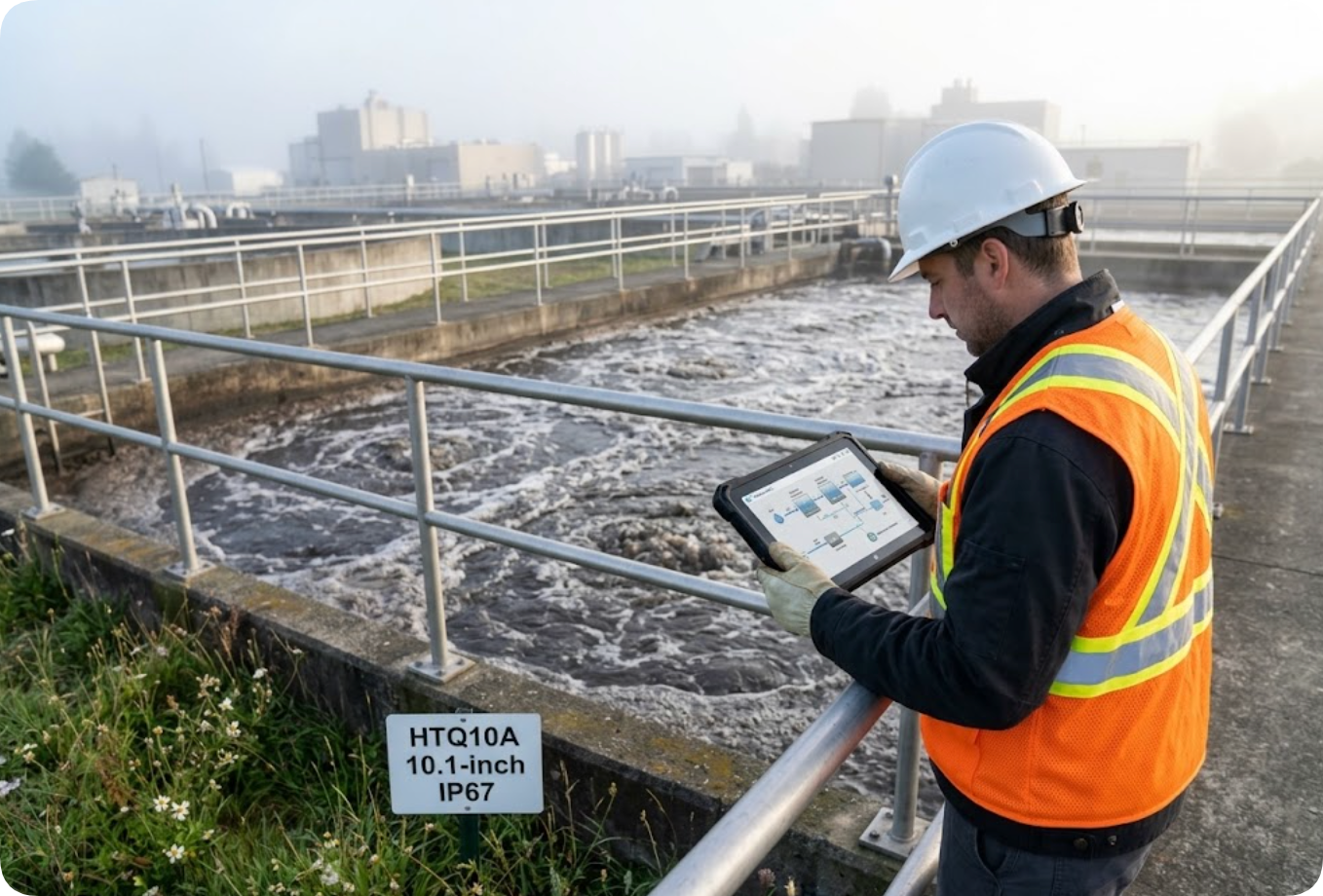
The first thing an operator does at a basin is pull up the process diagram: aerator states, valve positions, flow rates, and the trend line for the last twenty-four hours. On a phone-sized screen that diagram is a scroll-and-zoom exercise with wet gloves. The Hotus HTQ10A mounts a 10.1-inch IPS panel at 1200x1920 with 400 nits of brightness behind Gorilla Glass, and it accepts both wet-hand and gloved touch, which matters at a basin where mist off the weirs settles on everything. The plant's SCADA page renders at nearly full width, so the operator reads the trend instead of navigating to it. The M3 Mobile SL20, a well-regarded compact handheld, carries a 5.45-inch HD panel at 1440x720 — roughly a quarter of the pixel area. It is a fine device for scanning a shelf label; it is the wrong shape for a process diagram. The HTQ10A also carries an optional UHF RFID module, so the same unit reads the asset tags riveted to basin gates and dosing pumps, closing the loop between "I looked at it" and "the system knows I looked at it." Both devices are sealed to IP67 and survive 1.2-meter drops onto concrete, so the choice is not durability; it is what fits the work.
The Gasket That Fails First
Maintenance crews at treatment plants know which part of a mobile device dies first, and it is never the glass. It is the rubber port cover: hydrogen sulfide migrates as a gas into every cavity, condenses on cool metal overnight, and oxidizes into sulfuric acid that swells seals and green-cruds contacts. A device that gets opened twice a shift — for SIM swaps, SD cards, or charging on older models — ages its gaskets in plant-years, not calendar years. This is why the details that look minor on a datasheet decide the total cost here. The HTQ10A charges over Type-C but also exposes Pogo-pin contacts for a desktop or vehicle dock, so the daily routine can run without ever prying a port cover open; the dock connection wears a spring-loaded pin, not a rubber flap. The RS51 takes the same logic further with a large removable cell that swaps through a latched bay rather than an unsealed cavity. Crews that standardize on devices opened only at scheduled monthly inspections — ports checked, gaskets wiped with a silicone cloth, seals logged — routinely report three or more years of service in rooms where consumer phones lasted eighteen months. The SL20 earns its keep on the same point: its battery door is a managed wear item with a latched design, and its IP67 rating was proven in warehouse and courier fleets. The difference at a treatment plant is chemical, not mechanical, and it is the reason plant IT increasingly asks vendors for H2S exposure references rather than just drop-test numbers before standardizing.
Shift Change Without a Charging Queue
A three-shift plant burns batteries in a way an office never does, and the handover between shifts is the worst possible moment to plug something in. The HTQ10A carries a 10,000 mAh removable pack: the outgoing operator swaps in a fresh cell in seconds and drops the spent one into a charger, with no reboot and no lost session. The SL20's 5,000 mAh battery also hot-swaps and M3 Mobile rates it for up to 12 hours, which covers a shift but leaves the charger — and a spare battery per unit — as mandatory infrastructure. Inside the dosing building, where sodium hypochlorite fumes make corrosive air, neither company's seal ratings should be trusted on faith alone; both IP67 ratings assume the ports are closed, and plant practice is to inspect door gaskets monthly. What the bigger cell changes is procedural: the night shift that starts at midnight with 40% battery is the one that quietly stops scanning stations and just "eyes" them. A swap-in-the-hand battery makes that failure mode rare enough to audit.
⚖️ The Control Room Desk: 2015 Silicon vs Today
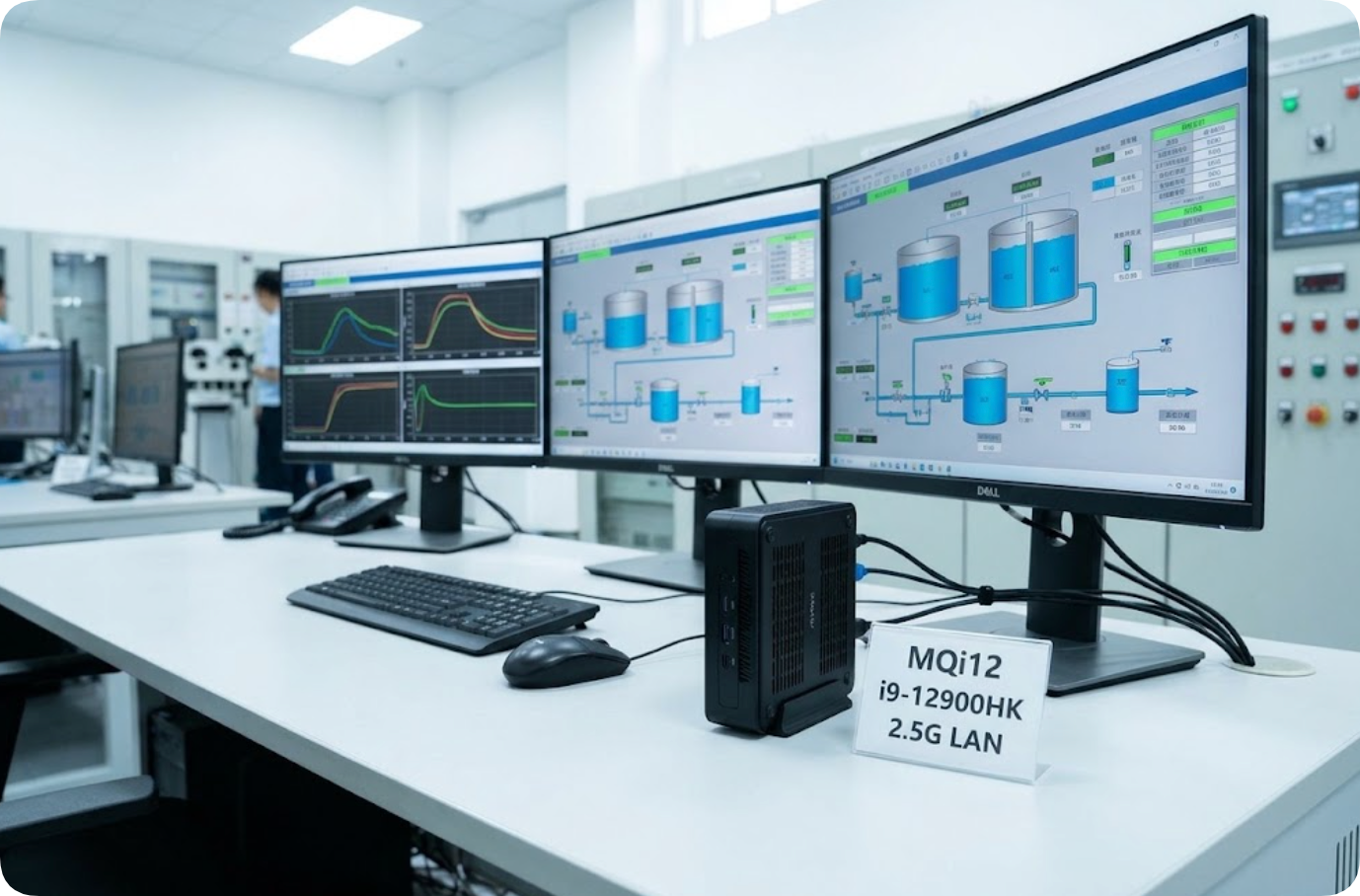
Most plants already have a control room, and most shortlists for the box under the SCADA monitors include the Cincoze DI-1000, a fanless embedded PC with a genuinely rugged spec: -40 to 70°C operation, 9-48 VDC input, six COM ports, eight isolated digital I/O lines, and DIN-rail mounting. Give Cincoze its due — if the box is going inside a control cabinet next to PLCs and dosing skids, that I/O portfolio is exactly right, and nothing in the Hotus line matches it port-for-port. But an operator station is a different job from a cabinet controller. The DI-1000 runs a sixth-generation Intel Core U-series processor — a platform Intel launched in 2015 — with a single DDR4 slot capped at 32 GB, and its display outputs are DVI-I and DisplayPort. The Hotus MQi12, an 800-gram palm-sized mini PC, runs 12th-generation Core processors up to the i9-12900HK, takes two memory slots to 64 GB, adds two 2.5-inch SATA bays for up to 12 TB of trend-history storage, and drives three monitors over dual HDMI 2.1 and a full-function Type-C port. At a plant retrofitting its control desk on a budget, the practical difference shows up in two places: historian queries that chokes on a 2015 dual-core finish in seconds on the newer platform, and the desk gets three 4K screens without buying display adapters for DVI-era ports.
Where the Serial Ports Actually Belong
There is a honest division of labor worth stating plainly. The DI-1000's six COM ports and isolated DIO belong inside the cabinet, wired to flowmeters and chemical analyzers that still speak Modbus over RS-485 — that is a controller job, and it should stay there. The operator's desk, though, runs HMI software, a historian client, a web browser for the utility portal, and video windows from the plant's cameras. That workload is general-purpose computing, and pinning it to a 2015-era 15-watt mobile chip means every screen redraw and every historian query pays the age tax. Plants that conflate the two roles end up asking a cabinet controller to also be a desk PC, then wondering why the SCADA client stutters when the analyzer polls spike. Split them: Cincoze in the cabinet, a Hotus MQi12 under the monitors, and both do what they were built for. The MQi12's 2.5G Ethernet and Wi-Fi 6 also mean the desk box reaches the plant network without a shelf of dongles.
Sampling Rounds That Produce Evidence
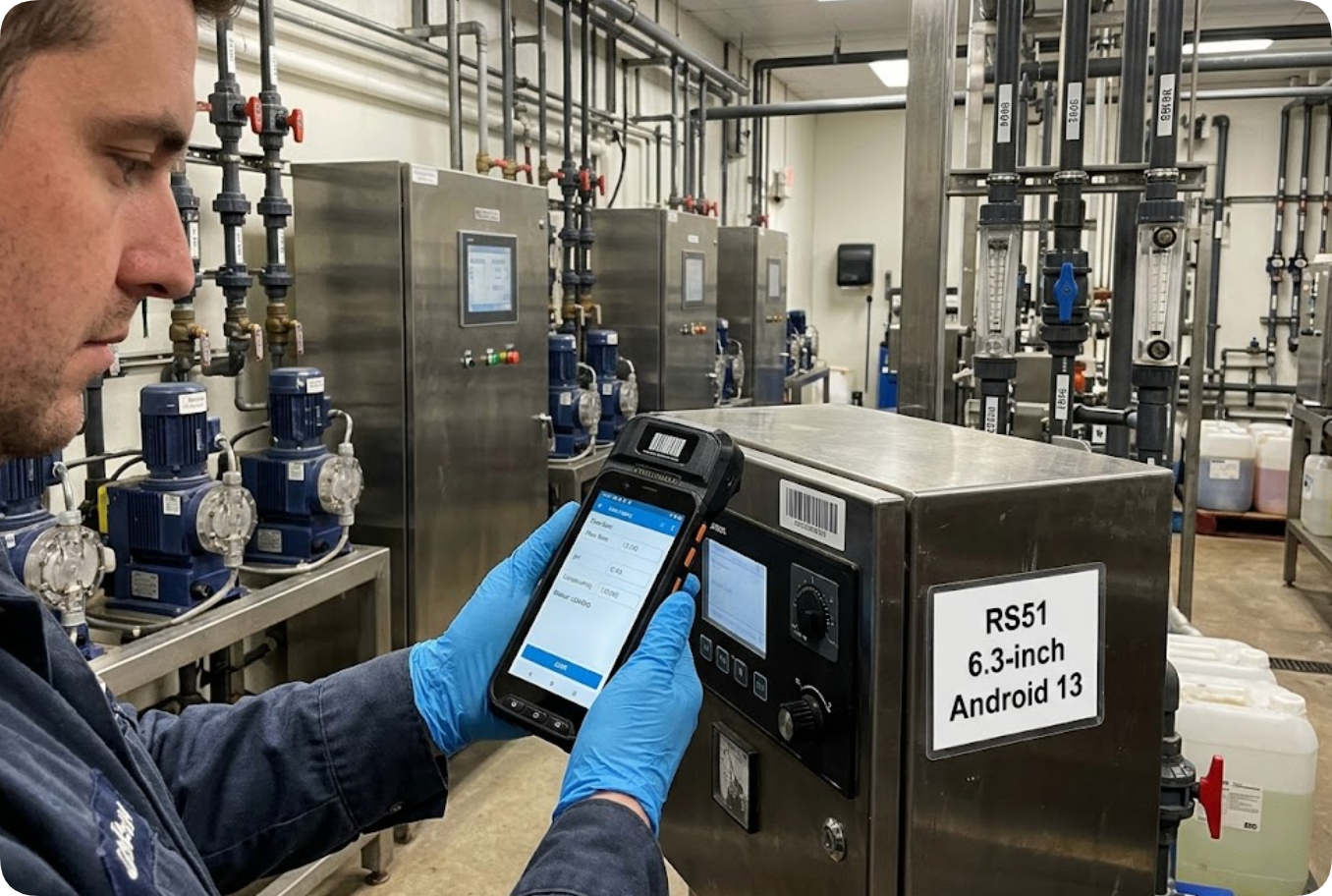
The third leg of the route is sampling: grab samples at fixed points, read the inline meters, log the numbers with a timestamp and a location the lab can trust. The Hotus RS51 is a 6.3-inch Android 13 handheld built for exactly this loop. Its Zebra or Honeywell scan engine reads the barcode tags on sampling ports and meter faces — no typing serial numbers with wet thumbs — and its GNSS precision positioning, a feature Hotus points out is rare on 4G rugged terminals, puts a coordinate on every sample point, so a lab result can be traced back to the exact basin and port years later. The 4G LTE link syncs records as the operator walks, which means the lab sees the round in progress instead of receiving a photographed paper sheet at end of shift. Against the SL20 the RS51 trades down slightly on pocketability and trades up on screen area, scan engine pedigree, and the positioning stack; at 236 to 250 grams the M3 unit wins the pocket test, but sampling rounds are carried in a hand, not a pocket.
The Retrofit Math
A typical mid-size plant retrofitting its inspection loop ends up needing three things: a device for the outdoor basin walk that shows the process diagram, a desk box for the control room that runs the historian without excuses, and a handheld that turns sampling into signed digital evidence. The industrial inspection stack covers the first, the MQi12 covers the second, and the RS51 covers the third, with each unit's data landing in the same plant system the same day. The M3 Mobile SL20 remains a good answer to a question this route does not ask — fast, light shelf-side scanning — and the Cincoze DI-1000 remains the right box for the cabinet, where its serial ports and wide temperature rating are genuine advantages no tablet matches. The expensive mistake is assigning either device a job it was not shaped for: a process diagram on a 5.45-inch screen, or a historian on 2015 silicon. Plants planning the retrofit can start from the inspection walkthrough patterns and the field maintenance workflows already mapped out for utilities, then size the hardware to the route rather than the reverse.