- Select Language
Full SpecificationsModel Hotus SH5‑WOperating ...
Explore an innovative Personal Digital Assistant f...
R860-S 5.5-inch Industrial PDA with Thermal Printe...
R530C 6.0-inch Industrial PDA | Qualcomm Octa-core...
RT82 5G Rugged Tablet | 10.1" FHD 400nit | Qu...
The PM158-1 is a 15.6-inch portable touchscreen mo...
Maintenance instructions: Store at room temperatur...
A term does not start on the day the hardware arrives. The first bell is set months earlier, when the timetable is written and the rooms are assigned, and nothing on the purchasing side moves that date. What sits between the two events is the short stretch of working days a department actually controls, and the only number that matters inside it is how long one classroom takes to become usable. Budgets are usually written against unit counts. Term-start capacity is written against something else entirely. Three units do most of this work in a school lab: the 8-inch HTNJ08A, the mini PC that sits under the teacher station, and the 10.1-inch ST11-M. Each one asks for a different amount of the same scarce thing, which is a person standing in a room with the door open. Compare them on that line and the shortlist stops looking like a spec sheet. rugged tablets for education
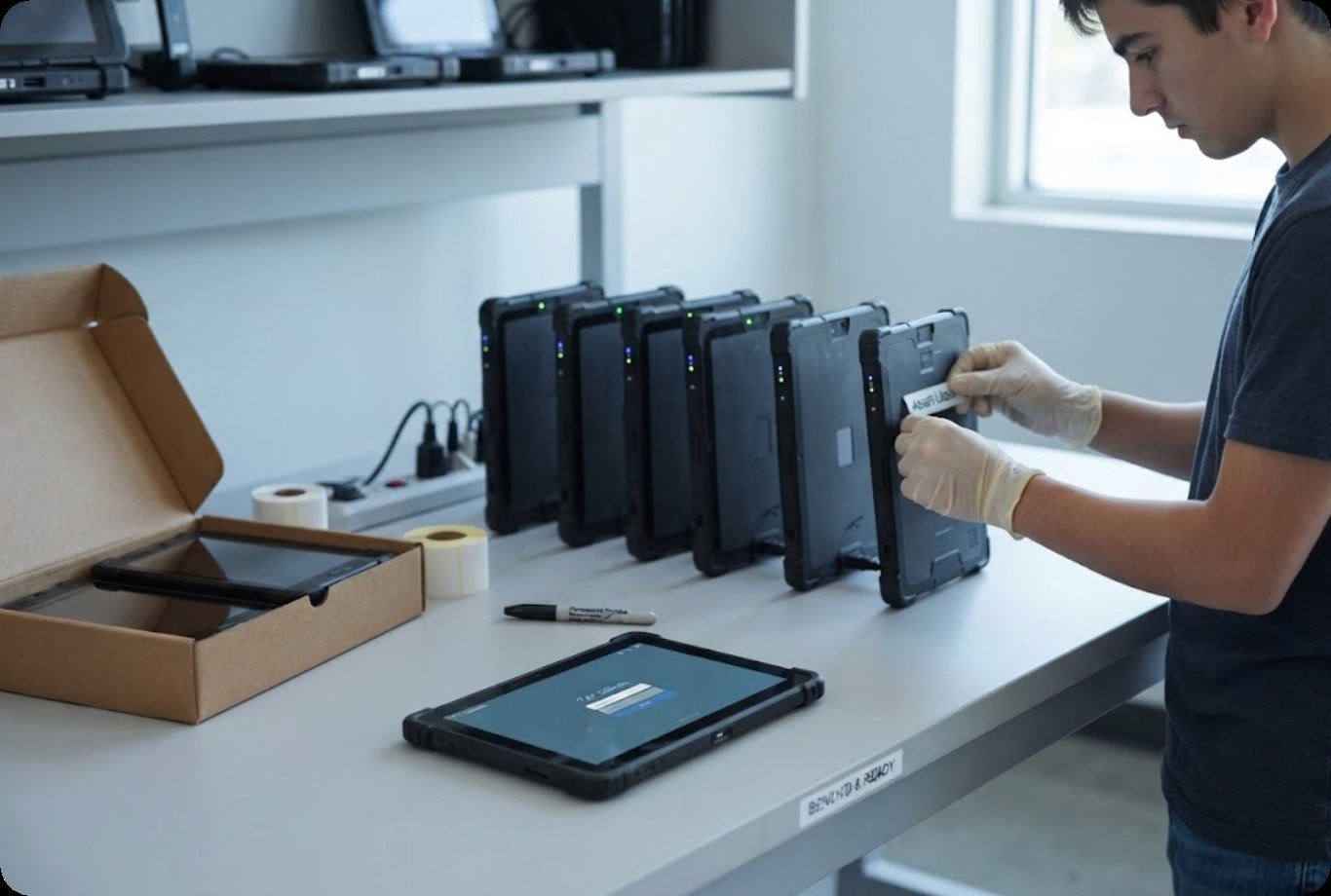
Sort the work into two piles and the shape of a term-start week appears. One pile does not care where it happens: unboxing, asset registration, imaging, account setup, charging, tags, a first power-on check. The other pile only happens in the room, at the desk, with the furniture already in place. The first pile can run in parallel across a bench, with more hands added whenever they are free. The second pile runs one room at a time, and it does not shrink when more units are ordered. Every hour saved in the second pile buys back a classroom. That is the whole arithmetic of the season.
A timetable is assembled from rooms, classes and periods, and it is published before the purchasing cycle closes. Once it is out, the start date stops being a decision and becomes a constraint. Everything downstream is dated from it: staffing, transport, the first week of lessons, the parents who have already been told. Delivery, by contrast, is the one date that can slip and usually does. What is left to a planner is the gap between the two, measured in working days rather than calendar weeks, since weekends and the last week of preparation are rarely available. Divide that gap by the time one room needs and the answer is a count of classrooms, not a count of units. Any plan that stops at unit totals has skipped the only step that decides whether the first morning works.
The two piles separate cleanly once the criterion is stated. A task belongs to the outside pile if it can be finished with the unit on a bench and no student present: opening the carton, recording the serial number, installing and updating the operating system, joining it to the management account, bringing the battery to full, applying an asset label, checking that it powers up and connects. A task belongs to the room pile if the furniture, the cabling or the mains supply is part of it: placing the unit, connecting a display, running a network lead, securing the unit to the desk, pairing it with a projector, and logging in once on the seat it will actually serve. Nothing in the first pile gets faster by being done in a classroom, and nothing in the second pile can be finished anywhere else. Term-start capacity is set by the second pile alone.
How much of the outside pile is available depends on what the unit brings with it. The HTNJ08A is an 8-inch tablet with a 1200 by 1920 panel at 560 nits and ten-point touch, rated IP67 and tested to a 1.22-metre drop, so it survives the bench as easily as the desk. Its 7.6V 3500mAh pack is built in, which means a row of them can be charged on a single strip in the store room without competing for the sockets a classroom needs. Imaging, account binding and labelling all happen on the same shelf. What arrives in the room is a set that boots and connects, so the work left at the desk is placement and a single login rather than a setup session. Each unit that finishes its outside work early is a unit that stops holding up a room. HTNJ08A Rugged Tablet
The room pile is smaller per unit and far more expensive per hour, because it consumes the one resource that cannot be multiplied. The ST11-M is a 10.1-inch tablet on an Intel i5 with 8GB of memory and a 256GB drive, a 1200 by 1920 panel at 430 nits, wet-hand touch and stylus support. Its 7.6V 6000mAh pack is quoted at 7 hours 30 minutes of use and roughly four days on standby, which reads as a full teaching day with margin rather than a charge to be repeated at lunch. That matters after the room is finished, not during it. Placement, the RJ45 run, desk fixing and a projector check all still take the same minutes as any other tablet, and they take them one room at a time with the door shut to classes. ST11-M

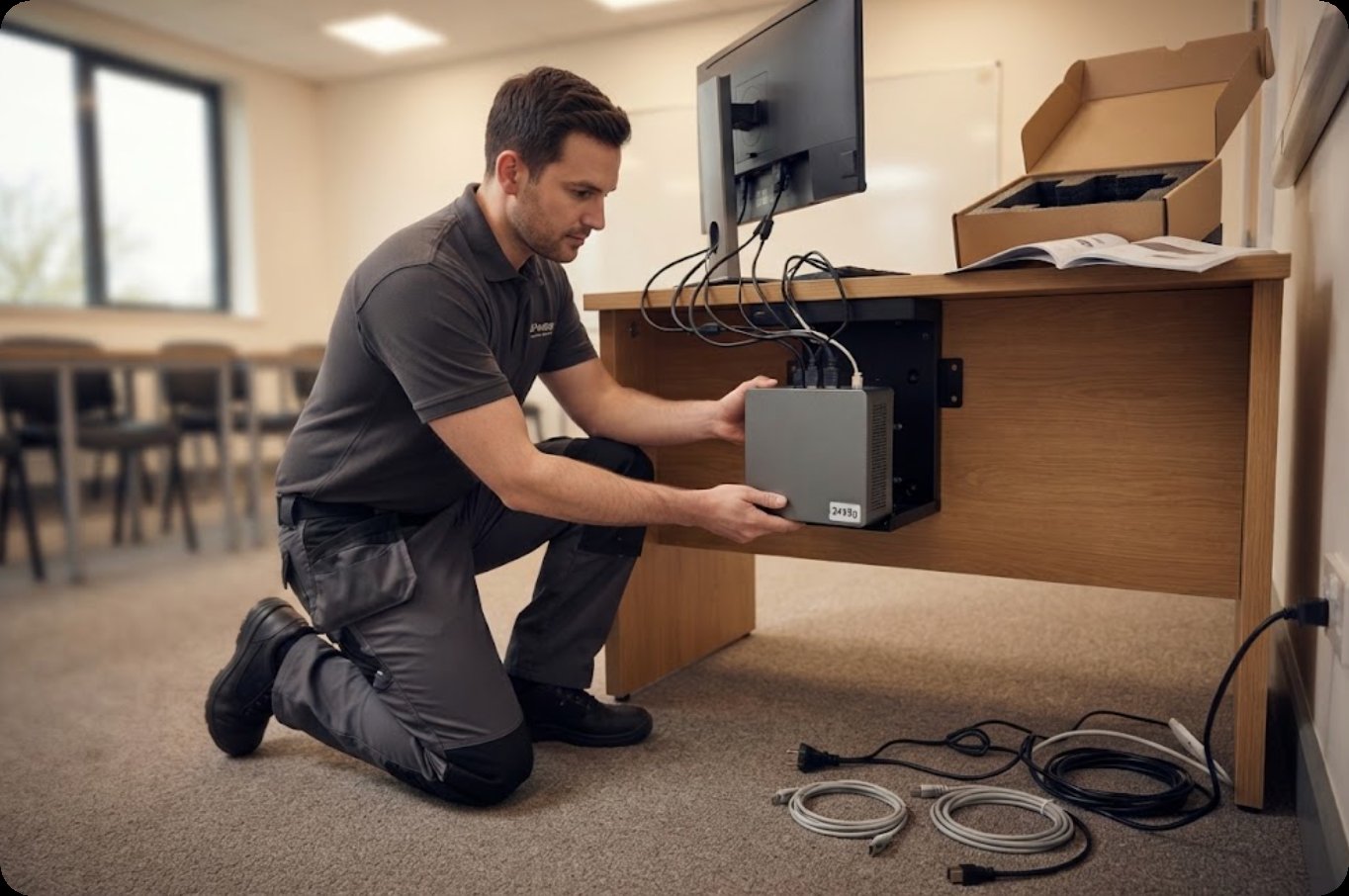
The third unit behaves differently in a way that has nothing to do with performance. The HCAR5000 MI is a mini PC on an AMD Ryzen 5000H with DDR4 up to 64GB, SSD options from 128GB to 1TB alongside a 7200rpm drive bay, measuring 202 by 212 by 65 millimetres and weighing 2455 grams. It ships with no display and no battery of its own, and the operating system line reads Windows 10 or 11, with a Linux soft route option. Until it is connected to mains power, a screen and a network lead it is not yet a working machine. Its entire preparation therefore lands inside the room, and its weight decides how it gets there: at just under two and a half kilograms, one person carrying two of them across a corridor is already an awkward trip. It replaces thirty desks' worth of local software with one box, and it adds a wiring job that can only be done on site. HCAR5000 MI
Set the three beside each other on the column that a term-start plan actually needs, and the differences stop being technical.
| Unit | What it brings | What can be finished outside the room | What must be done in the room |
|---|---|---|---|
| HTNJ08A Rugged Tablet | 8-inch 1200 x 1920, IP67, 3500mAh built in | Imaging, accounts, labels, charging, power-on check | Placement, login on the seat it serves |
| HCAR5000 MI | Mini PC, up to 64GB, 2455g, no display, no battery | Drive preparation only | Mains, display, network, positioning under the desk |
| ST11-M | 10.1-inch 1200 x 1920, 6000mAh, 7h30m of use | Imaging, accounts, labels, charging, profile setup | Placement, desk fixing, cabling, projector check |
Read down the third column and the term-start calculation writes itself. Where the outside column is long, a delivery becomes a sequence of short visits. Where it is short, the same delivery becomes a day of wiring. The units are not ranked here by capability; they are ranked by how much of their own preparation they will accept before the room exists.
Take a thirty-seat classroom and price the room pile. Thirty HTNJ08A units placed and logged in at four minutes each is 120 minutes. One HCAR5000 MI under the teacher desk, powered, connected to a display and joined to the network, adds about 20 minutes. That is 140 minutes for the room, or roughly two and a half rooms in a six-hour day and twelve across a five-day week. Now push imaging and accounts entirely off site so each tablet needs ninety seconds at the desk: the room drops to 65 minutes, five and a half rooms a day, close to twenty-eight in the same week. Same budget, same staff, more than double the rooms. Nothing in the second figure came from buying better hardware. It came from moving work into the pile that can run in parallel. our industrial hardware range
Finish with a single sheet, posted on the door of each room, carrying every task that cannot be done until the door is open. It earns its place three times over. It separates delivery from readiness, so a corridor full of cartons on Monday is not mistaken for progress. It produces the only number that can be quoted upward with confidence, which is the count of rooms that will be ready by the first morning. And it decides where the tools live, because anything used inside a room has to travel with the person doing the work rather than sit on a shelf two buildings away. The list needs no extra columns and no new software. It only needs to be written before the cartons arrive, and checked after each room is done. Anyone weighing that against a longer catalogue can start with the product comparisons already published.