- Select Language
RT82 5G Rugged Tablet | 10.1" FHD 400nit | Qu...
The N60 PDA is a cutting-edge device for inventory...
R366-S Thin 5.5-inch Industrial PDA | Qualcomm Oct...
R860-S 5.5-inch Industrial PDA with Thermal Printe...
️ X8 Series Handheld Label & Thermal Printing ...
Maintenance instructions: Store at room temperatur...
The U9000 handheld PDA combines advanced barcode s...
P11 Series Next-Gen Enterprise Rugged Industrial ...
Three rugged tablets land in the same week for the same kind of job: carrying a site to someone who is not standing on it. Two of them, the HTNJ10C and the HTXUK10A-55, publish the same camera line. The third, the RT80, publishes a different one. That single split is worth following, because in AR-assisted work the camera is not a feature on a list. It is the only road the far end has.
The split is easy to explain. The two units that share the camera are both Intel platforms, one running Windows 11 and one with no operating system published at all, and they pass the same imaging module through unchanged. The RT80 is built on a different platform with a cellular radio and an on-device AI block, and its camera was specified on its own. A camera is also the one component that stays with a unit for its whole service life, because none of the three publishes a lens mount or an external imaging path. Both paths are described in our AR-assisted inspection setup, but the practical question is narrower: what can the far end actually make out?
Read the three camera lines side by side and two of them match word for word. The HTNJ10C carries a 5MP front camera and an 8MP rear camera with autofocus and an LED flash. The HTXUK10A-55 carries a 5MP front camera, an 8MP rear camera, autofocus and an LED flash. Neither publishes an optional macro, and neither publishes a minimum focus distance. The pair is a documentation camera: wide, lit, and pointed at things a hand-width away or further.
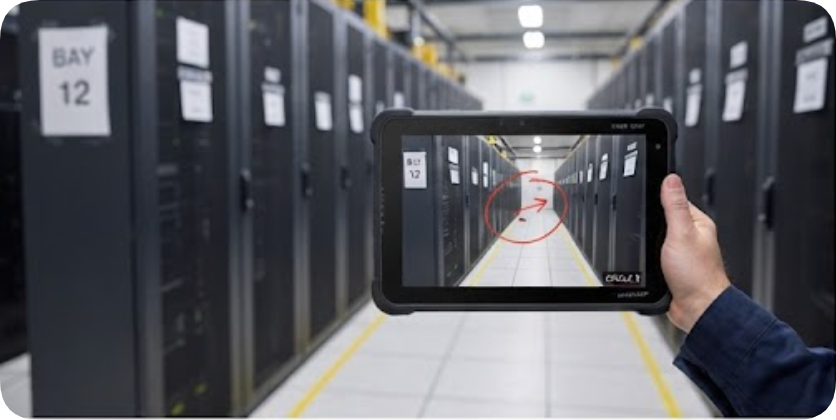
The RT80 leaves the pair in both directions. Its front camera is 8MP rather than 5MP, and its rear camera is 48MP with autofocus and a flash, several times the pixel count of the other two. It also lists a second rear module, an 8MP macro that focuses down to 2cm. That is the one line in this comparison that changes what a session can ask for. The same unit pays for it elsewhere: its display is rated 400 nits, the lowest of the three, against 560 nits on the HTNJ10C and 550 nits on the HTXUK10A-55.
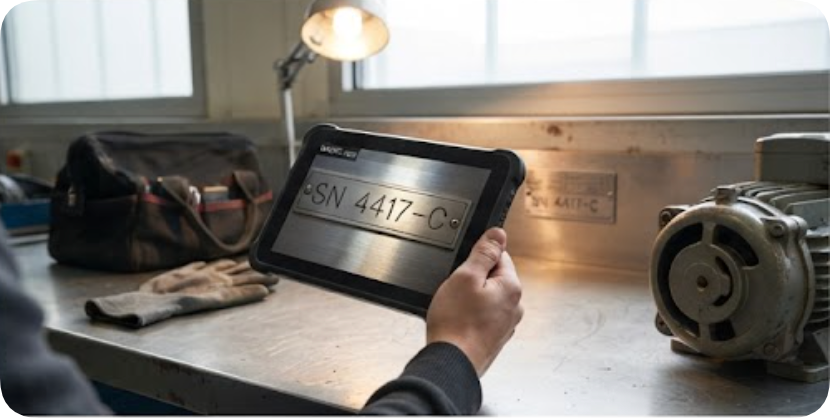
Every remote session is a fight against distance. The far end cannot walk closer, so the camera has to close the gap instead. There are two routes. One is to move the tablet until the subject fills the frame, which is what the shared 8MP module and its autofocus are for; it holds focus at short range, and the flash fills in when the room is dim. The other is to stay back and keep the pixels, which is what a 48MP sensor buys, a wide frame that still holds detail once it is cropped down to the label. The first route costs time and a steady hand. The second costs light, because the same sensor area stretched over more pixels gathers less of it per pixel. Neither route is free, and which one a site can afford tends to decide the choice before any other line on the sheet does.
There is a class of question that no amount of standing back will settle. A serial number stamped into a housing. A batch code on a small component. A hairline crack along a weld. These need the lens a couple of centimetres from the surface and held steady there. The RT80's optional macro module is the only part in this group that publishes such a distance. On the other two the nearest focus distance is not stated, so the honest reading is that the capability is not offered rather than that it fails.
None of this makes the shared module a poor choice. Most remote calls are not about hairline detail. They are about state: whether the panel is lit, whether the valve is open, which breaker has tripped, how many pallets are left in the aisle, whether the seal on a hatch is still intact. For that an 8MP rear camera with autofocus and a flash is enough, and it is enough on both units that carry it. A technician holding either of them can frame a whole machine, a whole rack or a whole doorway, which is what the far end wants for a first look. The shared camera runs out of room at exactly the point where a conversation moves from what the situation is to what the marking on a part says.
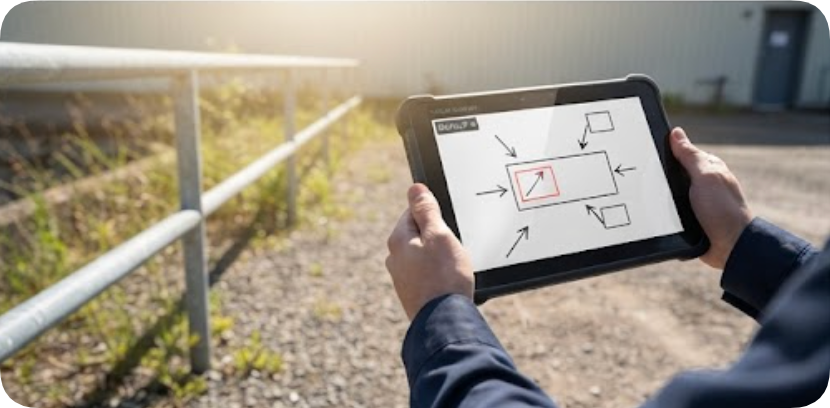
There is a second direction to the traffic that gets less attention. The far end does not only watch; it draws. Arrows, circles and short notes come back and land on the tablet screen, and somebody on site has to read them in daylight. That is where brightness stops being a spec-sheet number. The HTNJ10C is rated 560 nits, the HTXUK10A-55 is rated 550 nits with a 700-nit option, and the RT80 sits at 400 nits. The unit with the strongest camera therefore has the least margin on the return path.
Audio deserves its own line because it is the part of the chain that is published least often. Only the RT80 states its audio hardware: a pair of 2W stereo speakers and dual microphones with noise reduction. The HTNJ10C and the HTXUK10A-55 publish no speaker or microphone figures at all. That absence is not a defect, and plenty of buyers never ask. But in a session where the expert is listening for a bearing noise or the click of a relay, an unpublished audio chain is a risk taken without a number attached to it. The effect also cuts both ways. A site that cannot be heard clearly will repeat itself, and repetition is what turns a five-minute call into a twenty-minute one. The two units that publish nothing may well carry serviceable microphones; the point is that a buyer has no document to check them against, and no basis for a claim if the far end keeps asking for a repeat.
Choose by what you want the far end to be able to do. If the calls are about state, whether a thing is on or open or blocked, the two shared-camera units do the job, and the choice between them comes down to the platform behind the screen rather than the lens in front of it. If the calls regularly turn into read me that number or show me that crack, the RT80 is the only one of the three that publishes a way to answer, and the price of that answer is a dimmer panel. There is no configuration in which one unit wins every line. The pair wins on display brightness and on the number of software platforms available behind the glass. The outlier wins on pixels, on macro, on published audio and on the cellular radio. That is the whole point of setting the two groups side by side rather than ranking three tablets on a single score.
| Specification | HTNJ10C | RT80 | HTXUK10A-55 |
|---|---|---|---|
| Rear camera | 8MP, autofocus, LED flash | 48MP, autofocus, LED flash | 8MP, autofocus, LED flash |
| Front camera | 5MP | 8MP | 5MP |
| Extra optical module | None published | 8MP macro, 2cm focus | None published |
| Display | 10in, 1200x1920, 560 nits | 10.1in, 1200x1920, 400 nits | 10in, 1920x1200, 550 nits |
| Wireless uplink | Wi-Fi 6, Bluetooth 5, optional 4G | 5G SA/NSA, dual-band Wi-Fi, Bluetooth 5 | Wi-Fi 6, Bluetooth 5, optional 4G |
| Enclosure rating | IP67, 1.22m drop | IP67, 1m for 30 minutes | IP65 |
| Battery | 7.6V, 3500mAh (26.6Wh) | 3.8V, 10000mAh (38Wh) | 7.6V, 11200mAh (85Wh), detachable |
The table collects only the lines all three publish, so no cell stands in for a missing figure. Two lines are deliberately absent. Weight cannot be compared across the three, because two of them quote a gross weight with the carton while one quotes a bare figure for the unit. Operating temperature has the opposite problem: two units publish a range and one publishes nothing, so a column would be an empty box rather than a comparison. The wider range behind these units sits in our rugged tablet range.
If you are matching a device to a remote workflow, send over the calls you actually take and the conditions they happen in. We will tell you which of the three fits and which published line you should be checking first. Comparisons from earlier deployments are collected under product comparisons.