- Select Language
R530C 6.0-inch Industrial PDA | Qualcomm Octa-core...
Full SpecificationsModel Hotus SH5‑WOperating ...
The N40 Android smart PDA features a Cortex-A53 qu...
R860-S 5.5-inch Industrial PDA with Thermal Printe...
The N60 PDA is a cutting-edge device for inventory...
RS50 5G Rugged Handheld Terminal | 6.3" FHD+ ...
From the unknown so simpleUsed for mobile phones, ...
️ X8 Series Handheld Label & Thermal Printing ...
When a line stops or a field asset fails, the expensive part is rarely the first look. It is the second appointment: the expert who has to fly out anyway, the shift that idles while a photo is retaken, the part that was ordered against the wrong assumption. Remote guidance exists to absorb that risk, and Hotus builds three devices that approach it from different angles, all documented on the AR-assisted inspection application page.
The trio looks unusual on paper. The HTNJ10C Rugged Tablet carries a ten-inch panel. The HTNJ08C Rugged Tablet is the same machine cut down to eight inches, and the SH6 Rugged Handheld Tablet shrinks the idea again into a one-hand device with its own scanner option. This walkthrough prices each one by the same standard: what it contributes to finishing the call in a single visit, and what it leaves open for a return trip.
A remote guidance program saves money in exactly one place: it prevents the follow-up visit that would otherwise be inevitable. Every other benefit is downstream of that. A call that ends with "send someone tomorrow" has already cost the travel, the overtime, and the second disruption to production. So the honest way to compare hardware is to ask which failure modes each device removes from the first session. A screen too dim to read outdoors, a camera that cannot focus on a nameplate, a battery that dies mid-call — each one converts a solved problem into a scheduled revisit, and the bill grows from there.
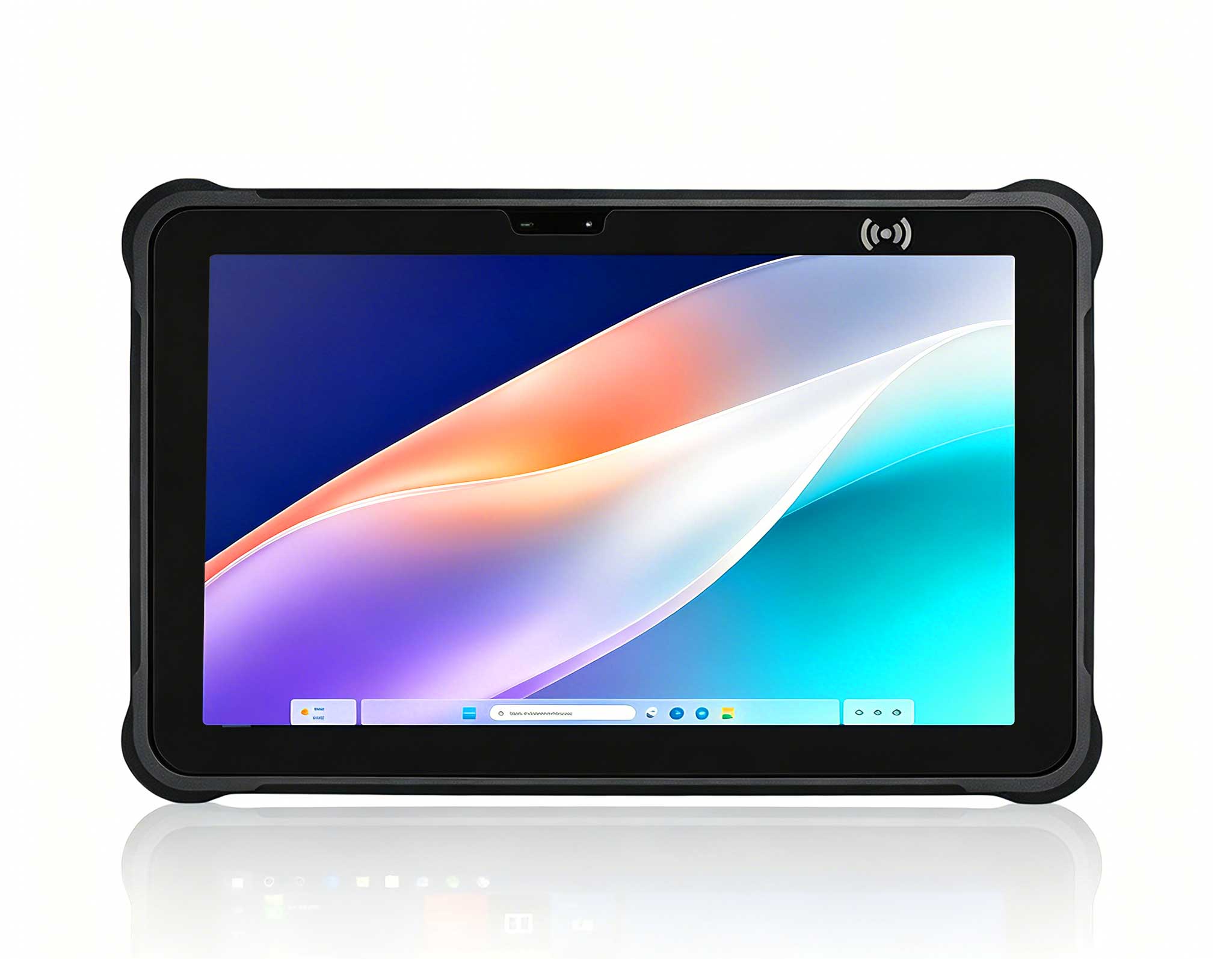
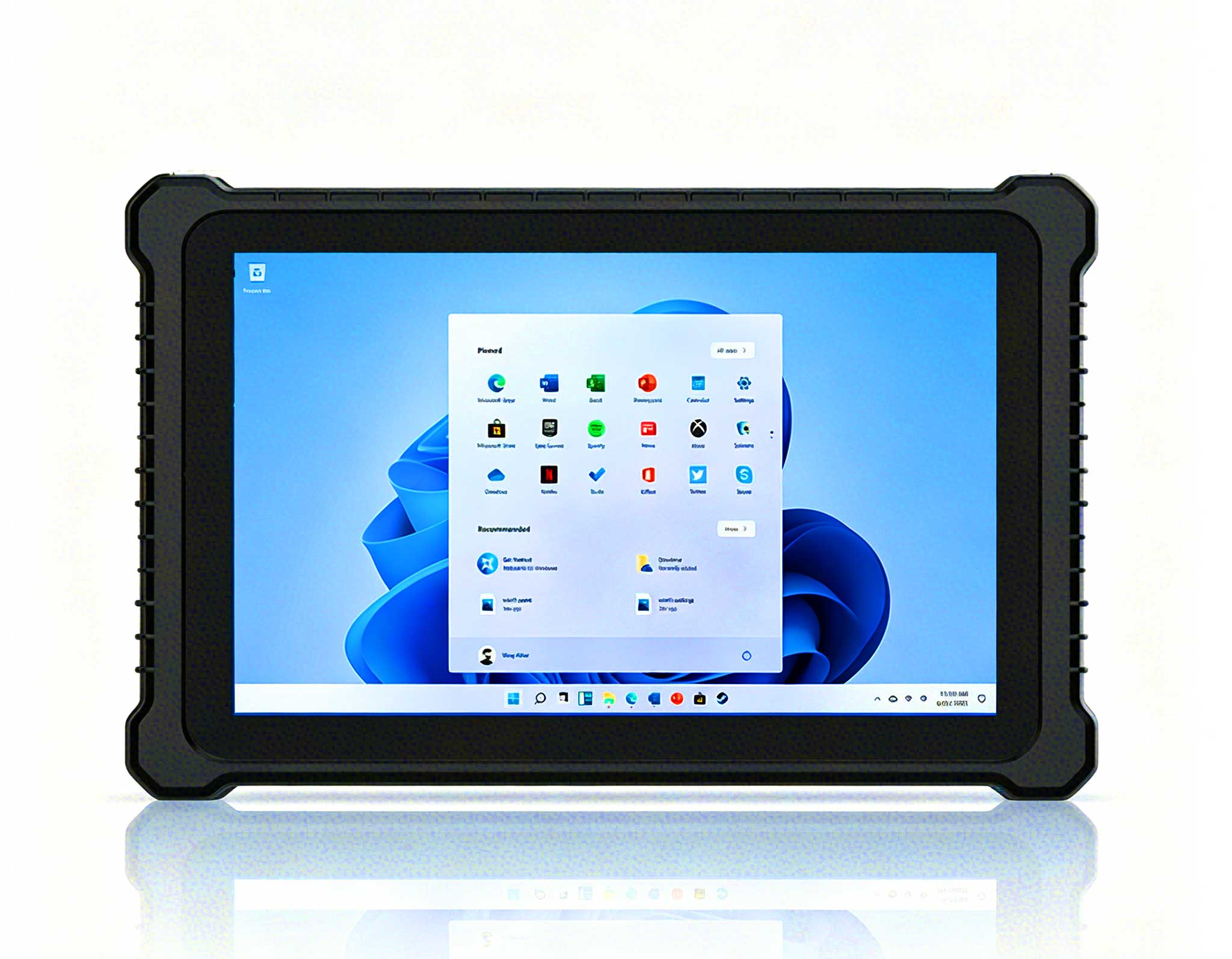
The HTNJ10C is the device you hand to the person who must see what the expert sees. Its ten-inch LCD runs at 1200×1920 with 560 nits of brightness, which keeps a marked-up video frame readable on a mezzanine or beside a loading dock rather than only in a shaded office. The 8-inch sibling shares that resolution and brightness on a smaller glass, but when the annotation is dense — torque tables, valve sequences, wiring colors — the ten-inch panel shows it without pinch-zooming, and every zoom gesture is a moment where the live video stalls. On paper the two tablets differ by two inches of screen; in a call, the difference is how many round trips of "can you scroll up" happen before the expert is confident.
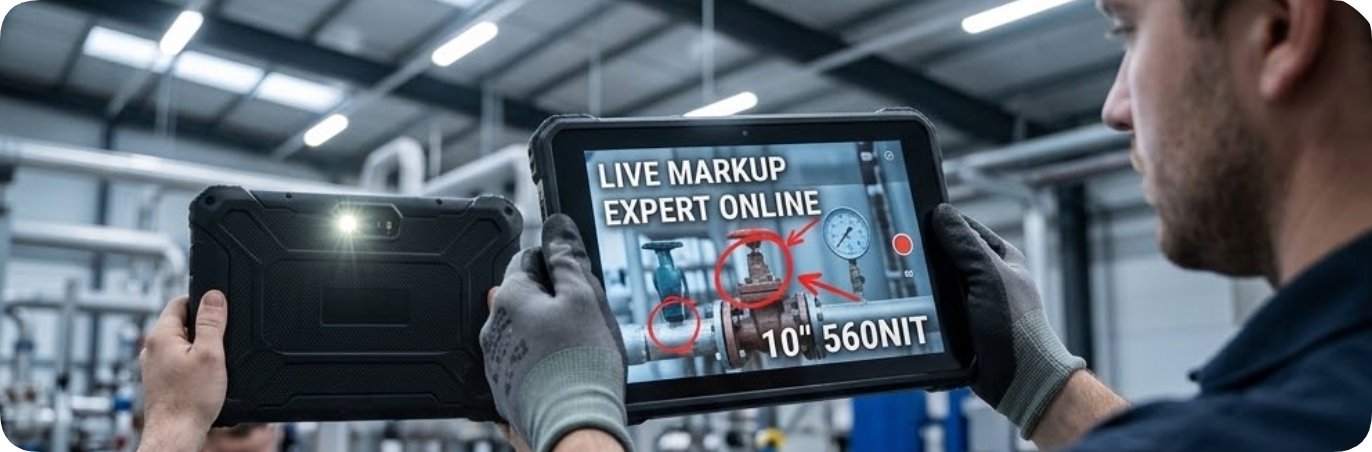
The HTNJ10C product page lists a 10-point capacitive touch layer with 7H surface hardness, WiFi 6 with Bluetooth 5, and a front 500W plus rear 800W autofocus camera with an LED assist. That camera pair matters more than any benchmark: the rear sensor reads a rating plate from arm's length, the autofocus holds it, and the LED fills the shadow inside a cabinet. The optional modules — 4G, NFC, barcode scanning, fingerprint reader, and a charging dock — let you match the fleet to the site instead of paying for every capability on every unit.
The HTNJ08C is where the fleet math starts to work. It runs the same Intel N100 processor at the same clock, the same 1200×1920 resolution at 560 nits, the same IP67 housing and 1.22-meter drop rating, and the same 7.6V 3500mAh battery as the ten-inch unit. What changes is the footprint: 23.8 by 16 by 2.5 centimeters against 28.4 by 19 by 2.5. For a team that issues tablets per crew rather than per site, the eight-inch version rides a harness without catching on railings, and it costs less to replace if a shift is careless with it. Because the platform is shared, a spares drawer does not split: one pool of chargers, one pool of batteries, one image to maintain.
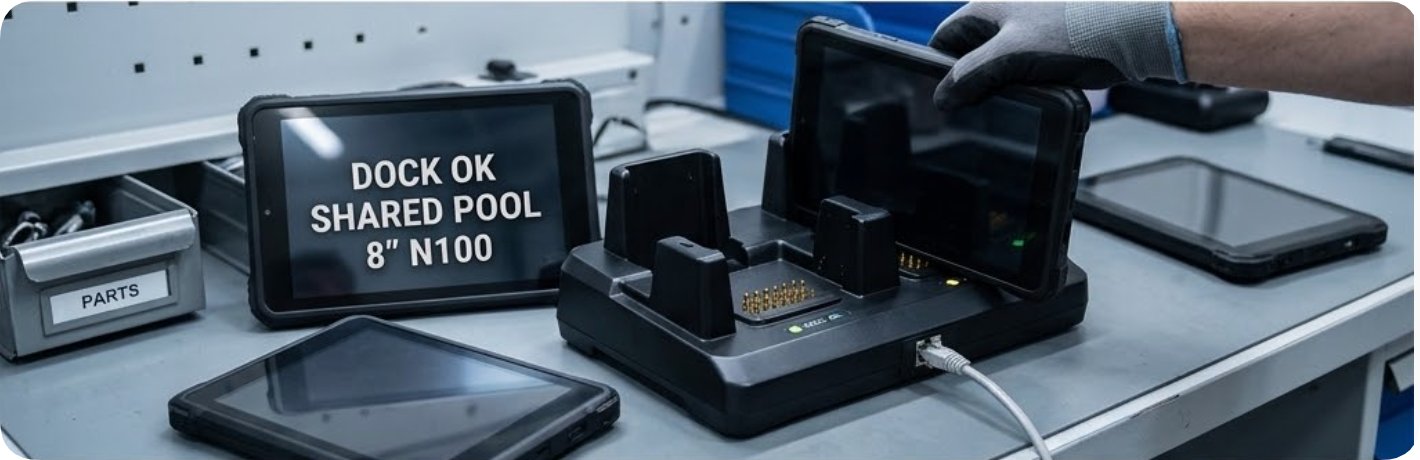
The interface row is identical across both tablets — audio, Mini HDMI, Type A, Type C, DC-in, RJ45, TF, SIM, and a 12-pin POGOPIN — which is worth real money in a guidance program. A dock at the technician's bench takes either tablet without retooling; the RJ45 port plugs into a plant network where WiFi is not welcome; and the POGOPIN keeps vehicle mounts simple. When a device spends most of its life between calls, those ports decide whether it is available when the call comes.
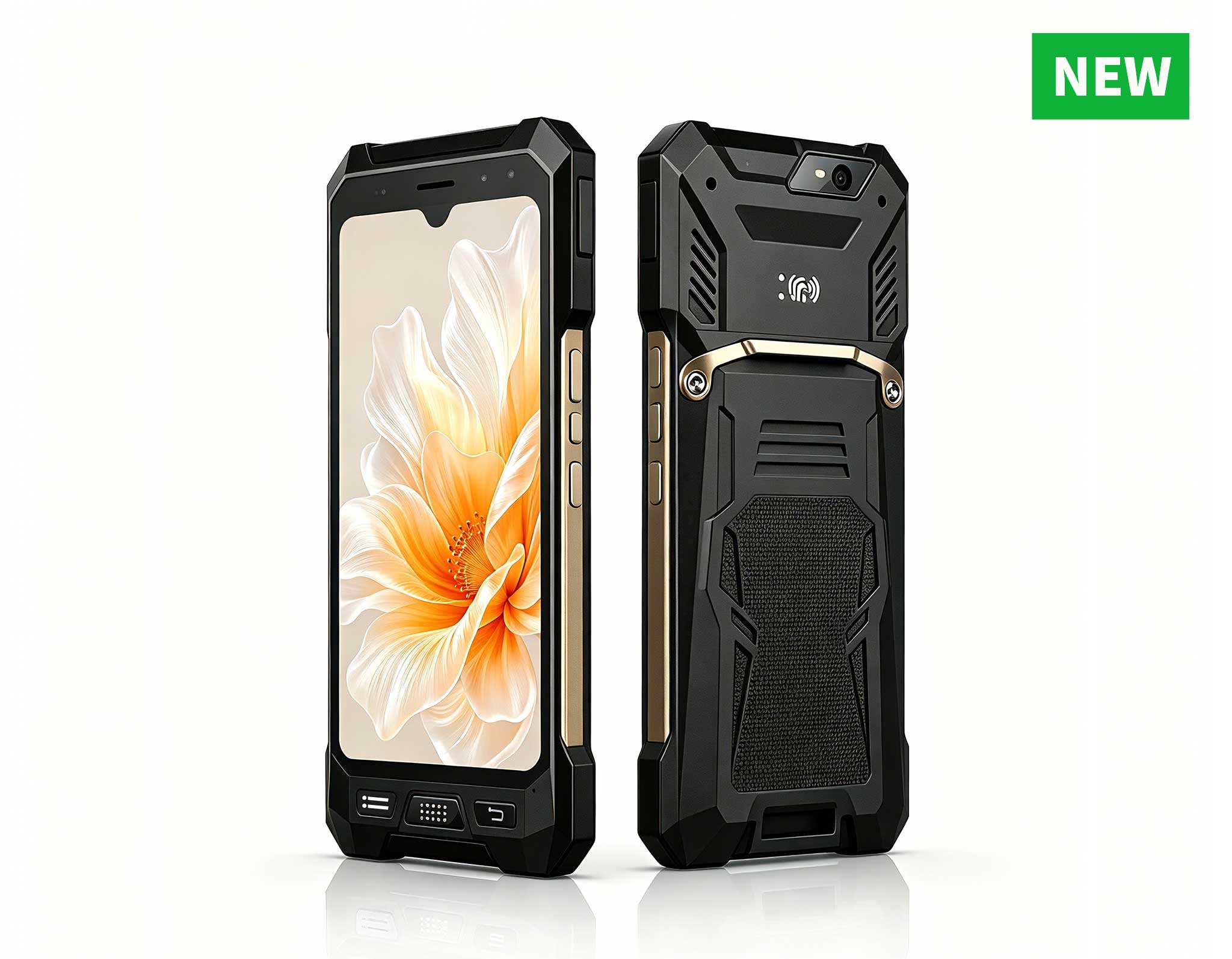
The SH6 is the unit that goes where the panels cannot. At 178.3 by 83 by 23 millimeters and 460 grams, it fits a hand, a pocket, or the gap behind a cabinet that no tablet will reach. It runs Windows 11 Pro on the same Intel N100 platform, with 8GB of RAM and 256GB of storage standard, so the same diagnostic software that runs on the bench tablets runs on it unchanged. The 6.5-inch display is smaller and dimmer at 380 nits, and that is the honest trade: the SH6 is not the screen you gather around, it is the camera you carry into the crawl space while the expert watches from the big panel back at the desk.
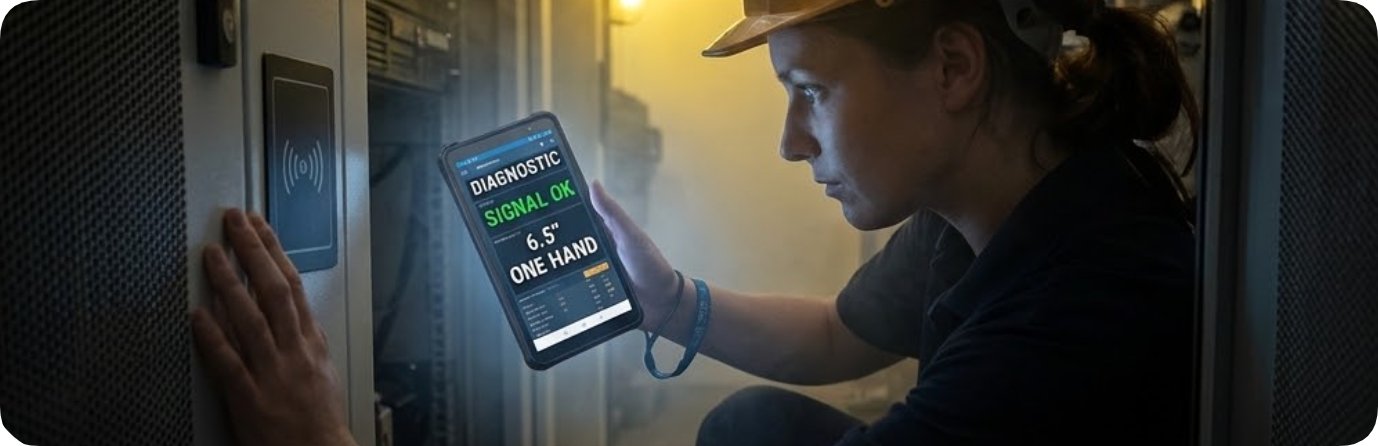
Its specification sheet reads like a field kit: a front 5MP and rear 8MP camera pair, GPS with BeiDou and GLONASS positioning, NFC at 13.56MHz, an optional 1D/2D scanner, and global 4G LTE bands on top of WiFi 6 and Bluetooth 5.2. The 5000mAh battery is rated up to 4.5 hours, which covers a diagnostic session but not a full shift, so the docking station moves from optional to planned. IP65 sealing and a 1.2-meter drop rating sit one grade below the tablets, and the operating range of minus 20 to 55 degrees Celsius covers outdoor panels and rooftop plants through most seasons.
Usually a mixed fleet pays a platform tax: different chargers, different software images, different spare pools. Here the tax runs in reverse, because all three devices sit on the same Intel N100 core. One Windows image covers the fleet, one diagnostic toolchain, one set of drivers. The table below collects the published figures; where a field appears on only some pages, it is discussed in the text rather than padded into the grid.
| Field | HTNJ10C | HTNJ08C | SH6 |
|---|---|---|---|
| Display | 10" LCD 1200×1920, 560nit | 8" LCD 1200×1920, 560nit | 6.5" HD+, 380nits |
| CPU | Intel N100, 4C/4T, 3.4GHz | Intel N100, 4C/4T, 3.4GHz | Intel N100 quad-core |
| Camera | Front 500W + rear 800W, AF, LED | Front 500W + rear 800W, AF, LED | Front 5MP + rear 8MP |
| Battery | 7.6V 3500mAh | 7.6V 3500mAh | 7.6V 5000mAh, up to 4.5h |
| Protection | IP67, 1.22m drop | IP67, 1.22m drop | IP65, 1.2m drop |
Three caveats belong next to that table. The tablet pages do not publish an operating system, memory, or storage figure, so those rows would be half empty; the SH6 page does publish Windows 11 Pro with 8GB and 256GB, and that is the configuration to assume when pricing the fleet. Weight is quoted on different bases — the tablets list a gross figure with the carton while the SH6 gives a bare 460 grams — so the column is omitted rather than compared. And the tablets' pages state no battery runtime, only capacity, while the SH6 states up to 4.5 hours.
Runtime is a scheduling cost. A 3500mAh tablet that lasts an unquantified stretch forces crews to top up between calls; the SH6's stated 4.5 hours forces something stricter, a charge before the afternoon round. The practical pattern is a dock at the dispatcher's desk — the tablets list a charging dock as an option, the SH6 pairs with a docking station — and a rule that no unit leaves for a call below half. Battery anxiety during a live guidance session shows up as rushed photos and missed annotations, which is just the revisit bill arriving early.
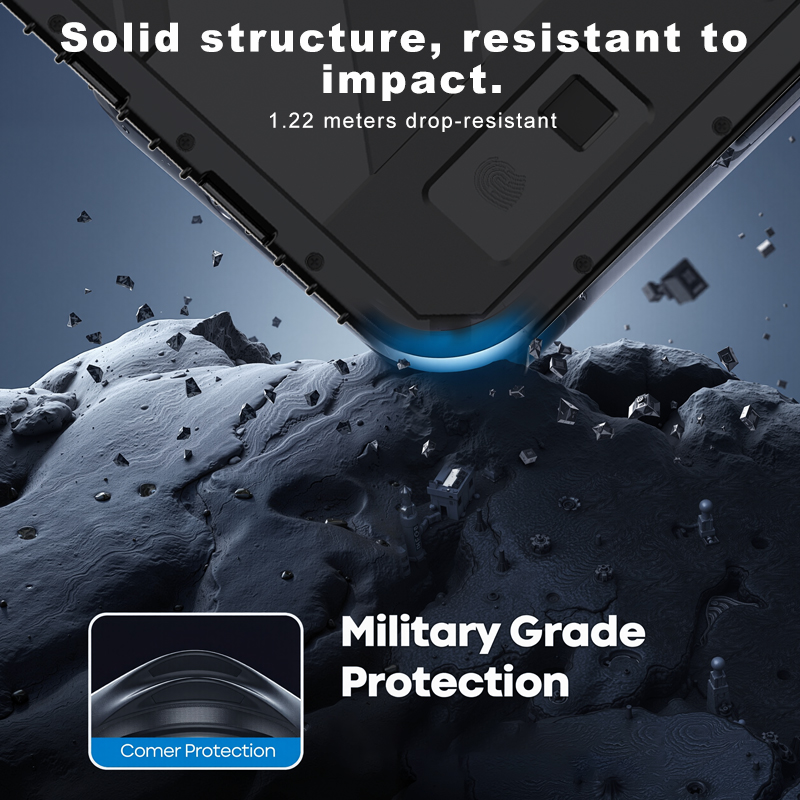
The two tablets carry IP67 and a 1.22-meter drop rating; the SH6 carries IP65 and 1.2 meters. One grade of ingress protection is the difference between hosing a unit down after a dusty panel inspection and wiping it carefully, and over a hundred-unit fleet that difference becomes a repair line item. The SH6 answers with its operating envelope, minus 20 to 55 degrees Celsius, which keeps it working through a winter round where an unrated device would be indoors. Match the grade to where the call actually happens rather than buying the top number everywhere.
Price the fleet backward from the session, not forward from the catalog. If most calls end at a fixed asset with dense annotations, the HTNJ10C pays for itself in avoided revisits; if crews walk long routes and issue tablets per person, the multi-function PDA fleet cost guide shows how a mixed HTNJ08C and SH6 pool amortizes. Hotus keeps the full product range and configuration options on one site, and the SH6's OEM page notes that scanner modules, positioning, and pre-installed images can be set before shipment. Hardware cannot make an unclear expert speak clearly, but each of these three removes one specific way for a first visit to fail — and the visit that never repeats is the cheapest one on the sheet.