A livestock farm runs on two kinds of paperwork. The first is the ear-tag census everyone knows about: once a breeding season approaches, the whole herd gets counted, weighed, and reconciled in one concentrated push. The second kind is quieter and far easier to neglect — the standing archive that says which cow had mastitis in March, which gilt was moved to pen 4 after farrowing, and which ram is due for its booster. A census can be scheduled and staffed; the archive can only be kept if someone records things while walking past the animal. That is why this article looks at archive-keeping as a staffing question rather than a hardware question: three devices, three routine jobs, three people who were already there.
The division that works on real farms maps each device onto a shift task that exists anyway. The barcode and RFID industrial PDA lineup covers the ground well: one unit with a built-in label printer for the treatment crew, one rugged 5G handset for the morning pen walk, and one slim inventory terminal for the feed and medicine store. None of the three was bought for record-keeping; each just happens to be in the right pocket at the moment a record needs to exist.
💡 Why the Herd Book Falls Behind When Pen Work Comes First
Ask a stockman why the herd book is three weeks stale and the answer is never that he refuses to write it down. It is that writing it down competes with loosing the bulls at 06:30, splitting the grazing cell at 07:15, and calling the hoof trimmer before the vet arrives. Paper records demand a trip to the office; a shared spreadsheet demands someone charge the office laptop. Both lose to the next pen that needs opening. The result is a specific and predictable gap: the events that happened far from the desk — a limp noticed mid-morning, a sow that farrowed early, a heifer that refused the water trough — are exactly the ones that never make it into the archive, and they are also the ones a buyer's inspector asks about first.
The fix is not more discipline; it is shorter distance. If the record can be created at the fence rail, in the aisle, or at the feed bin, within seconds of the observation, it stops competing with the pen work at all. That principle decides which device goes with which job, and the rest of this article walks through the three posts in the order the day meets them.
The Morning Pen Walk, One Scanner per Aisle
The first pass of the day belongs to the stockman doing the health walk: water lines checked, fresh feed pushed up, and every animal that looks off noted before the sun is high. The handset pocketed for this round is the RS50 Handheld Terminal, a 6.3-inch 5G unit rated IP67 with 1.2 m drop resistance — the two numbers that matter most when the alternative surface is a slatted floor and the alternate route is through a wash bay. Its 1080 × 2340 screen stays readable in the low light of a closed barn, and the published dual scan keys let the walker pull up an animal's tag without fumbling through menus while the rest of the pen is pushing past.
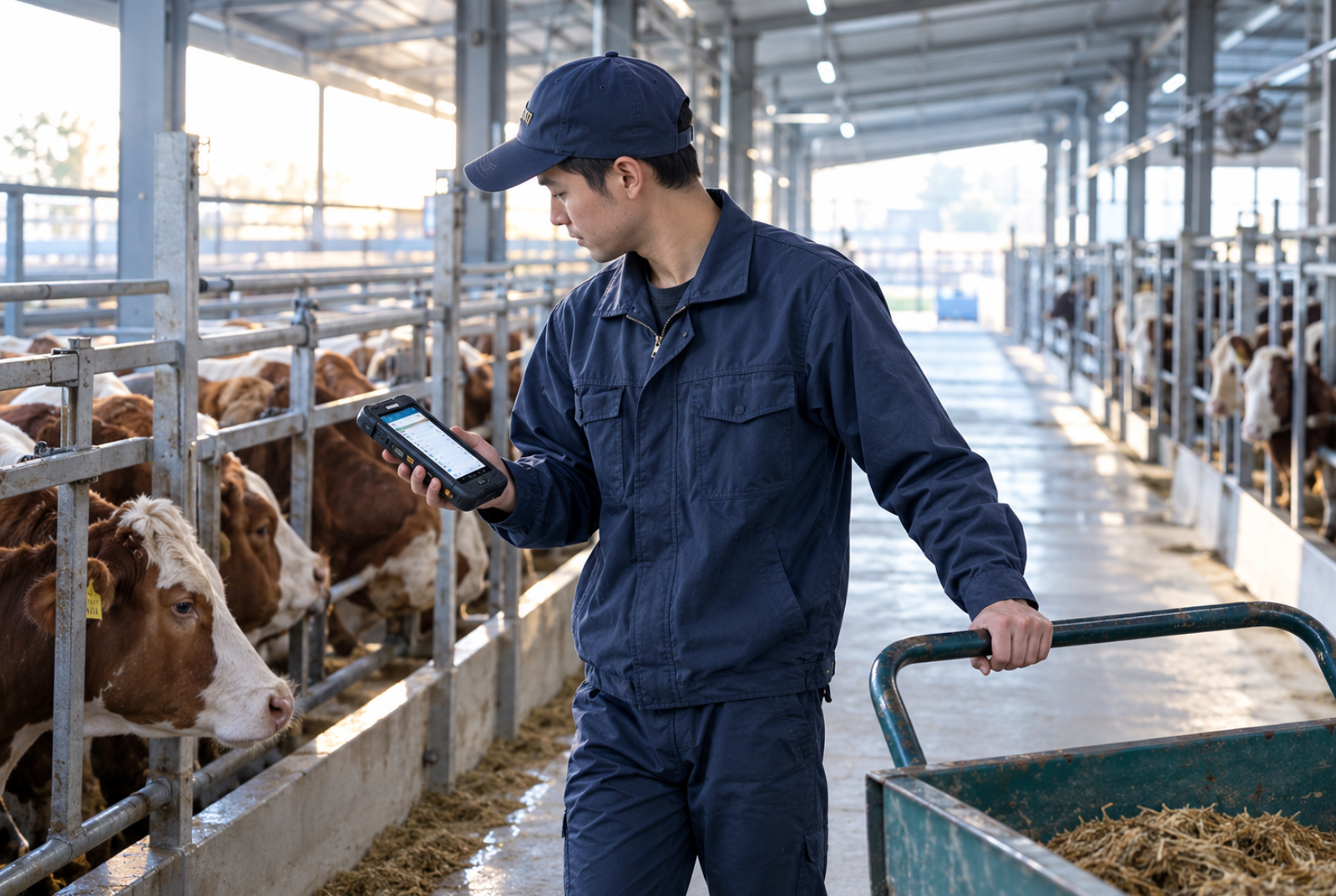
Two published details earn the RS50 its post on the walk rather than at a desk. The independent Beidou plus RTK high-precision positioning means the note a walker takes on the far paddock carries a real location with it, which is how a "movements oddly" entry from Tuesday gets tied to the actual corner of cell 3 when the vet reviews the week. And the camera story is unusual for this class: a 48 MP autofocus rear unit with LED, an optional 8 MP macro lens, and an 8 MP front camera — enough that the photo of a swollen hock is evidence rather than a blur, filed against the tag number at the moment of observation. The published spec sheet lists the removable 4800 mAh battery with Power Delivery fast charging, which is what lets one handset survive a morning walk and an afternoon treatment run on the same charge cycle. Underneath it runs the UNISOC UIS7885 octa-core at 2.7 GHz with an integrated 8T NPU, 8 GB of RAM and 128 GB of storage, expandable to 512 GB on microSD — headroom that matters less for the walk itself and more for the accumulated season of tag photos and notes the farm keeps on device.
Treatment Notes Written Where the Animal Stands
The second post of the day belongs to the treatment crew, and it is where most archives actually die. A withdrawal period, a re-treatment date, and a tag number that does not match the crate the animal was pinned in — any one of these, written on a glove or remembered wrong, quietly corrupts the record the farm will have to defend later. The device handed to this crew is the R860-S Handheld Thermal Label Printer & UHF RFID Smart Terminal, and its defining feature is printed directly into the name: a built-in 57 mm thermal and self-adhesive label printer running at 70 mm/s, with black-mark, out-of-paper, and overheat protection. When the vet treats an animal, the machine does two things in the same minute: it reads the herd number from the tag, and it prints a fresh treatment label that goes straight onto the crate card or the treatment board.
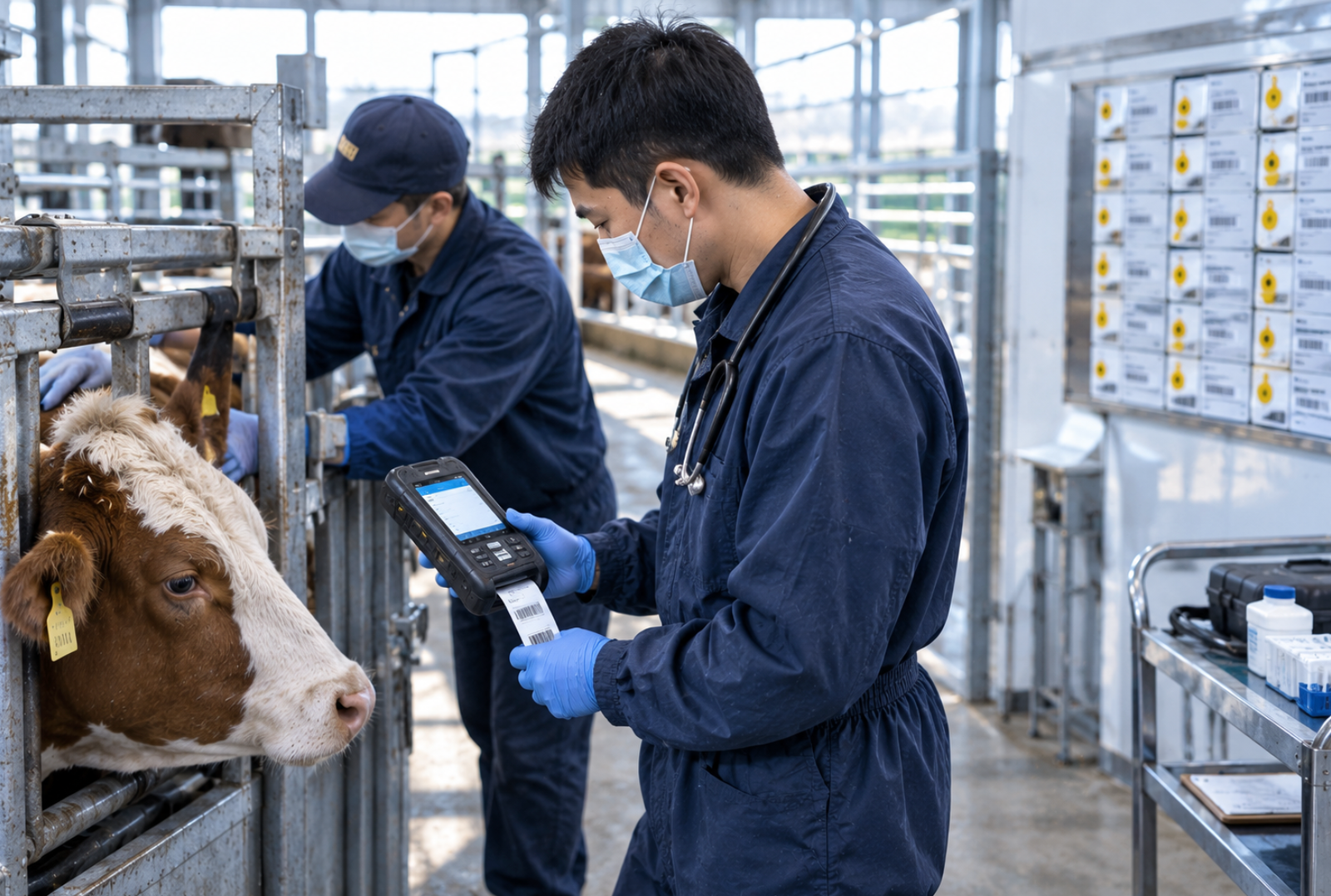
The archive value comes from the combination. The embedded UHF RFID side — a 40 × 40 mm ceramic antenna speaking the EPC Class1 Gen2 (ISO 18000-6C) protocol at up to 2 m — lets the crew sweep a pen of ear tags without handling every animal, so the "who is actually in this pen" question that breaks so many treatment logs gets answered on the spot. The Qualcomm SM6115 octa-core at 2.0 GHz, Android 16, and 4 GB + 64 GB of storage keep the herd-management app responsive through a full round, and the 5600 mAh removable battery — published standby above 350 hours with 3–4 hour charging and PD fast charge — means a spare battery in the truck covers a double shift. The published spec also carries 4 PSAM slots, dual nano-SIM, and 20 MP autofocus rear camera with LED flashlight, and the honest gaps stay honest: this is the unit farms pick when the record has to leave the device as a printed label, not when the priority is a big screen.
🛒 Feed Store and Medicine Cabinet Counts With Wet Hands
The third post is indoors but not dry: the feed store, the medicine cabinet, and the supplement shelf that the morning crew passes twice a day. Inventory drift here is an archive problem in disguise — the medicine count that does not match the treatment log is the first thing a compliance check flags, and the feed batch that cannot be traced back to a delivery note breaks the chain the farm promises its buyers. The terminal that lives on the store shelf is the N60 Inventory Management PDA, and its published touchscreen spec is the reason it stays there: a 5.99-inch 1080 × 2160 IPS panel with multi-touch that supports gloves and wet hands, which is precisely the state of the hands that do the counting at 07:00.
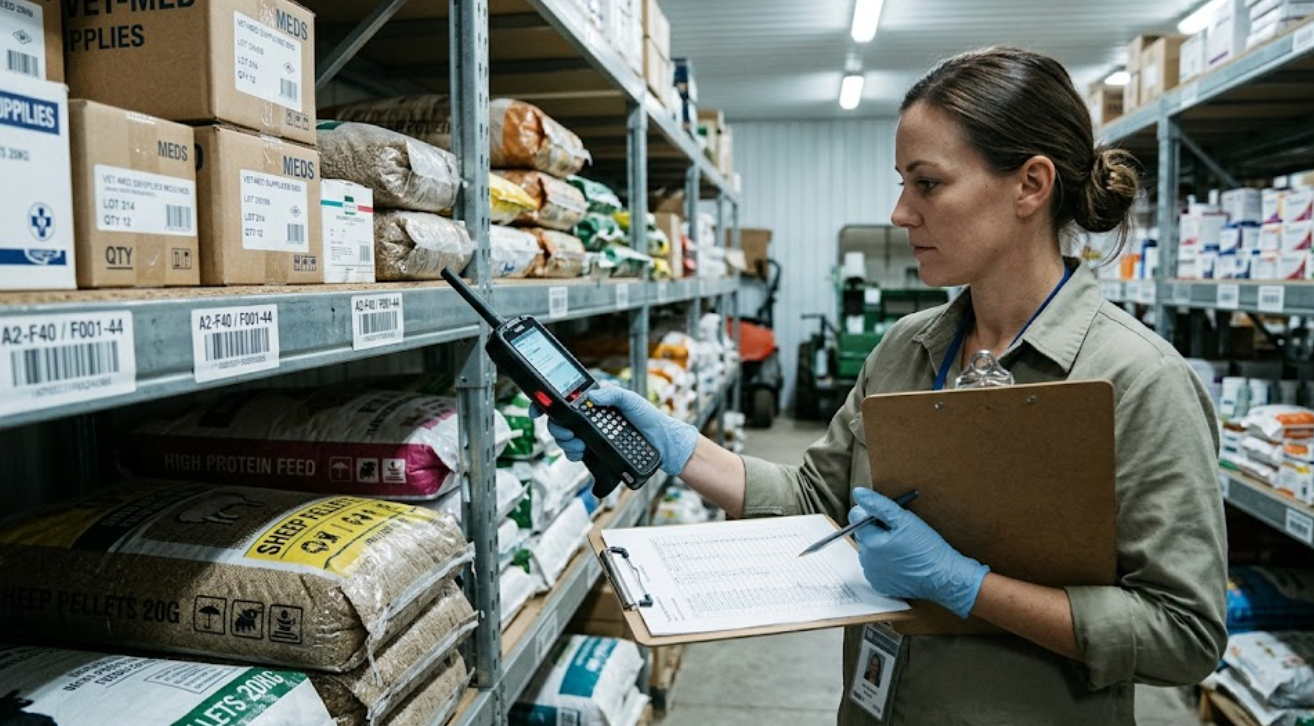
The rest of the published sheet fits the post: a Cortex-A76/A53 octa-core 2.0 GHz platform on Android 10.0, 4 GB + 64 GB expandable to 6 GB + 128 GB, dual-band WLAN across 802.11 a/b/g/n/ac, WWAN from 2G through 5G, and positioning across GPS, Galileo, GLONASS, and Beidou for the feed bins that sit outside the connected shed. Fingerprint unlocking and photo capture are listed as supported, so the cabinet count can be signed to a person. Where the sheet is silent, this article stays silent too: battery capacity, ingress protection rating, and scan-engine options are not published for the N60, and a farm that needs those numbers confirmed should ask before committing the unit to a wash-down area.
🪧 What Each Terminal Carries Into the Barn
Side by side, the three published spec sheets make the division of labor obvious. The table pulls only the rows where all three units publish comparable figures:
| Row | R860-S | RS50 | N60 |
|---|---|---|---|
| Processor | Qualcomm SM6115 octa-core, 2.0 GHz | UNISOC UIS7885 octa-core, 2.7 GHz + 8T NPU | Cortex-A76/A53 octa-core, 2.0 GHz |
| Operating system | Android 16 | Android 13.0 / HarmonyOS 6.1 | Android 10.0 |
| Memory & storage | 4GB + 64GB, microSD to 256GB | 8GB + 128GB, microSD to 512GB | 4GB + 64GB, expandable to 6GB + 128GB |
| Display | 5.5-inch IPS, 720 × 1440 | 6.3-inch IPS, 1080 × 2340 | 5.99-inch IPS, 1080 × 2160, glove & wet-hand touch |
| Network & positioning | 4G LTE, dual-band Wi-Fi, BT 5.0, GPS / GLONASS / Beidou | 5G SA/NSA, dual-band Wi-Fi, BT 5.0, GNSS, independent Beidou + RTK | Dual-band WLAN, 2G–5G WWAN, GPS / Galileo / GLONASS / Beidou |
| Dimensions & weight | 177 × 80(73) × 45(23.8) mm, under 500 g | 172 × 76.6 × 16.5 mm, under 500 g | 164.5 × 79.4 × 12.3 mm |
Rows that only some units publish — thermal printing, UHF RFID, ingress protection, battery capacity, and camera resolution — are covered in the sections above rather than forced into the table, because a blank cell in a spec table invites exactly the guessing this article tries to avoid. The full hardware families behind these three posts sit under the Hotus product line, which is where a farm sizing a mixed fleet usually starts.
Who Signs Off Each Entry at Day's End
Dividing devices only works if the archive also divides ownership. On the farm in this setup, the morning walker owns the health observations: anything noticed on the pen walk is his entry, timestamped by the RS50, and nobody re-types it later. The treatment crew owns everything with a withdrawal period: the R860-S prints the label, the label number matches the log entry, and the vet signs the day's batch before leaving. The store keeper owns the counts: the N60's end-of-day total has to reconcile with the treatment log's consumption, and the reconciliation is the check that catches the syringe that was used but not logged. The evening ritual is deliberately short — three people, three summaries, five minutes — because the archive only survives a busy season when closing the books costs less than skipping them.
The payoff arrives at the moments that used to be painful: the buyer's audit, the medication residue declaration, the cull decision that needs two seasons of treatment history. None of those require anyone to reconstruct anything, because nothing was ever left to be reconstructed.
Training a New Farmhand on Three Devices in One Week
Turnover is the real test of any archive system, and farms hire in spring exactly when they can least afford a slow ramp-up. The three-device division actually helps here: each new hire learns one device against one job, in the place where the job happens, rather than one abstract system against everything. A walker can run the RS50 competently in two mornings — scan, note, photograph — before the treatment crew ever borrows the handset. The R860-S takes longer because printing and RFID sweeping add steps, but the crew using it is small and the labels themselves provide the training feedback loop: a mis-printed crate card is visible immediately. The N60 is the simplest of the three, and the wet-hand touchscreen means the store keeper never has to choose between gloves and data entry. Farms that want to see how these handhelds compare against competing rugged devices before committing a fleet budget will find the side-by-side numbers in product comparisons and competitor analysis more useful than any single spec sheet.
Frequently Asked Questions
1. Can the RS50 cover the treatment run as well as the pen walk?
For the scanning and photo side, yes — the published 48 MP autofocus rear camera with LED and the independent Beidou + RTK positioning work the same way on an afternoon treatment visit. What the RS50 does not carry is a label printer: if the farm's process requires a printed treatment label on the crate card at the moment of dosing, that step belongs to the R860-S. Crews that only need the log entry to live in the archive run one handset for both jobs.2. How far away can the R860-S read an ear tag?
The published figure for its embedded UHF RFID side is up to 2 meters, on the EPC Class1 Gen2 (ISO 18000-6C) protocol through a 40 × 40 mm ceramic antenna. That covers sweeping a pen of UHF tags without handling each animal. Tag technologies outside that protocol are a different question — the spec sheet publishes what it publishes, and farms running other tag standards should confirm compatibility before assuming a fit.3. What is the N60's battery life across a full count day?
The manufacturer's published specification for the N60 does not list a battery capacity or runtime figure, so this article will not invent one. What is published is the platform — a Cortex-A76/A53 octa-core 2.0 GHz unit on Android 10.0 with a glove-and-wet-hand 5.99-inch touch screen — and farms that need a hard runtime number should request it from the seller for the specific firmware and battery configuration they would receive.4. Do all three terminals support wet or gloved hands on the touchscreen?
Only the N60 publishes that capability explicitly — its 5.99-inch IPS multi-touch panel is specified to support gloves and wet hands, which is why it holds the feed store post. The R860-S and RS50 spec sheets do not state glove support either way, so a farm that plans to operate those two in the rain or with nitrile gloves on should verify the touch behavior on a demo unit rather than count on it.One season in, the measure of success is boring: the herd book has no three-week gaps, the medicine cabinet reconciles, and the only person who thinks about the archive at all is the one auditing it. That is what kept records look like when they are kept between feeding rounds instead of after them.