A bonded warehouse lives and dies by its ledger. Every pallet that crosses the gate gets logged into the customs account book, every move between shelving bays updates the balance, and nothing leaves the zone until the release sheet matches what the book says is inside. The paperwork is not an afterthought here — the goods themselves are legally spoken for the moment they enter, so the crew spends more of its day typing and scanning than lifting. One mixed-up carton number can freeze a whole bay during a customs audit, which is why the devices doing the logging matter as much as the forklifts doing the moving.
Hotus covers this floor with three tablets that look similar on a spec sheet and behave completely differently once the work starts. The HTYJ08A and HTNJ10B are Windows machines built to run desktop filing software, while the RT80 is an Android 5G unit built for the open yard. This article walks through where each one earns its slot in a bonded operation, using the actual published specifications rather than a generic tablet checklist.
One Customs Workflow, Two Sides of the Fence
Picture a full inbound cycle. A container arrives at the gate, the driver hands over documents, and a clerk confirms each item against the manifest before the seal is broken. Inside, goods go onto racking, get cycle-counted weekly, and wait for an order that triggers a declaration. The declaration itself is typed into the single window client on a desk, reviewed against the account book, and only then does a release sheet reach the gate. The first half of that cycle — intake scanning, bay counts, yard checks — happens on foot, in the open, usually one-handed. The second half happens seated, indoors, on software that only exists as a Windows desktop program. No single device is honest if it claims to do both halves well, and pretending otherwise is how warehouses end up with three identical tablets that frustrate everyone equally. A container terminal crew went through the same split when they traded paper gate checklists for scanned proof — their first month with RT82, R530C and RS51 at the gate reads almost like a preview of bonded-yard operations.
The Eight-Inch Windows Unit That Runs the Filing Desk
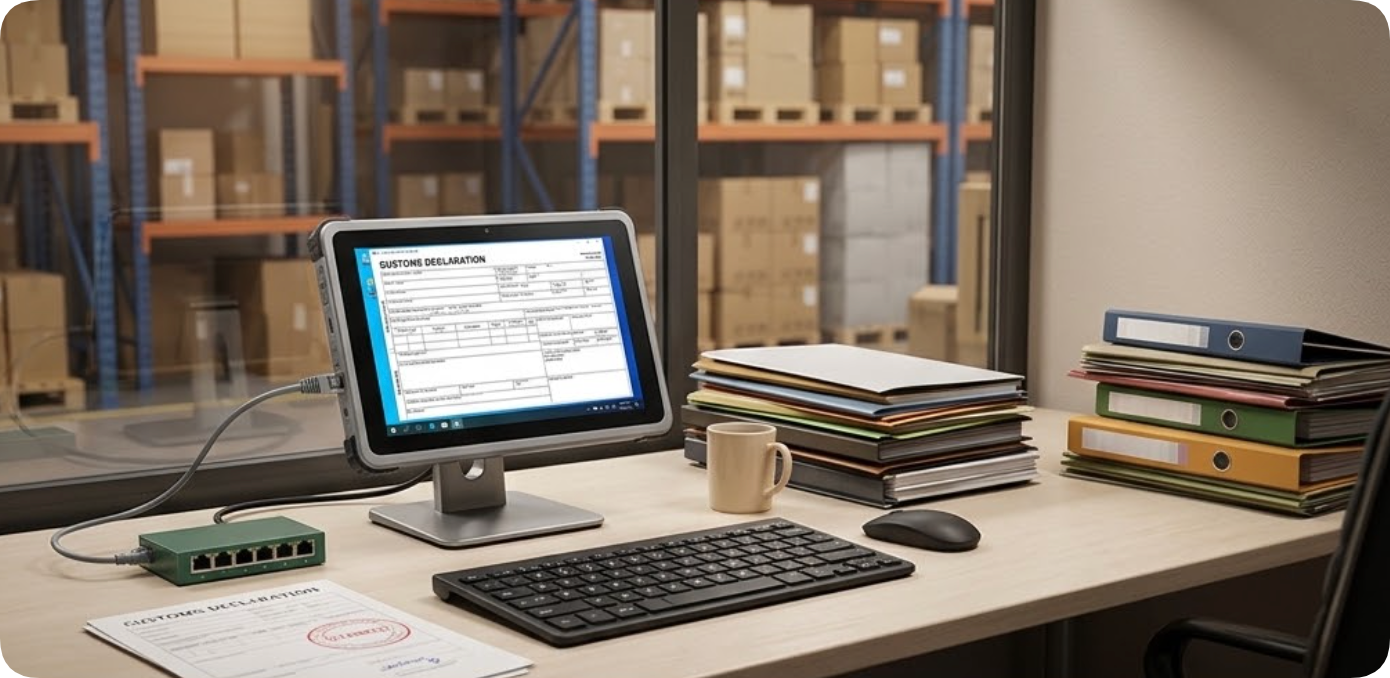
The HTYJ08A is the compact member of the Windows pair, and its case rests on the processor more than anything else. It runs 10th Generation Intel Core i5-10210Y or i7-10510Y quad-core silicon under Windows 10 or 11 Pro, which is desktop-class territory — the kind of headroom that keeps a customs filing client, a browser with the tariff schedule, and a spreadsheet open at the same time without choking. The HTYJ08A Rugged Tablet pairs that with an 8-inch 1200 x 1920 IPS panel at 560nits, so the same unit that sits at the desk can follow a checker out to a sunlit loading bay without the screen washing out. Connectivity is where it quietly wins its desk job: a built-in RJ45 Ethernet port plugs straight into the warehouse intranet that the filing system expects, alongside Mini HDMI, USB Type-A and Type-C, and a 12Pin Pogo-Pin for the docking station. The 7.6V 3500mAh battery is removable, protection is rated IP67 with MIL-STD-810G drop certification at 1.22m, and the operating window spans -20°C to 55°C. Optional modules cover a 1D/2D barcode scanner, UHF RFID, fingerprint reader and NFC, which lets the intake clerk consolidate two devices into one.
🖥️ The Ten-Inch Screen That Reads Long Declaration Tables
The HTNJ10B takes the same Windows-side job and stretches it vertically. Its 10.1-inch panel keeps the same 1200 x 1920 resolution and 560nits brightness, but the extra screen height changes what a clerk can do with a declaration form: tariff lines, origin codes and container manifests stay on screen long enough to cross-check without scrolling away the row being verified. Underneath runs the Intel Pentium N6000 quad-core processor bursting to 3.3GHz — a step down from the i5/i7 flagship in raw power, and honest about it, but comfortably sufficient for the filing client and the account book database. The HTNJ10B Rugged Tablet carries the full-size port set too: RJ45 Ethernet, Mini HDMI for pushing the declaration onto a second monitor where a supervisor can read along, USB Type-A and Type-C, plus optional scanner, UHF RFID, fingerprint and TPM2.0 security modules. It shares the 7.6V 3500mAh removable battery, IP67 sealing, MIL-STD-810G 1.22m drop rating and the -20°C to 55°C operating range with its smaller sibling, in a body measuring 28.4cm x 19cm x 2.5cm. Wet-hand and stylus operation on the 7H-hardness touch layer survive the rainy dock door.

The Android Unit That Patrols Outside the Fence Line
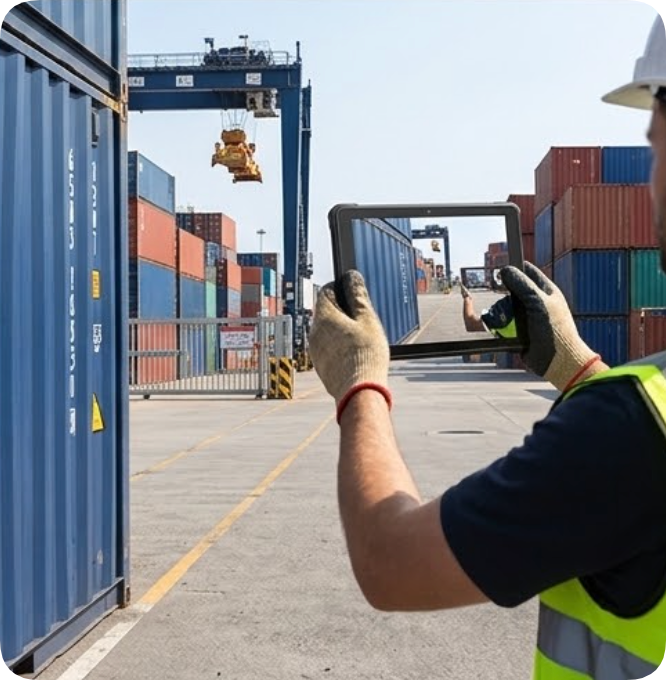
The RT80 answers a different question entirely. It runs Android 13.0 or HarmonyOS 6.1 on a UNISOC UIS7885 octa-core processor clocked at 2.7GHz with a built-in 8T NPU, and it is the only one of the three with 5G SA/NSA dual-mode cellular. That combination is aimed squarely at the moving half of the warehouse: the yard, the gate apron, the transit sheds where Wi-Fi dies and paperwork slows to a walk. The RT80 Rugged Tablet carries a 3.8V 10000mAh battery with Power Delivery fast charging, dual Nano-SIM slots, and independent Beidou positioning with an optional RTK module for centimetre-grade location fixes on outdoor stock. Its 48MP rear autofocus camera is the detail-work tool — photographing a damaged seal, a mismatched carton label or a container number at arm's length produces evidence sharp enough to attach to a discrepancy report. The 10.1-inch IPS display runs at 400nits, dimmer than the Windows pair but adequate under shed roofing, and IP67 sealing plus a sub-650g body keep it comfortable across a full walking shift. An optional 2D barcode engine reads labels down to 3mil precision, which matters when carton labels arrive worn.
The Numbers Behind the Split
| Item | HTYJ08A | HTNJ10B | RT80 |
|---|---|---|---|
| OS | Windows 10/11 Pro | Windows 10/11 Pro | Android 13 / HarmonyOS 6.1 |
| Processor | Intel i5-10210Y / i7-10510Y | Intel Pentium N6000 | UNISOC UIS7885 + 8T NPU |
| Display | 8in 1200 x 1920, 560nits | 10.1in 1200 x 1920, 560nits | 10.1in 1200 x 1920, 400nits |
| Battery | 7.6V 3500mAh removable | 7.6V 3500mAh removable | 3.8V 10000mAh, PD charging |
| Protection | IP67, MIL-STD-810G | IP67, MIL-STD-810G | IP67 |
| Cellular | 4G LTE | 4G LTE | 5G SA/NSA dual mode |
| Wireless | Wi-Fi 6, Bluetooth 5.0 | Wi-Fi 5, Bluetooth 4.2 | Dual-band Wi-Fi, Bluetooth 5.0 |
| Desk-critical ports | RJ45, Mini HDMI, USB-A/C | RJ45, Mini HDMI, USB-A/C | Type-C with OTG and PD |
Two Batteries, Two Working Days
The battery column hides the sharpest operational difference. The two Windows units carry 7.6V 3500mAh packs that are removable, and in a filing-desk context removable means the clerk never closes the account book: a charged pack slides in during a handover and the declaration session stays open, which matters because the filing client dislikes being interrupted mid-entry. The RT80 flips the logic. Its 10000mAh pack is fixed, and it is sized for the opposite workflow — a yard checker leaves the charging dock at shift start and returns after a full walking circuit, with Power Delivery topping the pack back up over a lunch break instead of a swap. The published figures use different voltage bases, so the honest comparison is behavioural: swap-sustained desk shifts versus charge-once field shifts, and a bonded operation usually needs both behaviours on the same day.
Brightness and Ports Where They Actually Matter
Brightness requirements split along the same fence as everything else. Both Windows panels run at 560nits, which sounds excessive for an indoor desk until the declaration desk sits within sight of the dock door and afternoon sun reaches the screen; at that position the extra headroom keeps tariff lines legible without pulling the blinds. The RT80's 400nits is the compromise that buys its other advantages, and it works because yard work happens under canopies, inside containers, or against the sky at arm's length — all places where 400nits holds up. Ports follow the same logic. A built-in RJ45 port is not a nostalgia feature: bonded warehouses keep their filing systems on an intranet, and a wired connection removes the wireless variable from a compliance-sensitive workflow entirely. The RT80 abandons wired networking on purpose and leans on dual SIMs instead, so if one carrier's coverage drops in a corner of the yard, the second SIM keeps the tracking session alive.
Matching the Split to Your Own Site
A practical starting rule: count how many of your daily tasks must run desktop filing software, and how many happen more than thirty metres from an access point. Sites where the declaration desk dominates — high declaration volumes, supervisor co-review on a second screen, intranet-only systems — should weight the fleet toward the Windows pair, choosing the rugged tablet series page to compare both configurations side by side. Sites with heavy outdoor counting, photo evidence requirements or patchy yard coverage tilt toward the RT80. Most bonded operations we see settle on a mixed fleet rather than a winner, because the fence line between desk work and yard work rarely moves even when the software stack gets updated. Hotus builds all three in the same product family, so spares, chargers and service channels stay shared across the split. Recent product comparisons and competitor analysis cover how these units fare against non-domestic rivals as well.
Frequently Asked Questions
1. Can the two Windows tablets run the customs filing client directly?
Yes, and that is the core reason they exist in this comparison. Both ship with Windows 10 or 11 Pro, desktop-class Intel processors, and a built-in RJ45 Ethernet port, so the filing client installs and connects the same way it would on an office PC. The RT80 runs Android or HarmonyOS, so desktop-only filing software is out of its scope unless your bureau offers a web or mobile client.2. Which unit survives a full outdoor shift without a battery swap?
The RT80, by a wide margin. Its 10000mAh pack with Power Delivery charging is built around a walking shift in the yard, while the Windows pair's 3500mAh packs assume a desk within reach of a charger. The trade runs the other way at the desk: the removable packs swap in seconds without closing a filing session.3. Do all three tablets read worn or damaged barcode labels?
Scanning is an optional module on all three, so spec it at order time rather than assuming it. The RT80's optional 2D engine reads down to 3mil precision, which handles abraded carton labels; the Windows units offer an optional 1D/2D scanner alongside UHF RFID, which is the better fit when pallet-level tracking rather than item-level reading drives the workflow.4. What drop and temperature ratings apply across the three?
The HTYJ08A and HTNJ10B are both certified to MIL-STD-810G with a quoted 1.22m drop resistance and a -20°C to 55°C operating range. The RT80's published specification lists IP67 sealing but no drop height or operating temperature figures, so verify those two points against your own handling conditions before standardising on it for heavy-use yard duty.Bonded warehouse computing fails when one device is asked to be two things. The split that the single window forces — desktop filing inside, walking verification outside — maps cleanly onto the HTYJ08A and HTNJ10B for the desk and the RT80 for the yard, and the specifications above show why the split holds. Size the fleet by counting where each hour of the day is actually spent, and the three tablets stop competing and start covering each other.