An industrial solution for Oem Odm Program lives or dies by its calendar. The customer's peak selling window is fixed, but every step that feeds it - custom firmware, laser-etched logos, preloaded suites, certified drop batches - is movable only until it suddenly is not. By the time a purchase order lands, the cheap slots to change anything are already gone. This piece walks through how we stage three rugged tablets across that calendar so the busy weeks arrive with hardware that is already signed, stocked and spare-backed.
The mistake most programs make is treating the order as the start of the clock. It is the end of a quieter one. The units that ship in week twelve were specified, sampled and validated in week zero, and the only reason that works is that someone booked the customization capacity before the demand signal was loud enough to act on.
The Customization Window Closes Before the Purchase Order Does
A custom tablet program has two clocks running at different speeds. The commercial clock starts when the buyer issues a PO; the production clock started weeks earlier with a frozen specification. We lock the spec freeze at ten to twelve weeks before the first peak shipment. That lead is not arbitrary - it is the sum of tooling confirmation, a pilot run, certification paperwork and the buffer that absorbs the first inevitable revision.
What surprises new program owners is that the firmware and boot wizard customizations close earlier than the hardware look. Shell color and silk-screen can still move inside that window; a change to the startup sequence or the scanned-barcode handshake cannot, because it forces a fresh regression pass. We write the software freeze date on the same line as the case-design freeze and never let the two drift.
The Demo Unit and the First Sign-Off
The ST11-J carries the demo and the first sign-off. It is a 10.1-inch Windows unit built around an Intel Celeron N5100 that turbos to 2.8GHz, with 8GB of memory and a 256GB drive as the standard build. The reason it leads the customer conversation is the screen: a 1200x1920 IPS panel at 420 to 450 nits, with an optional 1000-nit sunlight-readable version that holds up in a lit showroom or a loading bay.

For a sign-off sample we want the unit the buyer will actually see, not a stripped reference board. The ST11-J also brings IP65 sealing, MIL-STD-810G and a 1.2-meter drop rating, which is the part procurement checks first when the device will leave a controlled office. We ship the validation demo with the exact firmware the production units will carry, because a demo running a different build is worse than no demo at all.
The Preloaded Volume Goes to One Model
The ST11-U absorbs the preloaded volume. Under the same 10.1-inch 1200x1920 shell it runs an Intel Core i5-1235U that reaches 4.4GHz, with 8GB or 16GB of memory and an M.2 SSD, and an i7-1255U option for heavier local workloads. Where the ST11-J is the conversation piece, the ST11-U is the warehouse pallet - the model we image in bulk with the customer's suite already on the drive.

Preloading at our bench instead of the customer's is the single biggest schedule saver in the program. A hundred units that arrive with the right image, the right language pack and the right shortcut already on the desktop skip a full day of on-site IT labor. The ST11-U's 6000mAh removable battery and 65-watt Type-C fast charge keep the imaging benches turning without a charger bottleneck, which matters when the preload window overlaps a quarter-end rush.
The Field-Service Spare Pool Gets the Third
The RT81 lands in the field-service spare pool. It is the Android member of the trio - a Qualcomm SM6115 octa-core at 2.0GHz, 4GB of memory and 64GB of storage, expandable, with a 10.1-inch 1200x1920 panel at 400 nits. Its edge is the 10000mAh battery and the IP67 rating, the highest of the three, which is exactly what a service technician drops on concrete and expects to keep using.
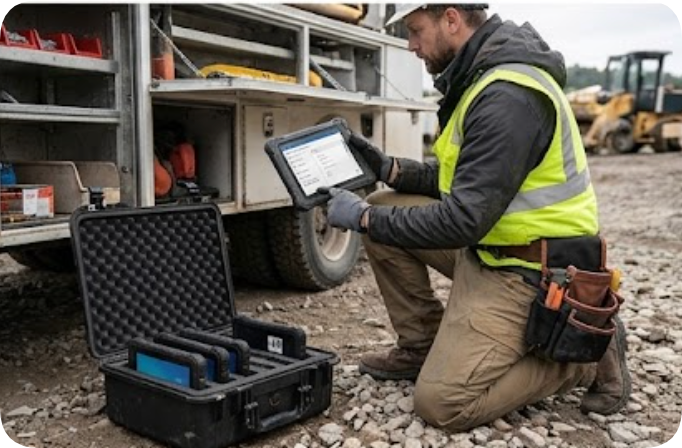
We do not preload the RT81 into the shipped order the same way. A share of the build is held back as field-service inventory, because the peak season that sells the tablets is also the peak season that breaks them. A technician with a dead unit and a two-week replacement lead is a technician who stops a line, so the RT81 buffer is planned as a standing pool, not as a line item on the original PO.
Long-Lead Parts Get Committed While the Plan Is Still a Spreadsheet
The part of the plan that blows the calendar is never the assembly - it is the components with their own long queues. Displays, battery cells and certain connectors have lead times that dwarf the tablet's own build time. We commit those orders against the forecast, not against the PO, which means someone has to put a number on paper before the order exists.
This is where a rugged mobile computing solutions partner earns the relationship. The supplier who will hold buffer stock of the 6000mAh cell and the 10000mAh cell on our behalf is the one we plan around, because the alternative is a finished tablet with no power source sitting on a dock while the Season slips. We treat component commitment as a purchasing decision, not a manufacturing one.
The Validation Batch Earns Its Keep
Between the frozen spec and full volume sits a validation batch - typically three to five percent of the first production run, built with the final custom firmware and the final label artwork. It is the only point where every customization is present at once and can be checked end to end: boot wizard, laser etch, preloaded suite, and the barcode scan the field will actually use.
Skipping this step to save a week is how a program ships ten thousand units that all need a reflash. The validation batch is small on purpose, but it is the gate. Nothing scales past it until the three checks pass, and we would rather slip the volume start by days than discover a label or scan defect in the customer's hands.
| Attribute | ST11-J | ST11-U | RT81 |
|---|---|---|---|
| Compute | Intel Celeron N5100, up to 2.8GHz | Intel Core i5-1235U, up to 4.4GHz (i7 optional) | Qualcomm SM6115 octa-core 2.0GHz |
| Operating system | Windows 10/11 Pro | Windows 11 Pro | Android 16 |
| Display | 10.1in IPS 1200x1920, 420-450 nits | 10.1in IPS 1200x1920, 450 nits | 10.1in IPS 1200x1920, 400 nits |
| Battery | 6000mAh (45.6Wh), ~8.5h | 6000mAh (45.6Wh), ~5.5h, 65W Type-C | 10000mAh, PD fast charge |
| Weight | 1150 plus or minus 50g | 1190 plus or minus 50g | under 650g |
| Build rating | IP65, MIL-STD-810G, 1.2m drop | MIL-STD-810G, 1.2m drop | IP67, MIL-STD-810G, 1.2m drop |
The ST11-U's page lists MIL-STD-810G and a 1.2-meter drop rating but does not publish an IP code, so we leave its ingress grade as not published rather than infer it from the other two. Battery runtime is shown only where the vendor quotes it; the RT81's endurance is quoted as capacity and charge method, not as a lab hour figure, so the column stays honest across all three.
A Spare-Parts Cushion Counted in Weeks, Not Units
Spare planning is where programs quietly fail. A percentage of shipment sounds tidy until a batch of RT81 batteries goes long and the service pool empties in the middle of the busy window. We size the cushion in weeks of coverage, not in units: how many weeks of expected returns and field swaps can the standing inventory absorb if the next replenishment is late.
Because the ST11 series and the RT81 use different battery packs, the pool is really two pools tracked as one calendar. The question we answer each month is not "do we have enough spares" but "can we cover the worst four weeks of the season if nothing new arrives" - and the answer is what drives the reorder, not the other way around.
Closing the Loop in the Quiet Weeks
The discipline that makes the peak smooth is spent in the quiet weeks before it. Spec freeze, pilot run, component commitment and spare-pool sizing are all back-loaded decisions pretending to be forward ones. The teams that look calm in season are the ones who booked the customization capacity while the plan was still a spreadsheet with blank cells.
For programs weighing build options across vendors, a look at product comparisons and competitor analysis helps frame what "customizable" actually costs in lead time. And for a concrete read on how mixed fleets get costed before a peak build, see Smart PDA N40, K401 and R350C as a worked example of the same staging logic on a different device class.
Frequently Asked Questions
1. How early should customization freeze before the peak season?
We lock the hardware spec ten to twelve weeks before the first peak shipment. The custom firmware and boot wizard close even earlier than the case look, because any software change forces a fresh regression pass that the silk-screen change does not.2. Which of the three carries the demo and the first customer sign-off?
The ST11-J leads that conversation. Its 10.1-inch Windows build with an optional 1000-nit sunlight-readable screen holds up in a lit showroom or a loading bay, and we send the sign-off sample with the exact production firmware so the demo is not a different device than the order.3. Should the spare pool be sized in units or in weeks?
In weeks. The RT81's 10000mAh pack and the ST11 series' 6000mAh pack are different cells, so we track two pools against one calendar and size them to cover the worst four weeks of the season if replenishment slips, rather than as a flat percentage of shipment.4. How large is the validation batch and what does it check?
Three to five percent of the first production run, built with the final custom firmware and label artwork. It is the only point where boot wizard, laser etch, preloaded suite and the field barcode scan are all present together, and nothing scales past it until those three checks pass.The peak season does not reward the program that reacts fastest; it rewards the one that booked its customization capacity before the order gave it permission to. With the ST11-J on the demo table, the ST11-U on the preload bench and the RT81 waiting in the spare pool, the busy weeks arrive as a logistics event instead of a fire drill.