On a contract manufacturing floor in Dongguan, the month used to end the same way every time: the finance team pulled the paper travelers for forty-two work orders, found that six of them were missing at least one operator signature, and spent the first week of the new month reconciling what the line had actually built. The travelers were not being lost by careless people. They were being lost by the process itself — a traveler clipped to a pallet that moved twice per shift, a signature line that reached the supervisor's desk after the operator had gone home, a scrap ticket written on the back of a drawing because the traveler was three stations away. The plant's fix was not a new ERP. It was a scanner in the right hand at every routing step, and three devices now carry that job: the work orders are dispatched on the HTYJ08A rugged tablet, component batches are pulled against the order with the F502 handheld terminal, and each operation closes with a scan on the T80 PDA. This case walks the four scans that turned a reconciliation week into a morning report.
A Line Where the Paper Traveler Went Missing
The plant runs two SMT lines, one assembly cell and a small box-build area, all feeding the same order book. Before the handhelds arrived, the routing document for one work order could pass through nine hands between kitting and final pack, and the plant's own audit had put the missing-signature rate at one traveler in seven. The cost was never the paper. It was the hour-long conversations at month end: did line two actually consume the second lot of connectors, or was that charged to the rework order? Nobody could answer from records, because the record was a stack of paper whose completeness depended on everybody remembering to carry it. The plant did not need more discipline; it needed the record to move with the material. The scenario they landed on is a common one for barcode and RFID industrial PDAs on a dispatch-and-report line: every routing step gets one scan, and the scan itself becomes the signature.
🖥️ Dispatch at the Shift Meeting, on a Rugged Screen
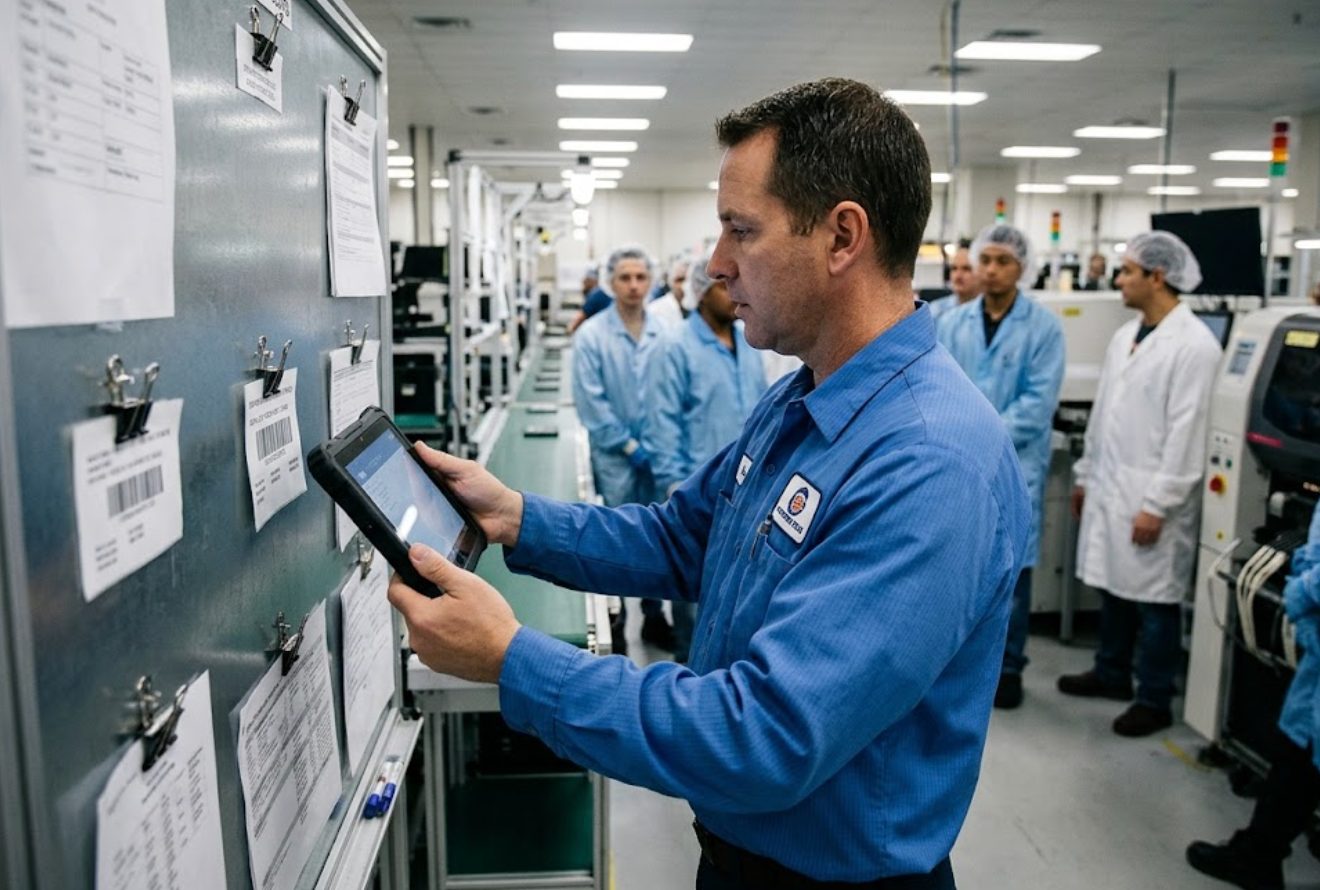
The day starts at the shift meeting, where the foreman used to read out work orders from a printout and operators used to copy order numbers onto their travelers by hand. Now the foreman carries the HTYJ08A rugged tablet, and the dispatch step is a scan of the work-order header label. The published screen — an 8-inch panel at 1200 x 1920 with 560-nit brightness and 7H hardness — is what makes the tablet usable at the line board under mixed lighting, and the Intel Core i5-10210Y (i7-10510Y optional) runs the plant's browser-based dispatch screen without the lag that had killed an earlier attempt with consumer tablets. The protection ratings are not decoration on a floor where pallets move: the sheet publishes IP67, MIL-STD-810G and 1.22 m drop resistance with an operating range of -20 to 55 degrees Celsius, and the removable 7.6 V 3500 mAh battery means a foreman on a twelve-hour double swap exchanges packs at handover instead of parking the tablet at a charger. For a fixed post at the line board, the RJ45 port puts the dispatch screen on the wired plant network, and the 12-pin pogo interface feeds the dock that keeps the tablet charged between meetings.
Batch Labels at the Rack, Scanned Before They Leave
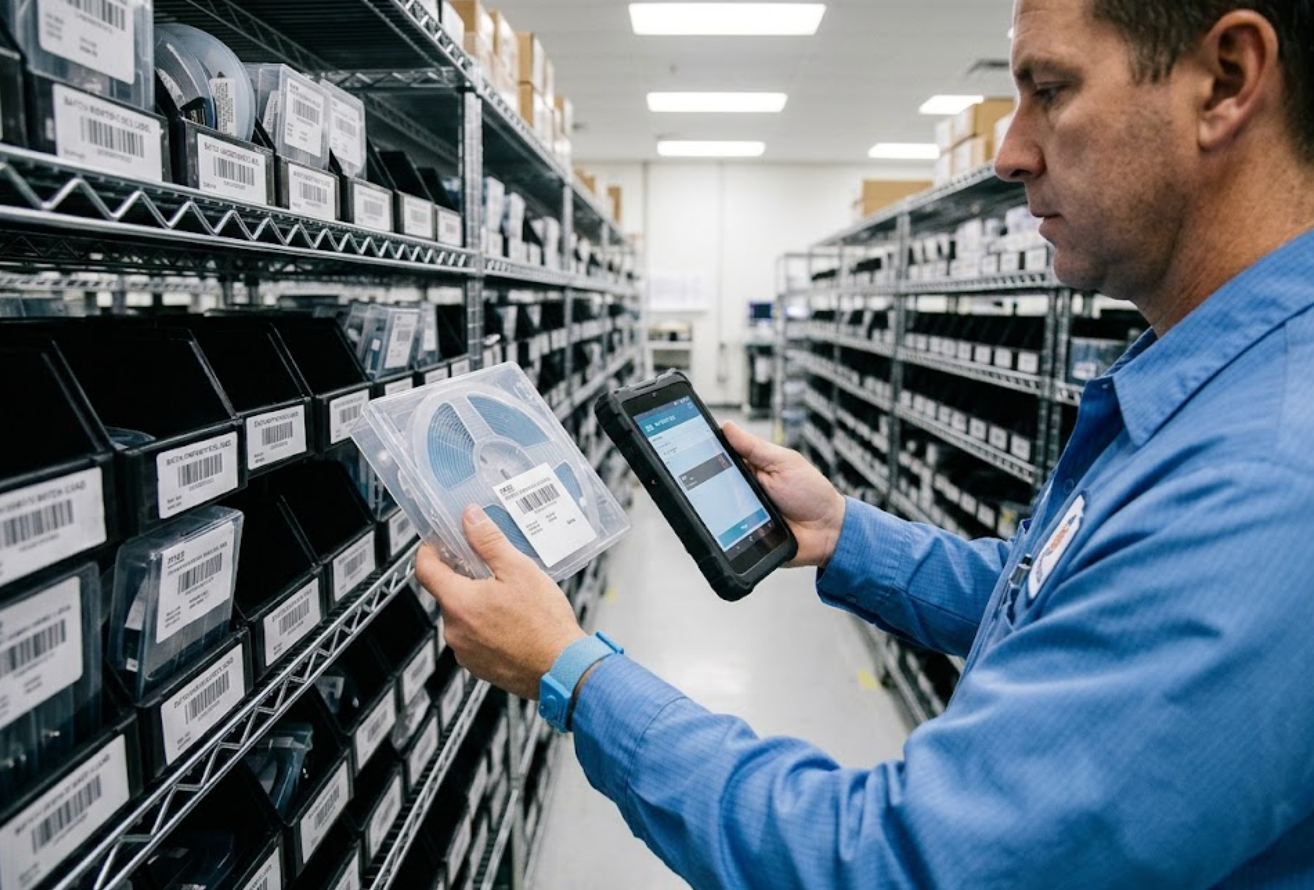
The second scan happens at the component racks, where a storekeeper issues material against the order. This is the step the plant's paper system failed most often, because batch numbers were copied by hand onto the traveler and one transposed digit was enough to poison the traceability chain. The storekeeper now scans the component batch label with the F502 handheld terminal before anything leaves the rack, and the record carries the batch number exactly as printed. The published sheet makes the device easy to live with at a rack: an MT6762 octa-core processor at 2.0 GHz, a 5.5-inch 720 x 1440 IPS panel, storage from 2 GB + 16 GB up to 4 GB + 64 GB with a micro SD slot that accepts up to 256 GB, and a net weight under 300 grams that matters when the same hand picks and scans several hundred times a shift. The Type-C port with OTG lets the storekeeper offload a day of capture logs without pulling a battery, and the quad-constellation GNSS — GPS, Galileo, Glonass and Beidou — is there for the yard work that shares the same terminal. Battery capacity is not published on the F502's sheet, so the plant schedules a lunchtime charge rather than claiming a runtime the page does not state.
The Operator Scan That Ends Each Operation
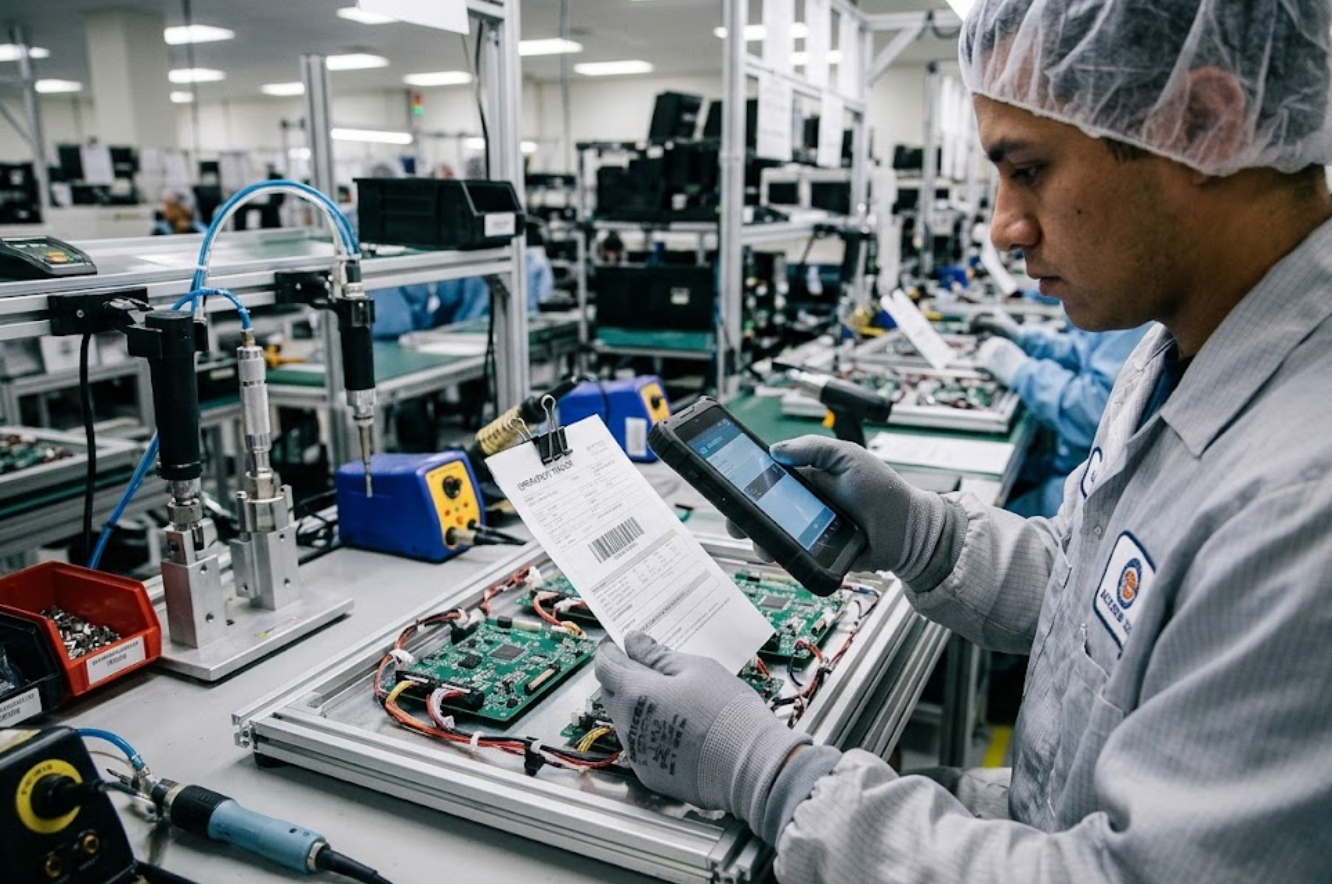
The third and most frequent scan belongs to the operators, and it is the one that replaced the signature line. At the end of each routing step, the operator scans the operation barcode on the traveler card with the T80 handheld PDA, and the record now carries operator, operation and quantity in one event. The published 4.5-inch IPS panel at 480 x 854 under Corning Gorilla Glass is deliberately small — the device lives in a hand, not on a bench — and the sheet's explicit support for gloves and wet-hand operation is what made it usable at soldering and wash stations where thin-film consumer phones had failed. The Cortex-A53 quad-core at 2.0 GHz runs Android 9.0 with 2 GB + 16 GB storage, extendable to 3 GB + 32 GB, which is enough for the scanning client and a day of cached events. The radio set is the reason the T80 covers the whole building: dual-band 802.11ac Wi-Fi where the plant has coverage, and 2G through 5G cellular where it does not, which includes the yard and the annex where the second SMT line's events previously died in a dead zone. The 8 MP rear camera with autofocus, flash and macro shooting closes the loop at stations that require visual proof, and the 166 x 77.5 x 22 mm chassis is grippable in the work gloves the line actually issues.
The Hold Point Where a Photo Settles the Argument
Quality holds used to be where the paper system produced its worst arguments. A unit pulled from the line carried a handwritten description — "scratched," "solder bridge," "cosmetic" — and the disposition meeting argued about severity because nobody could see what the inspector had seen. The hold procedure now runs on the foreman's HTYJ08A: the red-tagged unit's label is scanned, the defect code is selected from a list, and the rear 8 MP autofocus camera with LED flashlight captures the condition in the rack where holds are stored, under lighting that flatters nothing. The tablet's sheet publishes an optional 1D/2D scanner and UHF RFID module for plants that want the hold scan to be hands-free, but this plant runs the standard camera-and-touch configuration and has not needed the option. What changed is not the tagging; it is that the hold record became self-contained. A disposition meeting now opens with photographs and defect codes instead of recollections, and the travelers that used to be carried into that meeting have stopped being carried at all.
| Routing step | Device in hand | What gets scanned | Record written |
|---|---|---|---|
| Dispatch at shift meeting | Foreman's HTYJ08A tablet | Work-order header label | Order number, routing sequence, target quantity |
| Material issue at the rack | Storekeeper's F502 terminal | Component batch label | Batch number issued against the order |
| Operation report at the station | Operator's T80 PDA | Operation barcode on the traveler | Operator, operation complete, quantity good and scrap |
| Quality hold | Foreman's HTYJ08A tablet | Red-tagged unit's label | Defect code, photograph, disposition |
What the Numbers Looked Like After a Month
The plant's own comparison, one month in, was not dramatic in the direction people expect. Production output barely moved — the line was never short of speed; it was short of records. What moved was the reconciliation: the month-end traveler audit shrank from a week of chasing signatures to a same-day exception report, because the four scans gave the order book a completeness that paper never had. The missing-signature rate did not fall to zero; it moved to the places the plant can actually fix, because an unscanned operation now identifies itself the moment the next step tries to start. The storekeeper's batch issue went from copied digits to scanned ones, which ended the transposition arguments before they started. For a plant sizing its own fleet, the device classes behind this case sit under Hotus's full product range, and the wider trade-offs between handheld classes — screen size versus pocketability, Windows versus Android, wired versus cellular backhaul — are laid out in the site's product comparisons and competitor analysis rather than repeated here.