A container terminal runs on numbers that have to match the box: the container number stenciled on the door, the electronic seal ID on the lock bolt, and the damage notes that decide who pays for a dent. At one mid-size terminal we have been supplying, all three lived on paper for years. A clerk at the gate window copied them onto a form, the form rode in a truck cab to the office, and someone typed the whole stack into the terminal operating system at night. Every hand the record passed through was another chance for a wrong digit. This case walks through where each Hotus device now sits in that chain, what it reads, and what changed on the floor after four weeks.
The three devices do not overlap, and that is the point of the setup. An RT82 Rugged Tablet handles the desk work inside the gate booth. An R530C PDA reads electronic seals out in the yard, where boxes are stacked and ladders are a safety problem. An RS51 Handheld Terminal travels with the crew that checks trucks at ground level. Everything below comes from the published product pages plus what the terminal's operations office described to us about the rollout.
Inside a Gate Operation That Ran on Clipboards
Before the change, the gate lane worked like most paper systems do until they break. Trucks queued outside the booth while the clerk read the container number off the door, wrote the seal ID down digit by digit, and sketched dents on a grid diagram. Two failure patterns came up again and again in the office's own complaint log. The first was misreading a box number at dusk, when headlights wash out the stencil on the door. The second was transcription: a seal ID copied correctly on paper could still arrive wrong in the system, because the night shift retyped every form by hand. Disputes over damage were worse, since the paper sketch of a dent depended on which clerk had drawn it and how much time the queue allowed.
The operations office did not want a bigger form. They wanted the record captured once, at the point of contact, by the person standing next to the box. That single requirement shaped the whole deployment: every device in this case exists to remove one copying step, not to add a new screen somewhere.
RT82 at the Verification Desk: Seal Photos and the 5G Handoff
RT82 Rugged Tablet sits bolted to the clerk's counter in the first gate lane. The 10.1-inch panel is what sold the office on it: the inspection form and the camera preview fit side by side, so the clerk never switches apps mid-check. The 400-nit brightness keeps the stencil readable on screen even when headlight glare hits the booth glass, which was the exact failure the complaint log kept flagging.
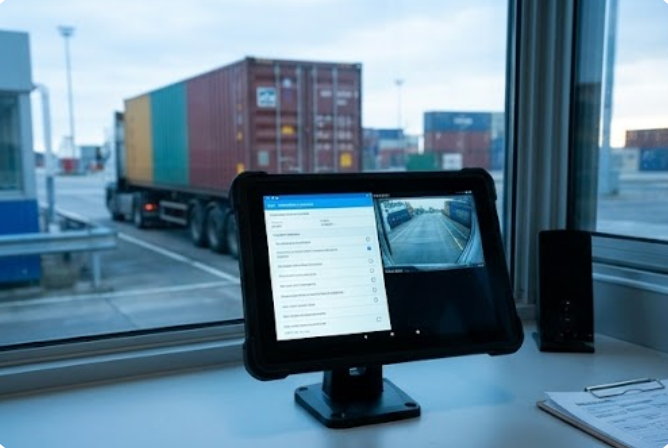
Each box now leaves the lane with a photo set: a wide shot of the door, a close-up of the seal bolt, and the corners where dents usually hide. The rear 20MP camera with flash handles the night lanes. Uploads go out over 5G before the truck has cleared the lane, powered by the Qualcomm 5G IoT platform inside the tablet, so the record reaches the office while the driver is still on terminal property. The 10000mAh battery is non-removable, and the office solved charging by docking the unit on a 12-pin pogo cradle overnight; a full shift at the desk has not required a mid-day recharge so far. The IP67 rating also earned its keep in a booth where doors swing open in the rain.
R530C in the Yard: UHF Reads the Electronic Seal Without a Ladder
R530C PDA solved a problem the gate desk never could: seal verification on stacked boxes. The built-in UHF RFID module, a 40x40mm ceramic antenna running EPC Class 1 Gen 2, reads an electronic seal chip at up to 2 meters. A yard checker stands on the ground, points the unit at the seal on the second tier, and the ID lands on the 6.0-inch FHD+ screen without anyone climbing. The office had a standing rule against ladder work for single-seal checks; the R530C retired it.
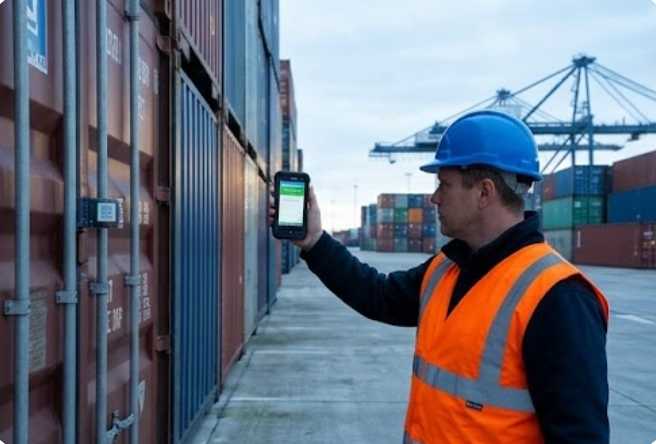
The 6000mAh built-in battery carries a double shift of yard work; checkers plug it in over Type-C at the shift break. The PSAM card slot logs the checker into the port community system with an encrypted credential, so seal IDs are tied to a named operator rather than a shared login. One honest gap: the product page publishes the operating temperature range but no IP rating or drop figure for this model, so the office's instruction is to holster it during heavy rain rather than assume sealing the page does not claim.
🔋 RS51 on the Truck Walk: Box Numbers With a Swappable Battery
RS51 Handheld Terminal belongs to the crew that checks trucks at the apron, away from any desk. Their core job is the printed container number: read it, confirm the ISO check digit validates in the app, and log a pass or fail against the booking. The 6.3-inch FHD+ display shows the booking list and the camera feed together, sized for one hand while the other steadies a clipboard that is slowly becoming decorative.
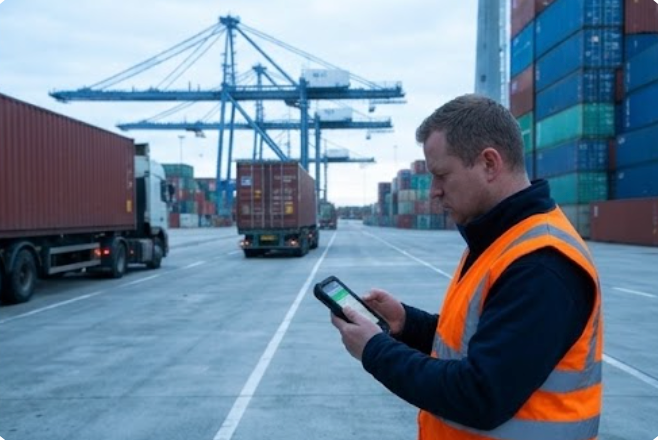
Weather exposure is why this unit had to be the toughest of the three. IP67 sealing and a 1.2m drop rating cover apron rain and the occasional fumble onto concrete. The 5000mAh battery is detachable, and the crew hot-swaps it at the mid-shift break without losing the app session, which matters because a reboot in the middle of a truck walk means starting that walk's log over. The rear 16MP camera captures a second set of dent photos at ground level, complementing the desk shots taken in the booth. The 2-pin pogo contacts feed a spare battery on the charging shelf, and the Qualcomm SM6225 platform keeps the scan-decode-and-upload loop responsive across a full walk.
The Spec Lines These Devices Can Put Side by Side
Three different roles do not make the devices incomparable; it just changes which lines matter. The table below keeps only the fields all three pages publish with the same meaning.
| Line | RT82 Rugged Tablet | R530C PDA | RS51 Handheld Terminal |
|---|---|---|---|
| Processor | Qualcomm 5G IoT platform, octa-core | Qualcomm SDM450, octa-core 1.8GHz | Qualcomm SM6225, octa-core 2.4GHz |
| Display | 10.1-inch IPS FHD; 400 nits | 6.0-inch IPS FHD+; 1080x2160 | 6.3-inch IPS FHD+; 1080x2340 |
| Battery | 10000mAh; non-removable | 6000mAh; built-in, Type-C charge | 5000mAh; detachable, hot-swap |
| Dimensions | 252 x 170 x 14.6 mm; under 650g | 188 x 83 x 22 mm; under 500g | 172 x 76.6 x 16.5 mm; under 500g |
| Wireless | Wi-Fi 6E; Bluetooth 5.2; 5G SA/NSA | Dual-band Wi-Fi; Bluetooth 4.2; 4G LTE | Dual-band Wi-Fi; Bluetooth 5.1; 4G LTE |
| Data capture | Optional 2D imager; 3mil minimum | Built-in UHF RFID; reads up to 2 m | Optional 2D imager; optional NFC |
Protection is deliberately missing from the table. The RT82 and the RS51 are both rated IP67 with a 1.2m drop figure on their pages, while the R530C page publishes temperature and humidity limits but no IP or drop number. Rather than fill one cell with a guess, the office treats sealing as a per-device decision: the two exposed roles got verified sealing, and the yard unit gets sheltered storage in bad weather. All three pages list the same operating window of -10°C to 50°C, which covers both summer apron heat and the winter wind that comes off the water.
🪧 Numbers the Terminal Reported After Four Weeks
The operations office shared its own read of the first month, and we pass it along with their caveat that this is one terminal, not a controlled trial. Every box record now carries at least two photos and one seal read, captured once and never retyped. Transcription disputes, the kind where a seal ID in the system matched no seal on any box, stopped appearing in the weekly log. Gate lane dwell did not fall by hours, because queueing was never the paper problem; what fell was the number of callbacks asking a clerk to remember what a form had said. The office also rebuilt the inspection form around confirmation instead of copying: the clerk's job on the rugged mobile computing solutions screen is now to verify what the device read, not to transcribe what the door said.
Where the Workflow Still Leans on People
Honest limits belong in a case like this. The UHF read on the R530C misses when an electronic seal sits in a recessed pocket or behind a corner casting, and the fix is procedural: the checker asks the driver to reposition, or falls back to reading the printed seal number with the RS51 and letting the system reconcile the two records later. Barcode lenses need wiping on dusty days, and the crew keeps a cloth in every truck cab. Selecting devices by exposure, not by spec-sheet rank, is the lesson the office repeats to visitors, and it is the same lesson we would hand anyone comparing models on our product comparisons and competitor analysis page before a rollout of this kind.
⚙️ Bringing the Same Setup to Another Berth
A neighboring terminal asked for the blueprint, and the answer travels well because it is role-based rather than model-based. One desk device for the lane, one long-range reader for the stacks, one walk-along scanner for the apron. The terminal now runs the same trio from its handheld terminals for port verification shortlist at a second berth, and the office started that rollout with a single gate lane and a four-week review before touching the rest. Terminals planning a similar move can copy that pacing: prove the record chain in one lane, then scale it.