Rugged Tablet Comparison for Industrial Edge Computing
When an industrial edge deployment needs a tablet that survives dust, vibration and intermittent connectivity, the real question is not "rugged enough" but "which operating model fits the workload". Hotus ships three Android-based rugged tablets — the RT82 Rugged Tablet, the RT81 Rugged Tablet and the HTQ10A Android Rugged Tablet — while Getac and Panasonic answer with full Windows 11 convertibles. Below we compare all five on the metrics that matter at the edge.
The Industrial Edge Challenge
Edge computing moves processing close to machines, sensors and field crews, so the tablet becomes a local node: it reads barcodes, streams video, pushes telemetry and runs a thin industrial app. That workload is light on x86 software but heavy on wireless reliability, positioning accuracy and all-day battery. A buyer weighing options should start from our rugged tablet solutions and map each device to its actual field duty.
Hotus RT82 5G Rugged Tablet — the 5G-First Edge Node
The RT82 is built on the Qualcomm QCM6690 octa-core 5G IoT platform running Android 13, with 8GB RAM and 128GB storage expandable to 256GB. Its 10.1-inch IPS FHD panel (1200×1920, 400 nits) stays readable under warehouse light, and the 10000mAh battery supports 12–14 hours of mixed scanning and transmission. The headline feature is connectivity: dual-mode 5G SA/NSA with 4×4 MIMO on the main bands, tri-band Wi-Fi 6E and Bluetooth 5.2. For edge nodes that must stay online, that radio stack beats most legacy 4G tablets. Optional modules add a 2D barcode scanner, NFC and an independent Beidou RTK receiver for 2–5 cm positioning — turning the tablet into a GIS and asset-tracking terminal without external survey gear.
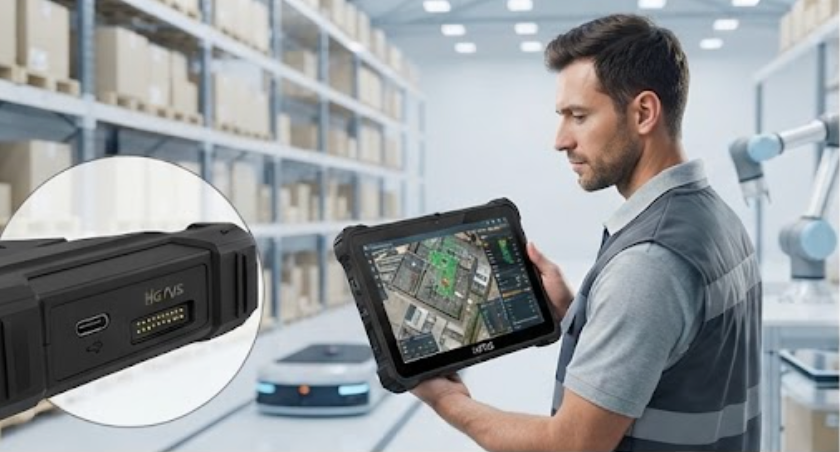
Hotus RT81 4G Rugged Tablet — Cost-Efficient 4G with Centimeter Accuracy
The RT81 trades 5G for mature 4G LTE on a Qualcomm SM6225 octa-core platform (up to 2.4GHz), also on Android 13, with 4GB+64GB or 8GB+128GB configurations. It keeps the same 10.1-inch 400-nit display, IP67 sealing, 1.2 m drop resistance and 10000mAh battery as the RT82, and shares the optional Beidou RTK, scanner and NFC modules. For sites where 4G coverage is sufficient — which is most warehouses, yards and utilities — the RT81 delivers the same rugged and positioning story at a meaningfully lower hardware cost, often 30–40% below a comparable 5G unit.
Hotus HTQ10A Android Rugged Tablet — the Lightweight Field Companion
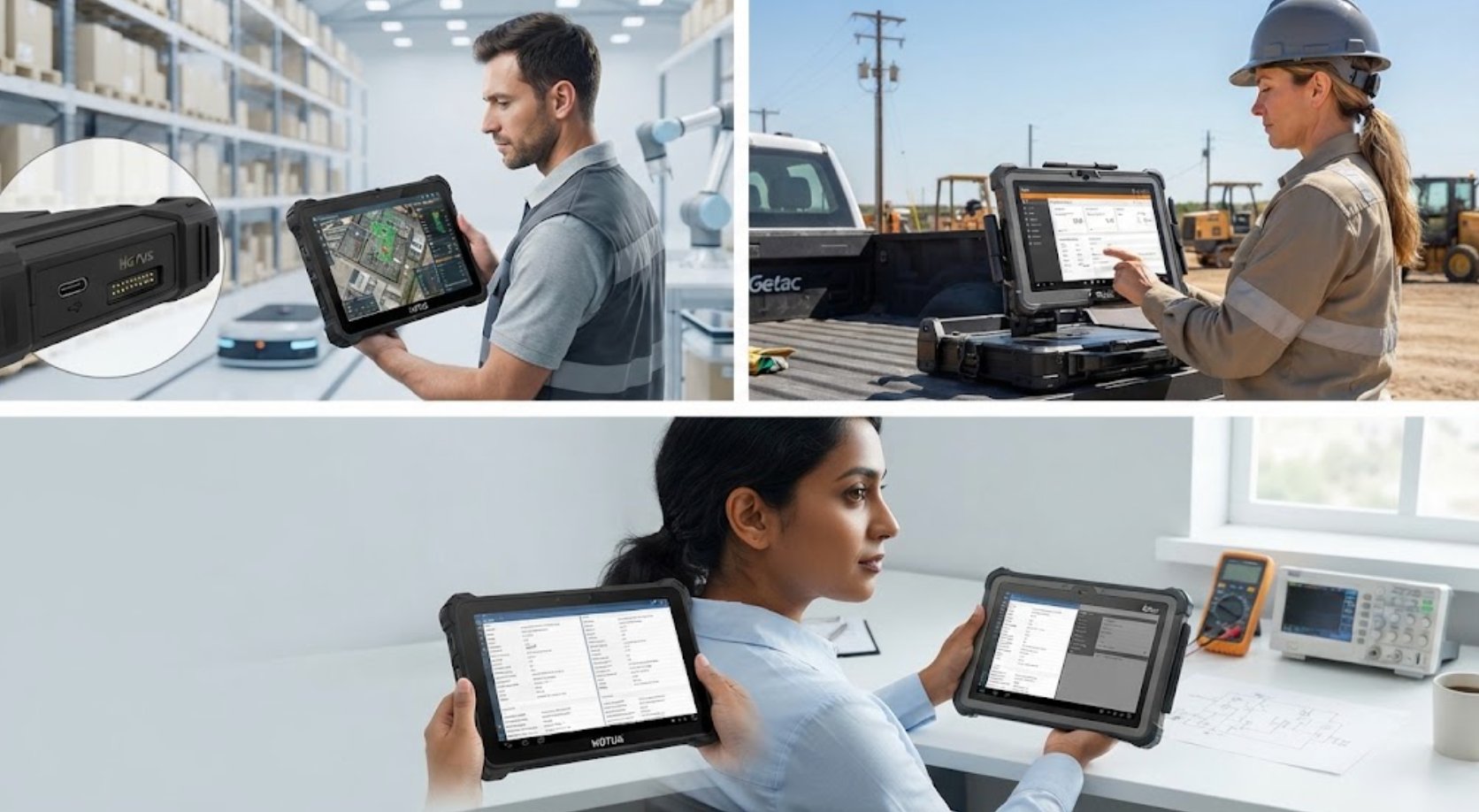
The HTQ10A is the value entry: a MediaTek MTK8788 octa-core 2.0GHz platform on Android 12, 8GB RAM and 128GB storage, with a brighter 10-inch LCD at 1920×1200 and 560 nits for outdoor readability. Its 7000mAh battery is smaller but the device is lighter, and it offers the same IP67 and 1.22 m drop protection. Connectivity is Wi-Fi 5 with optional 4G, NFC, scanner and fingerprint. Where the duty is inspection, checklists and photo capture rather than constant 5G streaming, the HTQ10A covers the base at the lowest total cost.
How the Competition Stacks Up: Getac F110 G7 and Panasonic FZ-G2 Mk2
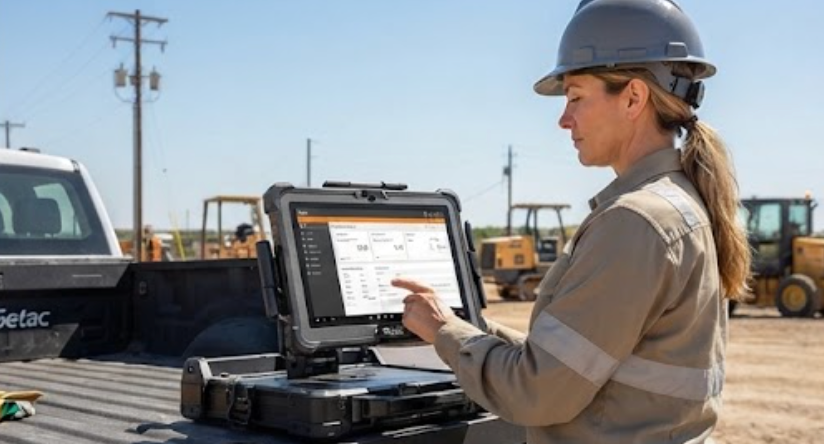
Getac and Panasonic take a different path. The Getac F110 G7 is an 11.6-inch fully rugged tablet with an Intel Core i5-1335U, 16GB RAM and 256GB SSD on Windows, rated IP65 and MIL-STD-810H, with a dual-battery design and a mature vehicle-dock ecosystem. The Panasonic Toughbook FZ-G2 Mk2 is a 10.1-inch fully rugged 2-in-1 with an Intel Core i5-1245U vPro, 16GB RAM and 512GB SSD, a 1000-nit sunlight-readable screen, IP65, MIL-STD-810H, 1.8 m drop resistance and modular expansion. Both run the full Windows software stack, which matters when the edge app is a legacy x86 program, a desktop SCADA client or a browser-locked enterprise tool. That capability comes at a price: the Getac typically lists around AU$3,750–3,939, and the Panasonic around £2,015–3,680 depending on configuration.
Side-by-Side Specification Comparison
| Device | OS | Compute | Memory / Storage | Display | Cellular / Wireless | Ruggedness | Battery | Price Tier |
|---|---|---|---|---|---|---|---|---|
| Hotus RT82 | Android 13 | Qualcomm QCM6690, 5G | 8GB / 128GB (256 max) | 10.1" 1200×1920 400nit | 5G 4×4 MIMO, Wi-Fi 6E, BT5.2 | IP67, 1.2 m drop | 10000 mAh | Mid |
| Hotus RT81 | Android 13 | Qualcomm SM6225, 4G | 4–8GB / 64–128GB | 10.1" 1200×1920 400nit | 4G LTE, Wi-Fi 5/6, BT5.x | IP67, 1.2 m drop | 10000 mAh | Value |
| Hotus HTQ10A | Android 12 | MediaTek MTK8788 | 8GB / 128GB (opt) | 10" 1920×1200 560nit | Wi-Fi 5, optional 4G | IP67, 1.22 m drop | 7000 mAh | Value |
| Getac F110 G7 | Windows 11 | Intel i5-1335U | 16GB / 256GB SSD | 11.6" 1920×1080 | 4G LTE, Wi-Fi 6 | IP65, MIL-STD-810H | Dual battery | High (~$1,800+) |
| Panasonic FZ-G2 Mk2 | Windows 11 | Intel i5-1245U vPro | 16GB / 512GB SSD | 10.1" 1920×1200 1000nit | 4G, Wi-Fi 5 | IP65, MIL-STD-810H, 1.8 m | Hot-swappable | High (~$1,800–3,400) |
Choosing the Right Rugged Tablet for Your Industrial Edge Workload
| If your edge workload needs… | Best fit | Why |
|---|---|---|
| Always-on 5G, real-time telemetry, RTK GIS | Hotus RT82 | 5G 4×4 MIMO + Wi-Fi 6E + optional Beidou RTK in one Android node |
| 4G coverage, centimeter positioning, tight budget | Hotus RT81 | Same rugged/RTK story as RT82 at 30–40% lower hardware cost |
| Inspection, checklists, bright outdoor screen | Hotus HTQ10A | 560-nit panel, lightest body, lowest TCO |
| Legacy Windows x86 app or SCADA client | Getac F110 G7 / Panasonic FZ-G2 | Full Windows 11 ecosystem and desktop software support |
| Maximum outdoor sunlight readability + modular I/O | Panasonic FZ-G2 Mk2 | 1000-nit display and modular expansion bay |
Making the Right Call at the Edge
The split is clear: choose an Android rugged tablet when the edge app is a thin mobile client, a scanner-driven workflow or a positioning task, and you want 5G-class wireless and RTK accuracy without the Windows price tag. Choose a Getac or Panasonic when a desktop-grade Windows program is non-negotiable. For most industrial edge rollouts — warehouses, yards, utilities and field service — the Hotus RT82/RT81/HTQ10A trio covers connectivity, durability and budget in one family, and pairs naturally with our related mini PC lineup for the fixed edge gateway. Explore more device comparisons to map the full range before you buy.