📦 Hotus RS50, RS51 and R530C Against Zebra TC58 and Honeywell CK67 in Warehouse Logistics
Warehouse and logistics teams live or die by the device in their handlers' hands. Missed scans, dead batteries, and frozen screens during a winter dock shift cost real money. This review puts three explore our handheld pda solutions from Hotus—the RS50 5G, the RS51 4G, and the R530C all-in-one PDA—head to head with two enterprise benchmarks, the Zebra TC58 and the Honeywell CK67. All four are 6-inch-class rugged handheld terminals, but they diverge sharply on connectivity, positioning precision, data-capture breadth, and price.
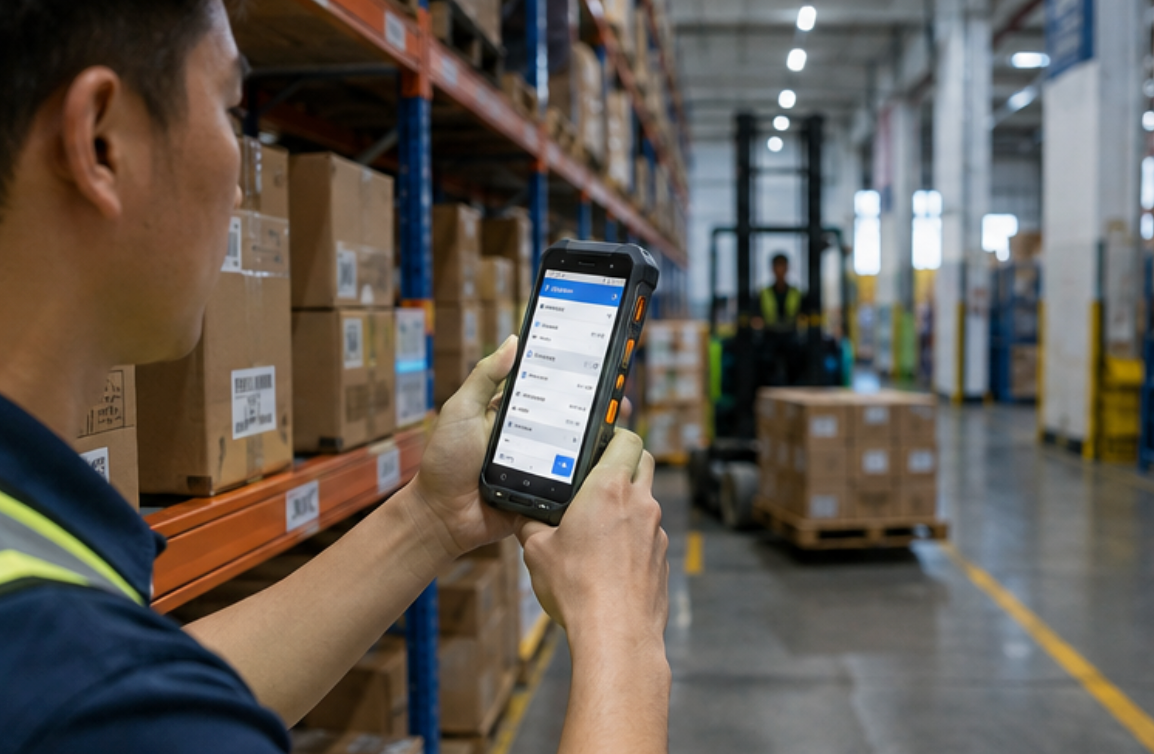
The Hotus RS50 5G Delivers Connectivity and Centimeter Positioning
The RS50 Handheld Terminal is built around an Unisoc UIS7885 octa-core chip at 2.7 GHz with an 8 TOPS NPU and 8 GB of RAM plus 128 GB of storage. It is one of the few rugged handhelds to pair full 5G SA/NSA (N1/N3/N5/N8/N28/N41/N78/N79) with an optional independent BeiDou RTK module that reaches 2–5 cm accuracy without an external receiver. A 6.3-inch FHD+ panel, a 48 MP main camera with an optional 8 MP macro, IP67 sealing, 1.2 m drop tolerance, and a hot-swappable ~4800 mAh pack round out a device aimed at yard tracking, forklift guidance, and field proof-of-delivery.
💰 The Hotus RS51 4G Brings RTK Accuracy at a Lower Cost
The RS51 Handheld Terminal keeps the same 6.3-inch FHD+ body and IP67 / 1.2 m ruggedness but steps down to a Qualcomm SM6225 platform (4 GB RAM, 64 GB storage) on 4G LTE. Crucially, it retains the optional independent BeiDou RTK, so sub-5 cm positioning stays available without paying for a 5G modem. For warehouses that already cover their floors with Wi-Fi 6-ready APs and 4G roaming, the RS51 delivers most of the RS50's value at a meaningfully lower acquisition cost.
The Hotus R530C Replaces Four Readers with One Device
The R530C PDA takes a different path: maximum data-capture density. Its optional module stack crams UHF RFID (built-in 40×40 ceramic antenna, ≤2 m read, EPC Class 1 Gen 2), a 2D imager down to 3 mil, NFC, and a PSAM secure slot into a 6.0-inch FHD+ body with a 6000 mAh battery for 12–14 hour shifts. A Qualcomm SDM450 keeps power draw low. Where the RS50 and RS51 are connectivity-first, the R530C is capture-first—ideal for mixed barcode-and-RFID warehouses that want one terminal instead of a phone, a sled, and a tag reader.
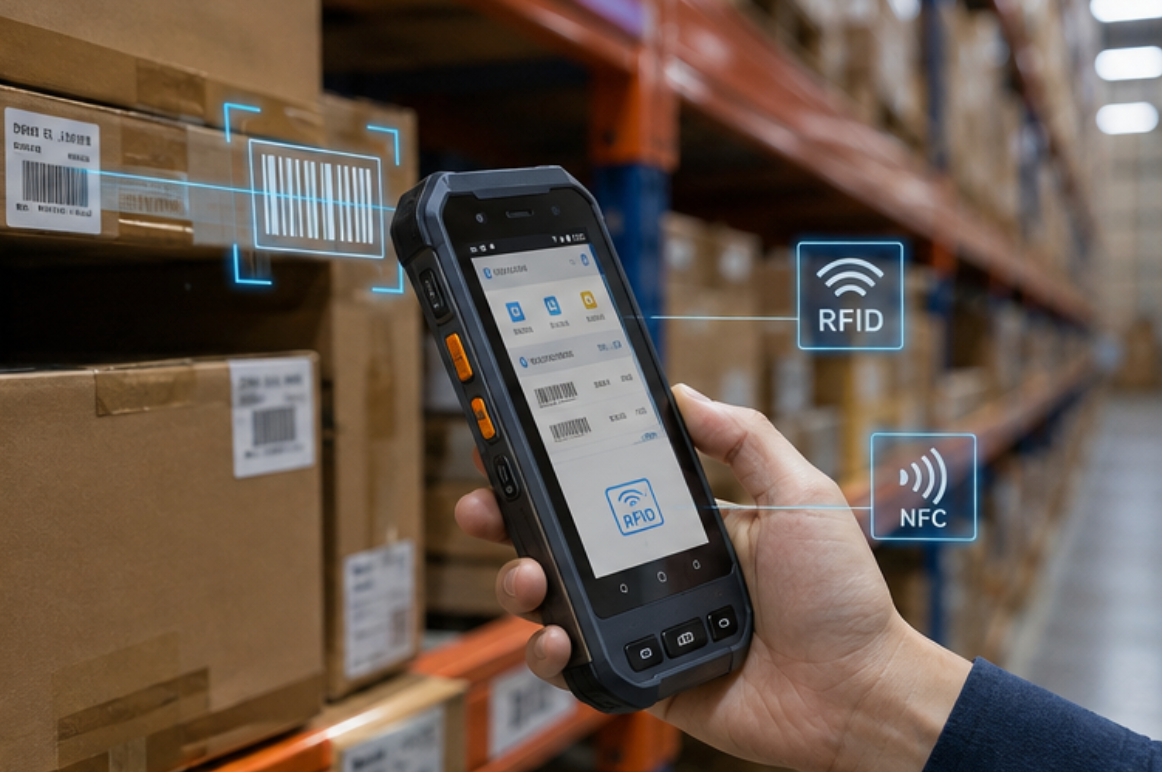
The Benchmarks: Zebra TC58 and Honeywell CK67
The Zebra TC58 runs a Qualcomm 6490 with 8 GB RAM and Android 15 (upgradeable to 18), rated IP68 / IP65 and MIL-STD-810H with a 1.8 m drop and a 7000 mAh extended battery quoted at 17 hours. Honeywell's CK67 uses a Qualcomm 4490 (4/8 GB) on Android 14–18, with an even tougher 2.4 m drop rating, a 28-hour 7000 mAh hot-swap pack, and a cold-storage variant rated to −30 °C. Both are exceptional devices—and both sit in the $900–$2,500 bracket depending on configuration.
Side-by-Side Specification Comparison
| Dimension | Hotus RS50 | Hotus RS51 | Hotus R530C | Zebra TC58 | Honeywell CK67 |
|---|---|---|---|---|---|
| CPU | Unisoc UIS7885 2.7GHz + 8TOPS NPU | Qualcomm SM6225 2.4GHz | Qualcomm SDM450 1.8GHz | Qualcomm 6490 | Qualcomm 4490 |
| RAM / Storage | 8GB / 128GB | 4GB / 64GB | 2GB / 16GB | 8GB / 128GB+2TB | 4–8GB / 64–128GB |
| Cellular | 5G SA/NSA | 4G LTE | 4G LTE | 5G | 5G |
| OS | Android 13 / Harmony OS | Android 13 | Android 16 | Android 15→18 | Android 14→18 |
| Battery | ~4800mAh hot-swap | ~4800mAh hot-swap | 6000mAh sealed | 7000mAh (17h) | 7000mAh (28h) |
| Ruggedness | IP67, 1.2m | IP67, 1.2m | Rugged sealed | IP68/IP65, 1.8m, MIL-STD | IP65/IP68, 2.4m, MIL-STD |
| Positioning | BeiDou RTK opt (2–5cm) | BeiDou RTK opt | GPS/BeiDou/Galileo | Dual GNSS | Dual GNSS |
| Data Capture | 2D/NFC/fingerprint opt | 2D/NFC opt | UHF+NFC+2D+PSAM opt | 2D, 16MP OIS | Long-range 2D |
| Price Tier | Factory-direct | Factory-direct (lower) | Factory-direct | $900–1,200 | $1,500–2,500 |
🎯 How to Choose for Your Warehouse
| Operational Need | Recommended Hotus | Why / When to Pick a Competitor |
|---|---|---|
| 5G + cm-level yard positioning | RS50 | Pick Zebra TC58 if you need 8GB everywhere plus the longest OS-support window |
| Cost-sensitive high-volume scanning | RS51 | Pick CK67 only if freezers or a 28h single-shift battery are mandatory |
| Mixed barcode + RFID + secure auth | R530C | No direct Hotus peer issue; TC58/CK67 need add-on sleds for UHF |
| Cold storage down to −30 °C | None | Honeywell CK67 cold-store variant is the clear choice |
| Maximum single-shift battery | RS50 / RS51 (swappable) | Honeywell CK67 28h wins only if hot-swap is impossible |

💰 Total Cost and Final Recommendation
Hotus positions the RS50, RS51, and R530C as factory-direct alternatives: you trade the absolute top-end IP68 / 2.4 m drop envelopes and −30 °C cold-store options of the CK67 for roughly a third to half the per-unit cost, while keeping 5G or 4G, optional BeiDou RTK, and—uniquely in this group—integrated UHF RFID on the R530C. For most warehouses the sensible split is the RS51 for high-volume scan roles, the RS50 for 5G plus RTK yard work, and the R530C where RFID and PSAM security matter. If your operation runs freezers or needs a guaranteed 28-hour shift on a single hot-swap, the Honeywell CK67 earns its premium; if you need the largest app ecosystem with 8 GB everywhere, the Zebra TC58 is the safe enterprise default. Browse our related rugged tablet lineup or read more device comparisons to map the full range.