🏥 Hotus HTYJ10A, ST11-J and ST13-J Against Durabook R11 and DT Research DT302RP in Medical Workstations
Clinical teams need computing that shrugs off spills, disinfectant, and constant cart movement while still running the Windows clinical software staff already know. This comparison puts three Hotus rugged tablets-the 10-inch HTYJ10A, the 10.1-inch ST11-J, and the 13.3-inch ST13-J-up against two established medical-grade benchmarks, the Durabook R11 and the DT Research DT302RP. All five are sealed, drop-tested Windows-capable tablets, but they diverge on screen size, processing headroom, battery strategy, and price. Browse our explore our rugged tablet solutions to see the full line before you decide.
💡 Why Medical Workstations Break Consumer Tablets
A hospital ward or outpatient clinic is one of the harshest environments a computer will ever face. Crews wipe every surface with alcohol and quaternary ammonium several times per shift, so consumer laptops with fan vents and unsealed seams fail within months. Carts roll over thresholds and cable trip hazards, dropping devices onto tile. Staff work in gloves, often at odd angles, under time pressure. Point-of-care software expects a real Windows session with peripheral support, not a locked-down slab. A purpose-built rugged tablet answers all four pressures: sealed edges, a hardened touchscreen readable under clinical lighting, hot-swap or all-day batteries for 24/7 rotations, and standard Windows drivers for scanners, printers, and EMR add-ons.
The Hotus HTYJ10A Brings a Bright 10-inch Panel and Rich I/O
The HTYJ10A Rugged Tablet centers on a 10-inch 1200x1920 LCD at 560 nits with a 7H-hardened 10-point capacitive surface, driven by an Intel Core 10th-generation i5-10210Y or i7-10510Y. Connectivity is generous for a bedside device: WiFi 6 plus Bluetooth 5, an RJ45 LAN port, Mini HDMI, Type-A, Type-C, DC-in, a SIM slot, and a 12-pin POGO connector, with optional 4G, NFC, 1D/2D scan, fingerprint, and a charging dock. A 7.6V/3500mAh pack, IP67 sealing, and 1.22 m drop resistance make it a compact cart or wall-mount companion where a single full-featured port set matters more than screen acreage.
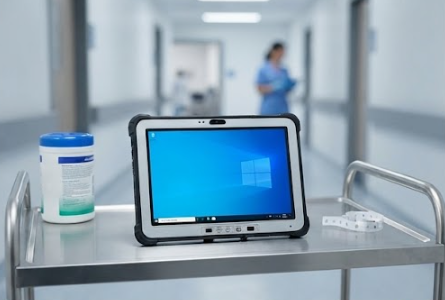
✅ The Hotus ST11-J Is the 10.1-inch Ward Standard
The ST11-J runs Windows 10 Pro or Windows 11 Pro on an Intel Celeron N5100 quad-core (1.1-2.8 GHz) with 8 GB RAM and 256 GB storage, behind a 10.1-inch IPS panel at 1200x1920 and 420 nits (1000-nit optional for sunlit corridors). A 6000 mAh / 7.6 V battery delivers about 8.5 hours, with 4G LTE, GPS/BDS/GLONASS, dual-band WiFi, Bluetooth 4.2, and NFC built in. Rated IP65 and MIL-STD-810G at 268.9 x 176.8 x 18 mm and 1150 g, it adds optional TPM 2.0, barcode scanner, UHF RFID, fingerprint, and a docking cradle-ideal for medication administration, specimen tracking, and mobile charting.
🖥️ The Hotus ST13-J Scales Up to a 13.3-inch Station Display
The ST13-J keeps the same Windows 10/11 Pro foundation and Intel N5100 with 8 GB/256 GB, but expands the display to a 13.3-inch 1920x1080 IPS panel for multi-window EMR and imaging review. The larger 8000 mAh / 7.6 V cell extends stationary use, while IP65 sealing and 1.2 m drop resistance hold up on rolling workstations. At 331.7 x 203.2 x 19.5 mm and 1450 g, with optional TPM 2.0, scanner, docking, and vehicle mount and an operating range of -20 to 55 C, it fits nursing stations, command carts, and fixed patient-info kiosks that need a bigger canvas.
The Benchmarks: Durabook R11 and DT Research DT302RP
The Durabook R11 is an 11.6-inch FHD (1920x1080) fully rugged tablet built on an Intel Core i5-1235U with 8 GB DDR5 and 256 GB SSD, sealed to IP66 and MIL-STD-810H with a 4-foot drop rating and a 1000-nit sunlight-readable panel; it typically lists around $2,179-$2,699. The DT Research DT302RP is a 10.1-inch Windows tablet with a built-in CAC reader and hot-swappable battery, rated IP65 and MIL-STD-810H, positioned at roughly $2,000-$3,000. Both are proven across healthcare and government fleets, and both carry a per-unit price several times that of a factory-direct Hotus configuration.
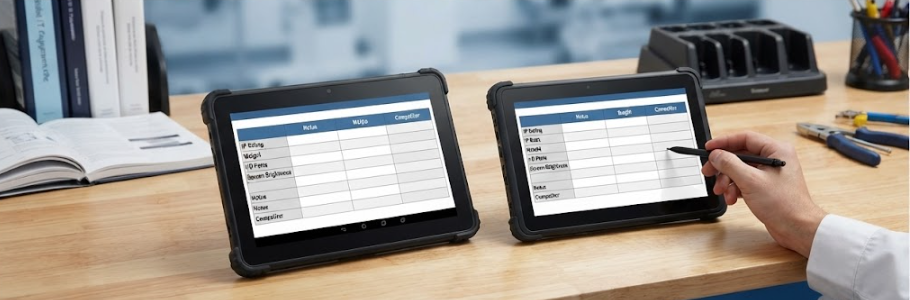
Head-to-Head Specification Comparison
| Dimension | Hotus HTYJ10A | Hotus ST11-J | Hotus ST13-J | Durabook R11 | DT Research DT302RP |
|---|---|---|---|---|---|
| Display | 10" 1200x1920 560nit | 10.1" IPS 1200x1920 420nit | 13.3" IPS 1920x1080 | 11.6" FHD 1920x1080 1000nit | 10.1" Windows panel |
| CPU | Intel i5-10210Y / i7-10510Y | Intel Celeron N5100 | Intel Celeron N5100 | Intel Core i5-1235U | Intel-based Windows |
| OS | Windows-capable | Windows 10/11 Pro | Windows 10/11 Pro | Windows | Windows |
| RAM / Storage | Configurable | 8GB / 256GB | 8GB / 256GB | 8GB DDR5 / 256GB SSD | Configurable |
| Battery | 7.6V 3500mAh | 6000mAh / 7.6V (~8.5h) | 8000mAh / 7.6V | Hot-swap (long shift) | Hot-swappable |
| Cellular / Positioning | Optional 4G, WiFi 6 | 4G LTE, GPS/BDS/GLONASS | 4G LTE, GPS/BDS/GLONASS | Optional cellular | Cellular-ready |
| Ruggedness | IP67, 1.22m drop | IP65, MIL-STD-810G | IP65, 1.2m drop | IP66, MIL-STD-810H, 4ft | IP65, MIL-STD-810H |
| Standout I/O | RJ45, SIM, POGO, scan/NFC/fingerprint opt | TPM2.0, scanner, UHF, dock opt | TPM2.0, scanner, dock, vehicle mount opt | 1000nit, DDR5, 4ft drop | Built-in CAC reader |
| Price Tier | Factory-direct | Factory-direct | Factory-direct | $2,179-$2,699 | $2,000-$3,000 |
🏥 Which Tablet Fits Your Medical Workflow
| Operational Need | Recommended Hotus | Why / When to Pick a Competitor |
|---|---|---|
| Bright bedside cart with full port set | HTYJ10A | Pick Durabook R11 if you need a 1000-nit 11.6" panel and DDR5 headroom for heavier apps |
| Med-admin and specimen tracking at 10.1" | ST11-J | Pick DT302RP only if a built-in CAC reader is a hard compliance requirement |
| Nursing station or imaging review, large screen | ST13-J | No direct Hotus peer issue; rivals cost 2-3x for similar size |
| Government / VA-grade CAC authentication | None built-in | DT Research DT302RP integrates CAC natively |
| Maximum sunlight readability on a cart | ST11-J (1000nit opt) | Durabook R11 1000-nit is the safer default if budget allows |

Making the Call for Your Facility
Hotus positions the HTYJ10A, ST11-J, and ST13-J as factory-direct alternatives: you trade the absolute top-end 4-foot drop envelope and native CAC of the DT302RP, or the DDR5 and 1000-nit panel of the Durabook R11, for roughly a third to half the per-unit cost, while keeping sealed IP65/IP67 bodies, Windows 10/11 Pro, 4G, NFC, and optional scanner, UHF, fingerprint, and TPM 2.0 security. For most wards the sensible split is the HTYJ10A where port density rules, the ST11-J for mobile charting and med-admin, and the ST13-J at fixed stations and command carts. If your facility mandates a built-in CAC reader, the DT Research DT302RP earns its premium; if you need the largest sunlight-readable panel with the newest Intel silicon, the Durabook R11 is the safe enterprise default. Explore our related mini PC lineup for cart-mounted compute, or read more device comparisonsto map the full range.