RT81, RT82 and ST13-J: Where an OEM Program's Money Is Really Spent
Custom hardware quotes are easy to compare and hard to trust, because the figures on the page are rarely the ones that decide the outcome. Two suppliers can quote the same unit price and deliver programmes whose five-year cost differs by a wide margin, and the difference almost never appears in the line item anyone negotiated over.
Having run a number of custom builds, we have come to see the pattern as an accounting problem rather than a manufacturing one. This is what we tell customers who arrive through our oem odm solutions and ask, reasonably enough, how to tell a good quote from a cheap one.
💡 Why Unit Price Is the Wrong Number to Negotiate
Unit price is a function of volume, and volume is the single thing you are least certain about at the start of a programme. A quote built on an optimistic forecast looks excellent and collapses the moment the forecast misses, because fixed costs that were being spread thinly are suddenly not spread at all.
The numbers that survive a forecast miss are the ones tied to what must exist before the first unit ships: tooling, certification, firmware, test fixtures. Those costs are real whether you build three hundred units or ten thousand, which makes them the part of the programme worth negotiating hardest.
The Tooling Bill and How Volume Spreads It
A new enclosure means a new mould, and a mould means a fixed bill that lands before anything has been sold. Spread across ten thousand units it is a rounding error. Spread across three hundred it can be the largest single line in the project.
This is why the most valuable question in an OEM conversation is not what a unit costs but what already exists. Starting from a platform that has been through tooling once moves the fixed bill out of your programme and into someone else's history, and it removes months rather than dollars.
Reusing a Chassis: Two SKUs From One Platform
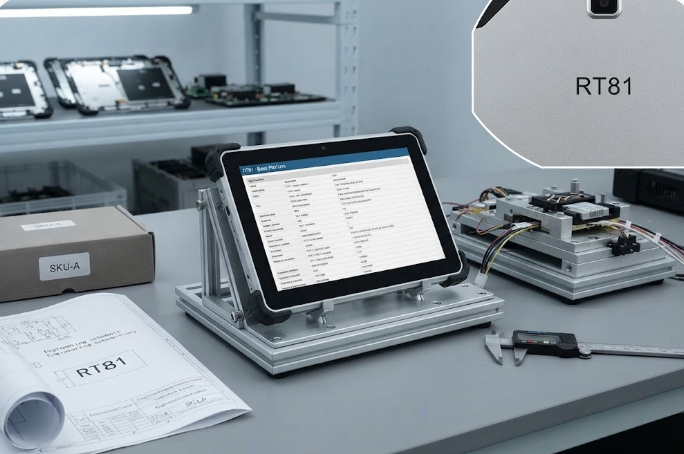
The clearest example in our own range is a pair of 10.1-inch Android tablets that share a form factor while sitting at different points in the market. RT81 Rugged Tablet is the entry configuration: 4GB+64GB or 8GB+128GB with expansion to 256GB, Android 13, 4G LTE, a 10.1-inch FHD panel, NFC and a 2D barcode reader, and a 10,000mAh battery inside an IP67 shell rated for a 1.2 metre drop.
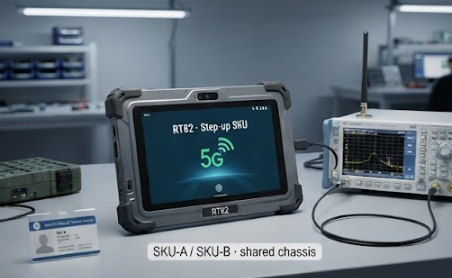
RT82 Rugged Tablet occupies the same 10.1-inch IPS FHD footprint and the same 10,000mAh, IP67, 1.2 metre drop envelope, but steps up to 8GB+128GB, a Qualcomm octa-core platform built for 5G IoT work with an integrated NPU, WiFi 6E, and multi-constellation positioning with an independent BeiDou option.
The commercial point is that this second SKU does not require a second programme. Same footprint, same battery class, same rugged rating, same mounting assumptions, so a second model aimed at a different customer segment costs a fraction of what a first one did. Every platform in our rugged tablet range is organised this way, and it is the reason a two-model catalogue is affordable for a buyer who could never fund two independent designs.
When a Second Form Factor Pays Off
The arithmetic changes completely when the second product is a different size. ST13-J is a 13.3-inch Windows industrial tablet: an Intel Celeron N5100 quad-core, 8GB/256GB with 4GB/128GB and 512GB options, a 1920 x 1080 IPS panel, an 8000mAh battery at 7.6V, 4G LTE, WiFi 5, NFC at 13.56MHz, IP65 with 1.2 metre drop resistance, and 1,450 grams across a 331.7mm chassis.
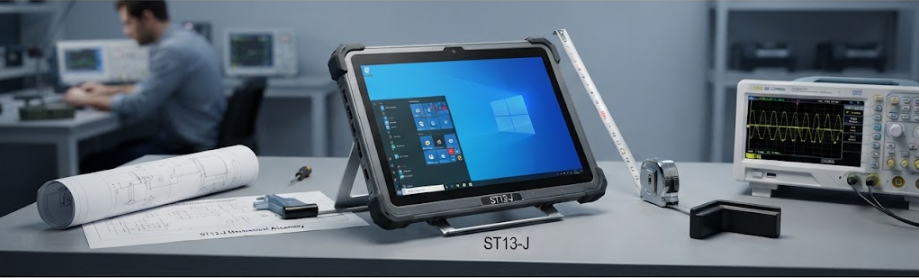
Almost nothing here is shared with the 10.1-inch pair. New tooling, a different operating system, a different certification path, and a screen size that changes how the unit is carried and mounted. That is not a criticism of the product; it is simply what a genuinely different form factor costs. It pays off when the application needs the larger panel and the Windows environment, and it does not pay off when it was chosen because a bigger screen felt safer.
💰 Certification Is the Cost Nobody Budgets For
Once a design changes, the paperwork around it has to be redone, and certification is the least visible fixed cost in any programme. A new radio module, a moved antenna, a different battery supplier, and the test cycle restarts, with lead times that cannot be negotiated the way commercial terms can.
That is why we push buyers to settle their regulatory markets early. A unit certified for the regions you actually ship to, decided before tooling is cut, is worth more than a discount negotiated afterwards.
Reading the Numbers Side by Side
| Model | Form factor | Platform | Memory and storage | Rugged rating | Role in a custom programme |
|---|---|---|---|---|---|
| RT81 | 10.1-inch Android tablet | Qualcomm octa-core, 4G LTE | 4GB+64GB / 8GB+128GB, TF to 256GB | IP67, 1.2m drop | Entry model; a second variant at near-zero tooling |
| RT82 | 10.1-inch Android tablet | Qualcomm octa-core, 5G IoT, NPU, WiFi 6E | 8GB+128GB, TF to 256GB | IP67, 1.2m drop | Step-up model on the same chassis programme |
| ST13-J | 13.3-inch Windows tablet | Intel Celeron N5100 quad-core | 8GB/256GB, with 4GB/128GB and 512GB options | IP65, 1.2m drop | Separate platform; needs its own volume case |
The table is deliberately not a specification comparison. It is a map of which costs are shared and which are not, because that is what decides whether a second product in your catalogue is an incremental project or an entirely new one.
What Changes if Your Volume Triples
Everything above assumes a modest forecast, which is where most custom programmes begin. Triple the volume and the relationship between fixed and variable cost shifts, and so does the ranking of your options.
At higher volumes a bespoke enclosure becomes worth paying for, because the tooling you were avoiding is now spread thinly enough to disappear into the unit cost. At low volumes it almost never is. The mistake is deciding this once. The answer changes as the forecast firms up, and a supplier who cannot explain where the crossover sits is not really modelling your programme.
The Decision Rule We Give Customers
Start with what can be reused, and treat everything else as a deliberate purchase. If your application can live inside an existing form factor, a second or third model is a marginal project. If it genuinely needs a different size, a different operating system or a different certification footprint, budget it as a new platform rather than a variant, and say so plainly to whoever signs the purchase order.
Written that way, the economics stop being a matter of trust in a quote. Most of the questions we receive about custom hardware are really questions about which costs are shared, and the shorter deployment notes behind industrial hardware solutions are a useful place to see how the same platform decisions play out across different applications.