A boundary crew closes out a parcel file with three kinds of proof: the coordinates that fix each corner, the photos that document the monuments, and the sketch that ties them together for the title office. On most sites the first two are captured by noon. The third is where the day used to stall, because the data had no way to leave the crew's hands until somebody drove it back. The three tablets below sit at three different points along that same problem: one pushes its coordinates off the site while the stakes are still in the ground, one carries a wired port that closes the file before the crew leaves the curb, and one turns the cab of a truck into a quiet second office.
Read together, they trace the path survey data takes on its way out of the field — from the night drive that used to end every job, to the wired handoff, to the always-connected tablet. All three come from one product family built around rugged tablets for outdoor field work, and all three carry an IP67 shell, yet each solves the "when does the office see this" question in a different decade's way.
💡 Why the Field Day Used to End at the Office Door
The traditional workflow treated the site as a capture-only place. Crews logged points, shot reference photos on whatever camera was in the truck, and carried everything back on a memory card. The office saw nothing until the card did. If a corner reading looked wrong, nobody knew until the crew had left the parcel — which meant a second trip, another access permission from the owner, and another day off the schedule. Property transfers run on deadlines: a mortgage filing or a subdivision hearing does not move because a control point needs re-measuring. The gap between "measured" and "delivered" is where survey days were actually lost.
RT82: The Stakeout That Sends Its Own Coordinates
The RT82 Rugged Tablet attacks the gap at its root: it is the only one of the three built to move data off the site without any stop in between. Its Qualcomm QCM6690 octa-core platform runs at 2.9GHz on a 5G IoT modem with 4x4 MIMO downlink across the N1/N3/N41/N77/N78 band set, and dual-band Wi-Fi 6E for sites where a portable hotspot does the job instead. Positioning is where it separates from the Windows pair: GPS L1+L5, Glonass, Galileo, NaviC and QZSS, with independent BeiDou support and optional RTK for centimeter-level fixes — the accuracy class a boundary corner actually requires, not just a navigation-grade dot on a map.
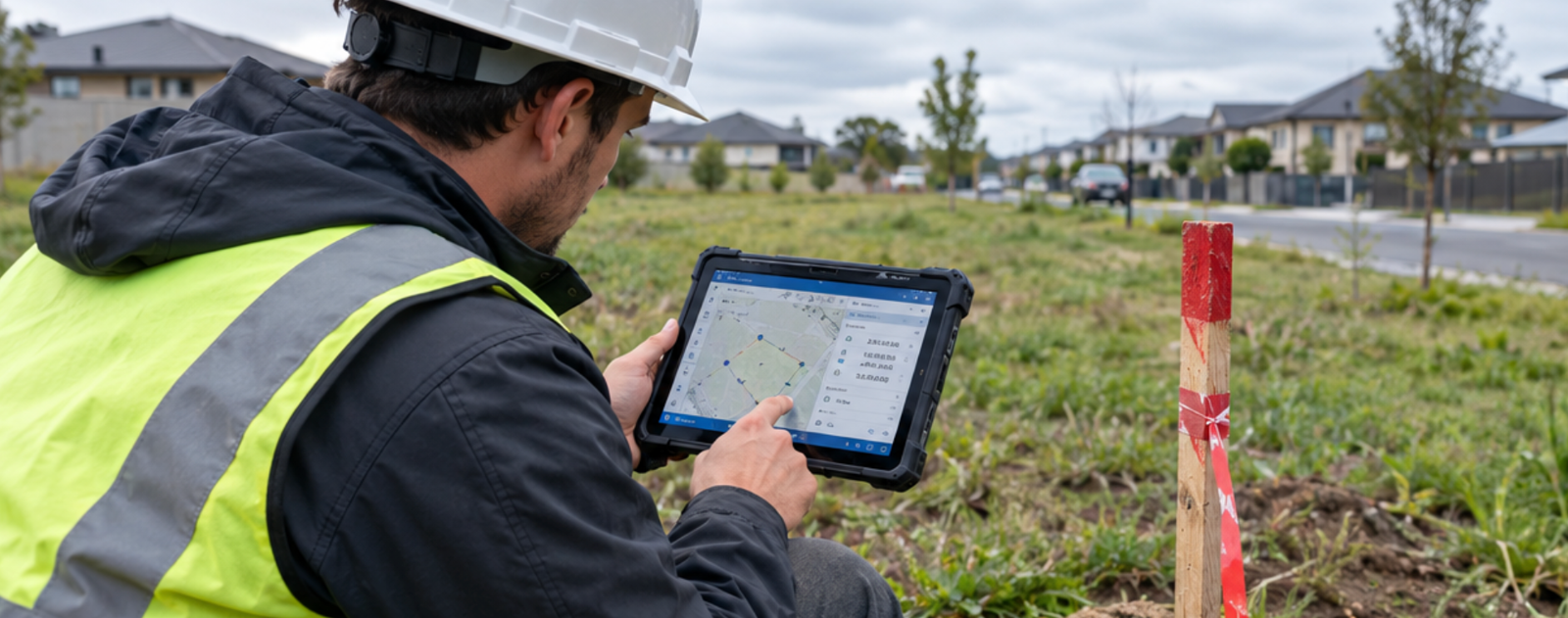
The 10.1-inch FHD panel at 400 nits stays readable under an overcast sky at the parcel edge, and the 10000mAh 3.8V battery is sized for a full stakeout day without a charge. It records on 8GB of RAM and 128GB of storage, expandable to 256GB by TF card — enough for a season of point files before anyone prunes anything. IP67 sealing, a 1.2m drop rating and a -10°C to 50°C operating window cover the ordinary hazards of a right-of-way walk. The rear 20MP autofocus camera with flash takes the monument photos; the front 8MP handles a video call with the draftsperson while the crew is still standing at the corner. Android 16 keeps the app layer thin: the coordinate file lands in the cloud folder from the site, and the office drawing starts moving the same afternoon.
HTYJ08A: The Port That Ends the Day on Site
The HTYJ08A Rugged Tablet belongs to a different generation of the same answer. It runs Windows 10 or 11 Pro on an Intel 10th-generation Core i5-10210Y or i7-10510Y quad-core, which means the crew can run the same CAD and GIS packages the office runs — no re-export, no format conversion at the end of the day. Its defining port is the one most tablets gave up years ago: a full RJ45 Ethernet jack, alongside Mini HDMI, USB Type-A, USB Type-C, a DC input, TF and SIM slots and a 12-pin Pogo connector. Plugged into the site trailer's router or a portable fiber box, it joins the client's network directly and prints, plots or uploads at LAN speed.
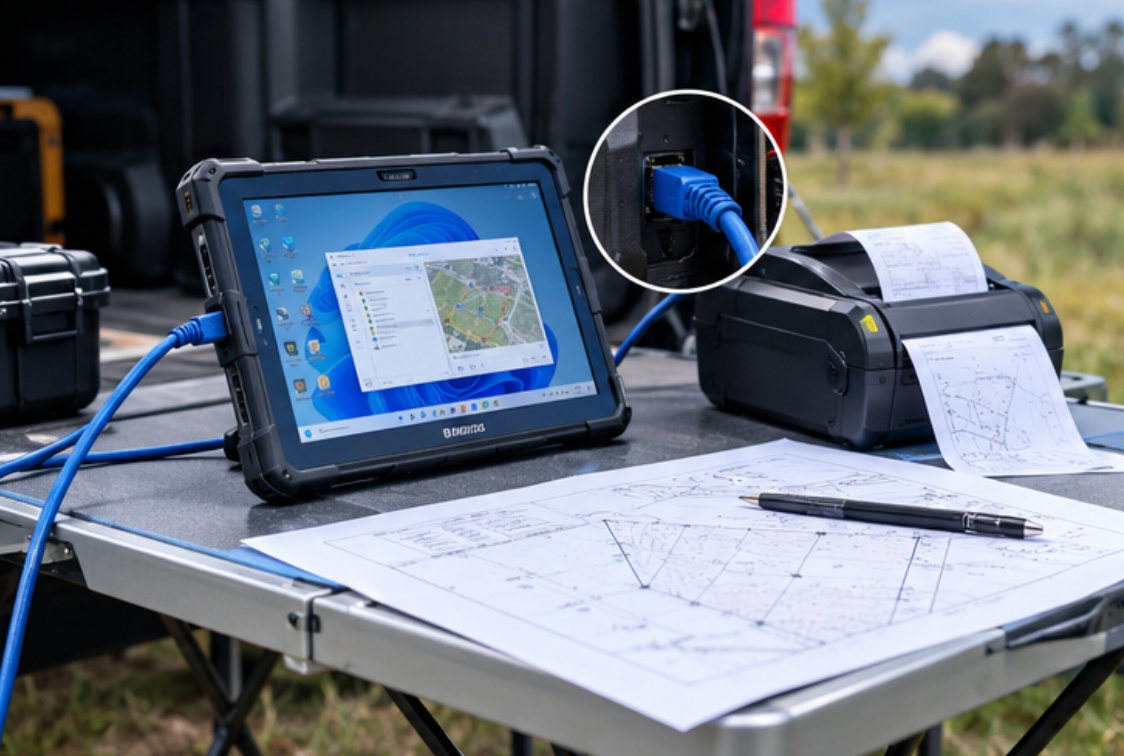
The 8-inch IPS screen holds the same 1200×1920 resolution as its bigger sibling but pushes brightness to 560 nits with a 7H hardness layer that accepts a stylus and wet-hand operation — the difference between reading a sketch at noon and squinting at it. Its 7.6V 3500mAh battery is removable, so a charged spare swaps in seconds instead of a charge cycle. Protection is the strictest of the three in paper terms: IP67 plus MIL-STD-810G, a 1.22m drop rating and a -20°C to 55°C operating window that keeps winter mornings inside spec. At 238×160×25mm it is the compact option, the one that fits a jacket pocket on a walk-in parcel with no vehicle access.
HTYJ10A: A Second Office Behind the Windshield
The HTYJ10A Rugged Tablet takes the same Windows platform, the same Intel i5/i7 quad-core, the same 560-nit 7H display technology and the same IP67 plus MIL-STD-810G body, and stretches it onto a 10.1-inch panel at 284×190×25mm. That extra screen area is not cosmetic on a survey job: a plat drawing, a deed sketch and a photo log fit side by side without window switching, which is precisely how a crew chief reviews work before signing anything. It adds one spec its smaller sibling leaves unpublished — 8GB of RAM and 256GB of storage, expandable further over M.2 SSD — which is the headroom local CAD files and a season of point data actually need.
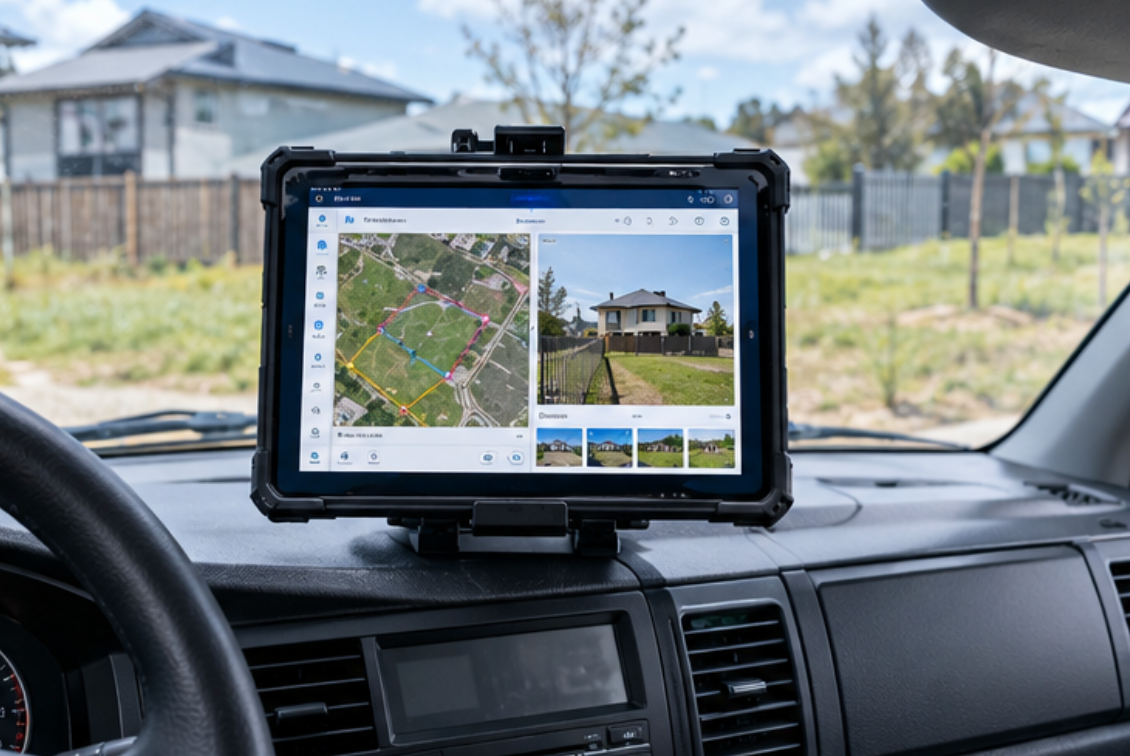
Mounted on the cab console, it becomes the field office: the Mini HDMI output drives a portable plotter or a second screen at the trailer, the RJ45 port ties into the site network during a lunch break, and the global 4G LTE module with Wi-Fi 6 covers the stretches between. The gross weight is quoted at approximately 2.1KG with the carton included — the panel and the port set are what a two-person crew shares, while the walk-around device stays in a pocket. Its 7.6V 3500mAh removable battery follows the same swap logic as the 8-inch model, and the same -20°C to 55°C window applies.
Where the Spec Table Actually Sorts the Three
| Column | RT82 | HTYJ08A | HTYJ10A |
|---|---|---|---|
| Display | 10.1in IPS 1200×1920, 400 nits | 8in IPS 1200×1920, 560 nits, 7H | 10.1in IPS 1200×1920, 560 nits, 7H |
| OS | Android 16 | Windows 10 Pro / 11 Pro | Windows 10 Pro / 11 Pro |
| Wireless | 5G SA/NSA 4x4 MIMO; Wi-Fi 6E; BT 5.2 | Global 4G LTE; Wi-Fi 6; BT 5.0 | Global 4G LTE; Wi-Fi 6; BT 5.0 |
| Positioning | GPS L1+L5; BeiDou RTK optional | GNSS via accessory | GNSS via accessory |
| Battery | 10000mAh 3.8V, fixed | 7.6V 3500mAh, removable | 7.6V 3500mAh, removable |
| Protection | IP67; 1.2m; -10°C to 50°C | IP67; MIL-STD-810G; 1.22m; -20°C to 55°C | IP67; MIL-STD-810G; 1.22m; -20°C to 55°C |
| Dimensions | 252×170×14.6mm | 238×160×25mm | 284×190×25mm |
Two rows stayed out of the table on purpose. Memory and storage would have an empty cell in the middle column: the HTYJ08A page lists "high-speed RAM plus SSD storage with M.2 extension" without publishing capacities, and guessing there would be worse than omitting. Weight is the other omission, because the three figures are not the same measurement — the RT82 lists under 650g without stating gross or bare, while the Windows pair quote approximately 1.8KG and 2.1KG gross with the carton included. Comparing those side by side would mislead more than help.
Where Each Connection Strains on a Real Site
The always-connected path has its own edge cases. A 5G link depends on the carrier map, and rural parcels at the county line are exactly where coverage thins; the RT82's LTE fallback bands keep a slower path alive, but a basement vault or a deep ravine still wins. Its fixed 10000mAh battery cannot be swapped, so a crew that runs long needs a power bank rather than a spare cell. The 400-nit panel, readable in shade and overcast, gives up ground to the 560-nit Windows pair under direct noon sun.
The wired path strains differently. The HTYJ tablets assume the site offers something to plug into — a router, a fiber box, a plotter — and on a greenfield parcel with no infrastructure, the RJ45 advantage pauses until the crew reaches the truck or the trailer. Their removable 3500mAh batteries make long days a logistics question instead of an outage: two spares in the cooler box outlast any fixed cell. And the MIL-STD-810G certification with the wider -20°C window is the reason the Windows pair keeps winter stakeouts on the schedule that the Android unit would slip.
🏆 Matching the Path to the Client's Deadline
Sort the three by when the client needs the file. If the deliverable clock starts before the crew leaves the parcel — same-afternoon drafts, live review with the title office — the RT82 and its 5G-plus-RTK build own that lane, and its centimeter-grade positioning makes it the only one that can also serve as the measuring instrument rather than just the delivery device. If the site has infrastructure and the workflow lives in Windows CAD, the HTYJ08A ends the day at the curb with a printed, signed set. If the review itself is the work — side-by-side plats, a plotter in the trailer, a season of files on local storage — the HTYJ10A is the field office. More dispatch notes and comparison pieces sit in the comparison archive for teams still weighing the trade.