- Select Language
Enterprise Flagship SeriesEngineered for mission-c...
P11 Series Next-Gen Enterprise Rugged Industrial ...
The PM156-1 is a 15.6-inch portable PC monitor fea...
Full SpecificationsModelHotus ST13‑JOSWindows 10 P...
A patrol kit is not installed the way an office device is installed. Nobody signs an office laptop over to a named officer at the start of a shift and reconciles it against a list at the end of one. A body camera, a handheld and a vehicle tablet all sit inside a chain of custody, and the moment a piece of that chain is unclear, the records the kit produces become arguable. I have watched a rollout stall for a fortnight over something as small as two units sharing an asset number that nobody could trace, and the hardware itself was fine the whole time.
That is the reason the three Hotus units in this article belong to different parts of the problem rather than to different price bands. A patrol day is spent in a vehicle, on foot, and at a fixed point where equipment crosses a line, and each of those three positions asks for a different device. What the three have in common is that they are all sealed, all built to be carried, and all meant to be handed to somebody who is not an engineer.
Most installation guides treat the job as finished when the screen lights up. In this setting that is only the halfway mark. A patrol installation is complete when three identifiers line up and stay lined up: the asset number on the device, the identifier of the position it is assigned to, and the time base it records against. If a handheld moves between vehicles without its asset record following it, the logger data it produces still looks valid — it is simply attached to the wrong place. That failure is silent for weeks and expensive when it surfaces.
So the first task in a rollout is not mounting anything. It is deciding which numbering scheme the force will use, and making sure the device records carry the same number an evidence log will print. Teams that have done this before tend to work outward from public safety solutions rather than inward from a hardware list, because the numbering decision constrains what the devices must be able to report.
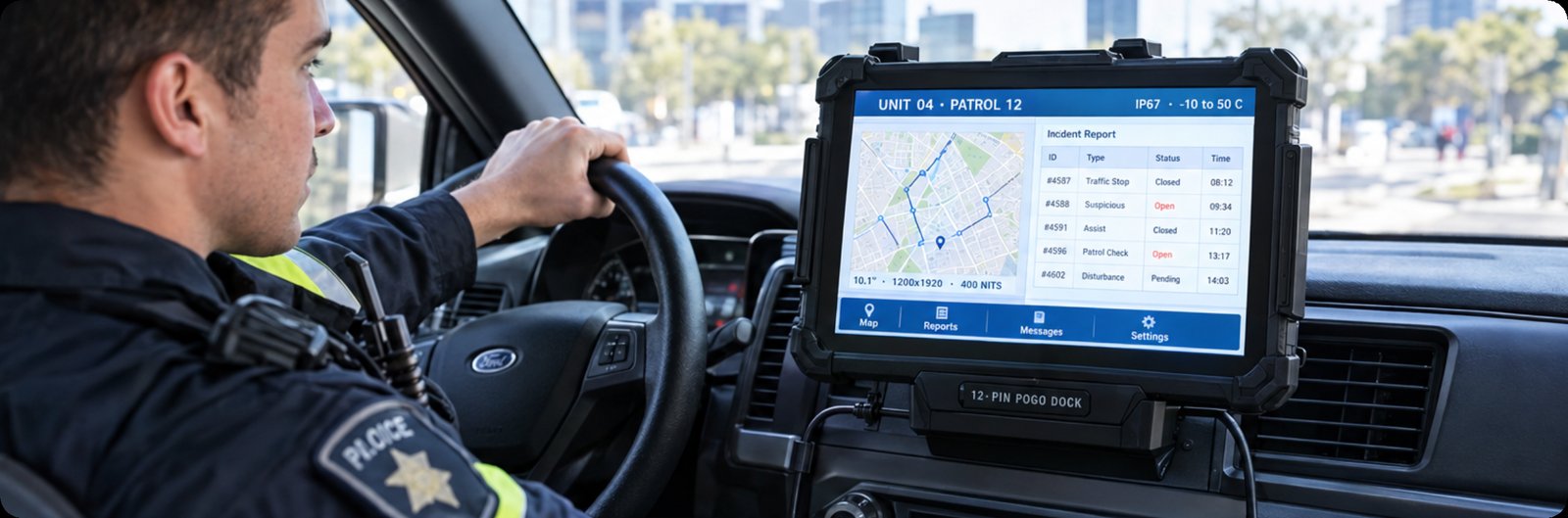
A mount in a patrol vehicle is not a bracket that keeps a tablet from sliding. It is the join between a moving platform and a device that has to stay readable while the platform moves. Three things decide whether that join holds. The first is vibration: a cradle that lets the unit rock will wear a connector long before it wears the screen. The second is where the panel sits relative to the driver's line of sight, which is a question of panel size rather than of software. The third is the power path, and that one is covered further down.
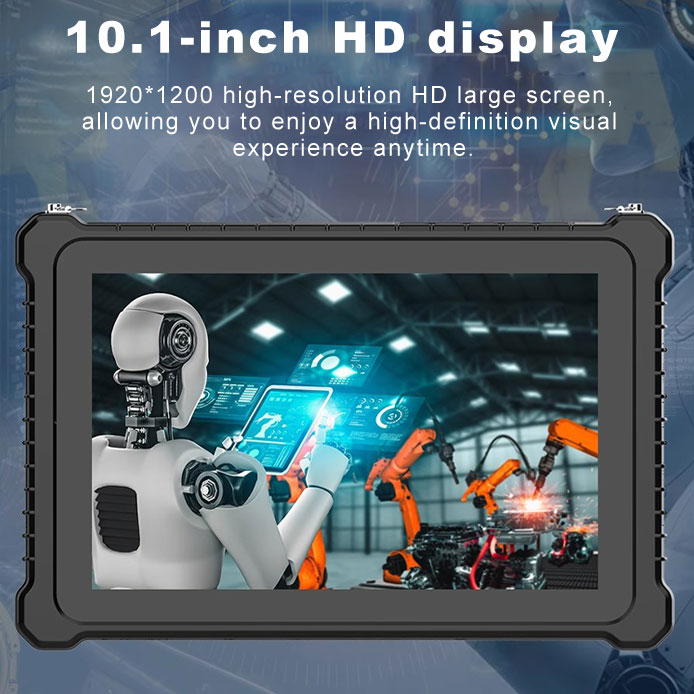
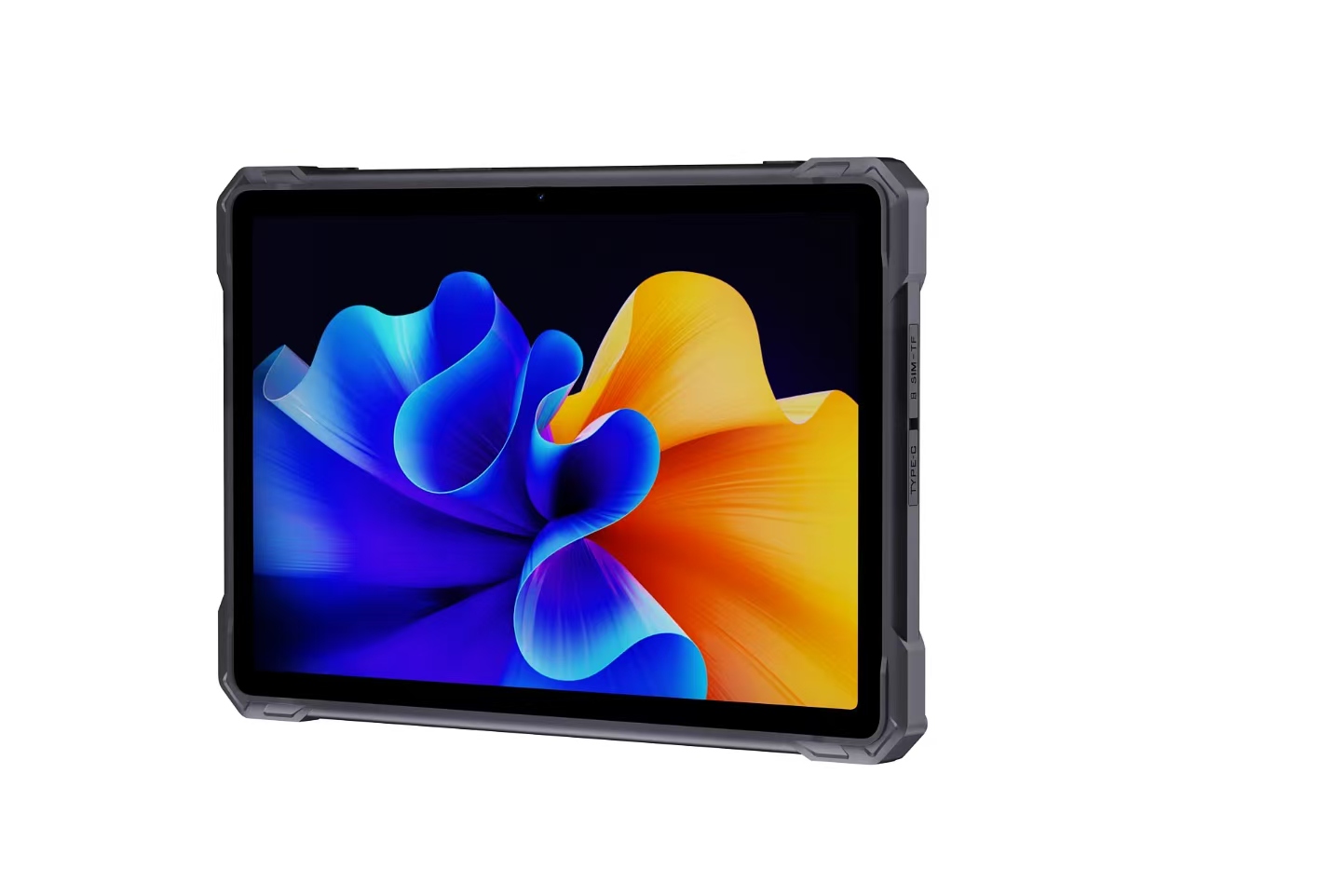
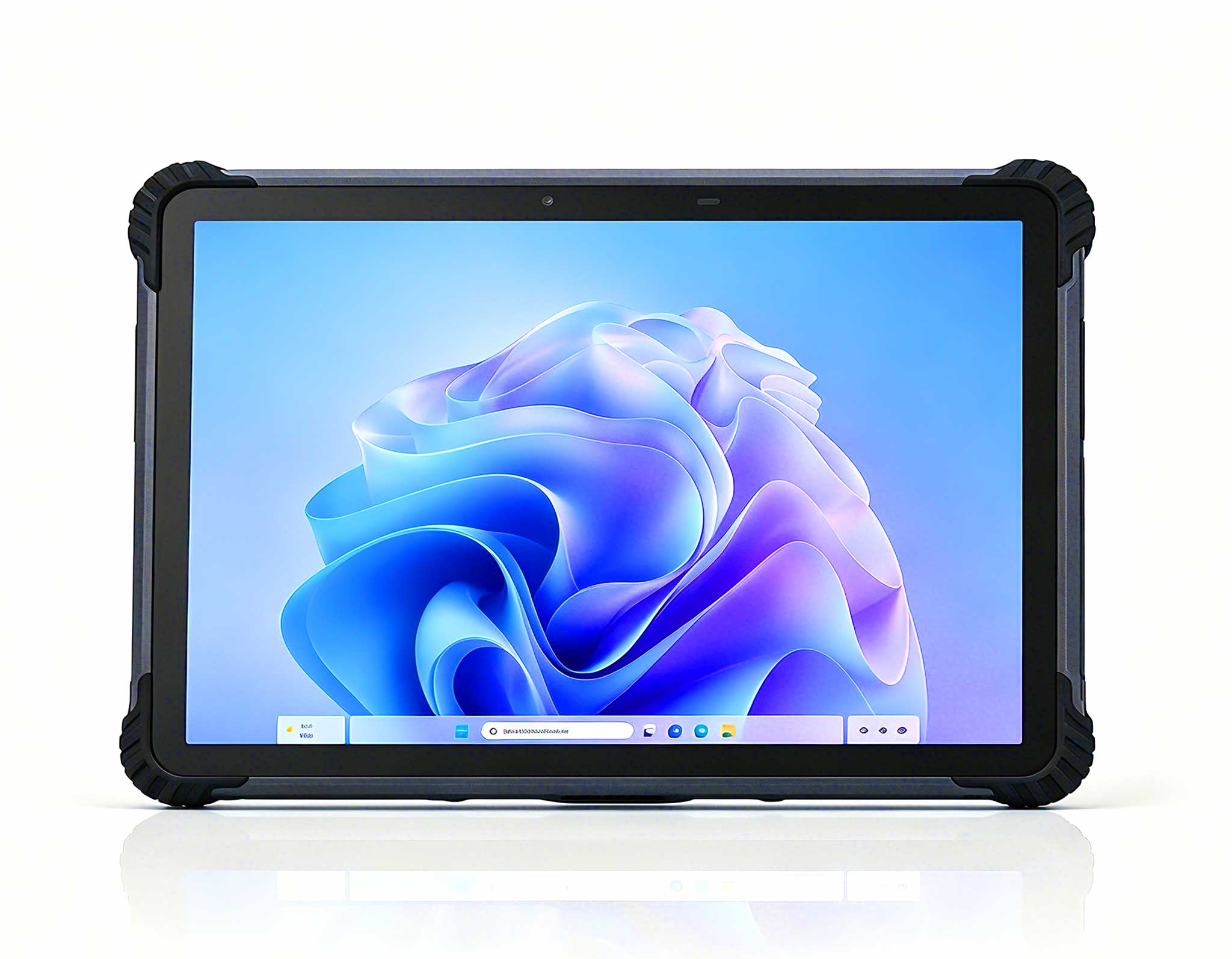
The RT82 Rugged Tablet answers all three in a way that suits a vehicle station. Its 10.1-inch IPS panel runs 1200 by 1920 at 400 nits, which is enough to read a case sheet at an angle in daylight without dimming the cabin. The housing is rated IP67 and survives a 1.2 metre drop, and the working range runs from minus 10 to 50 degrees, so a vehicle that sits in the sun and then drives into a cold store does not take the unit outside its envelope. The detail that matters most for a mount, though, is the 12-pin Pogo pin connector: one dock supplies power and data together, which removes the charging cable that would otherwise be the first thing to fail.
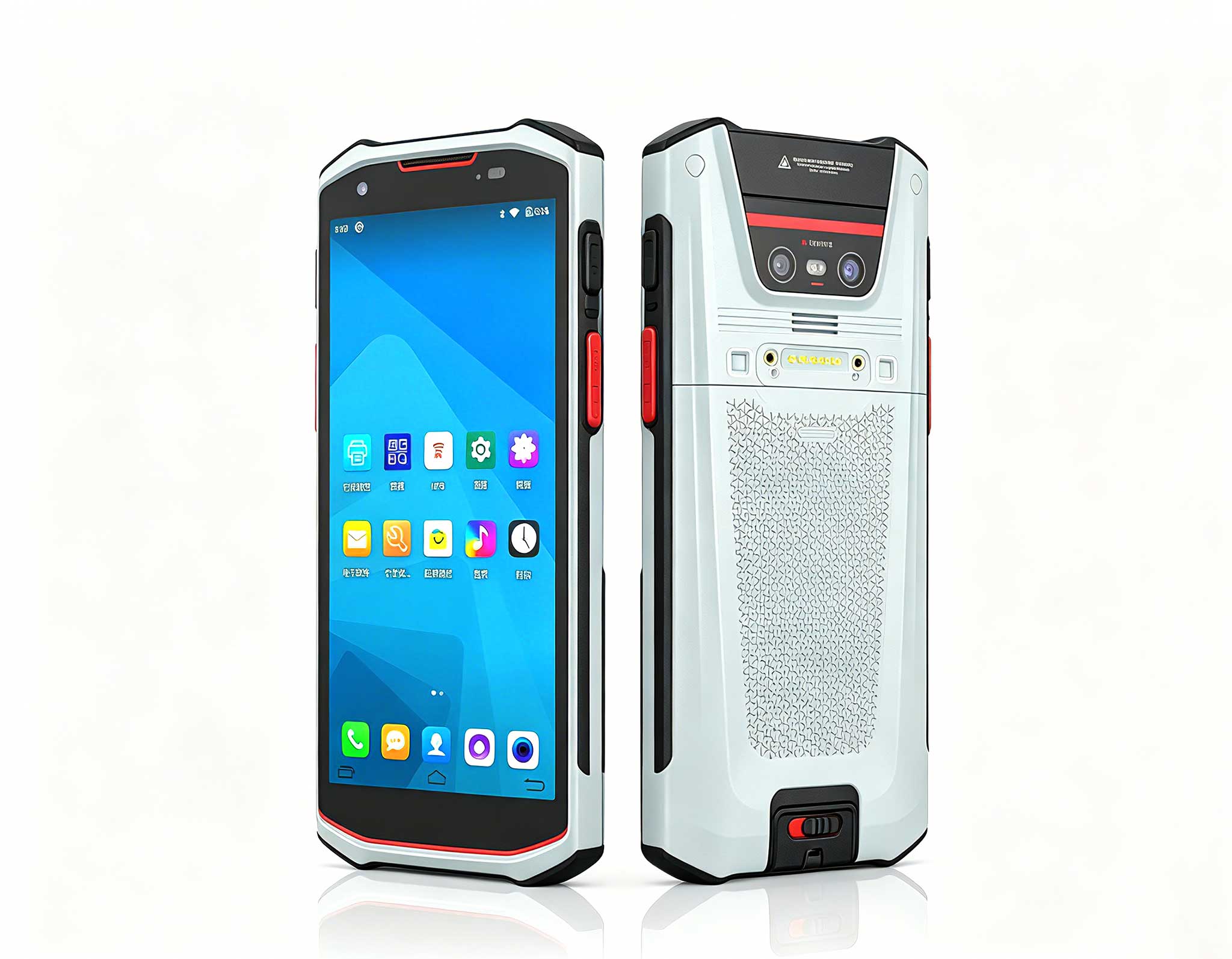
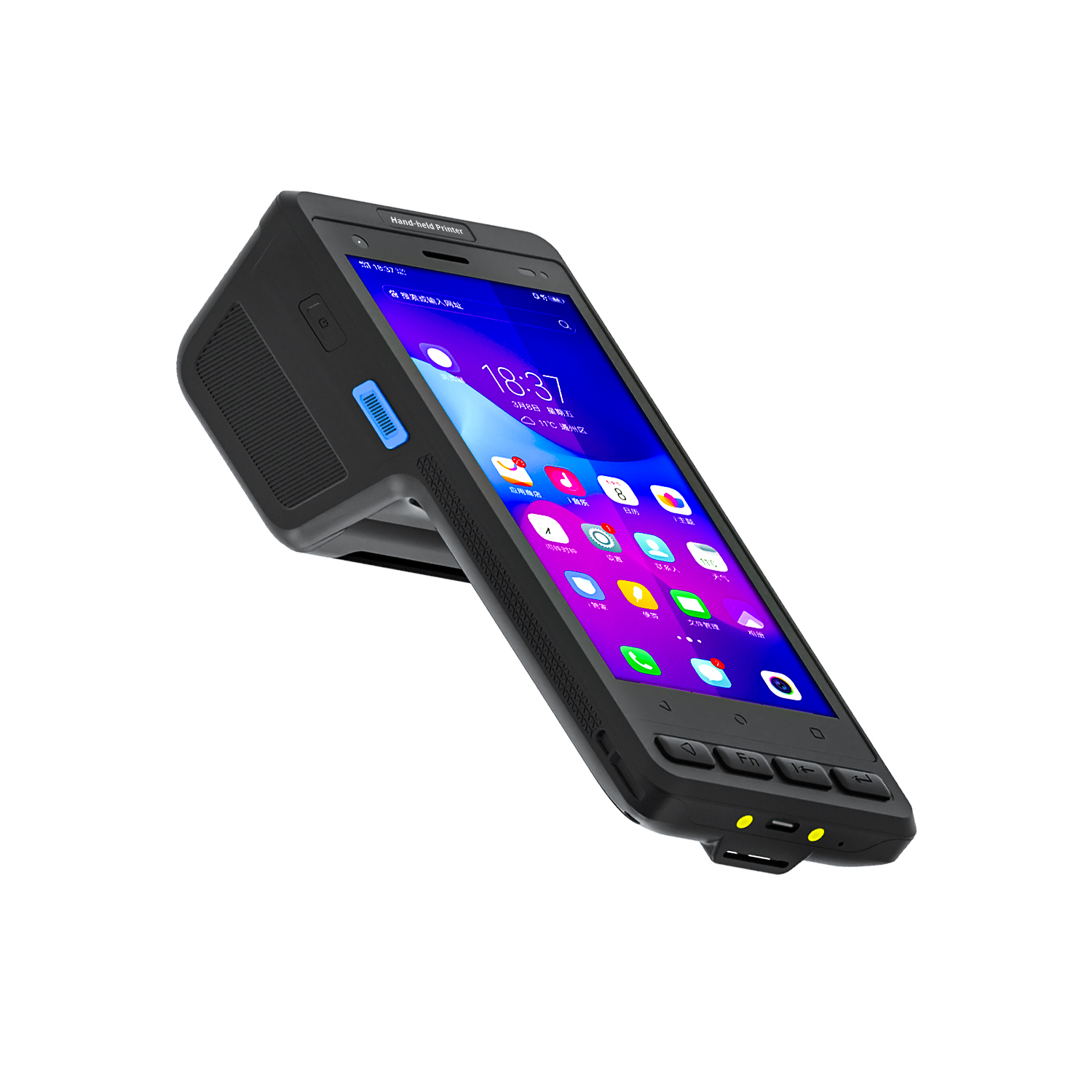
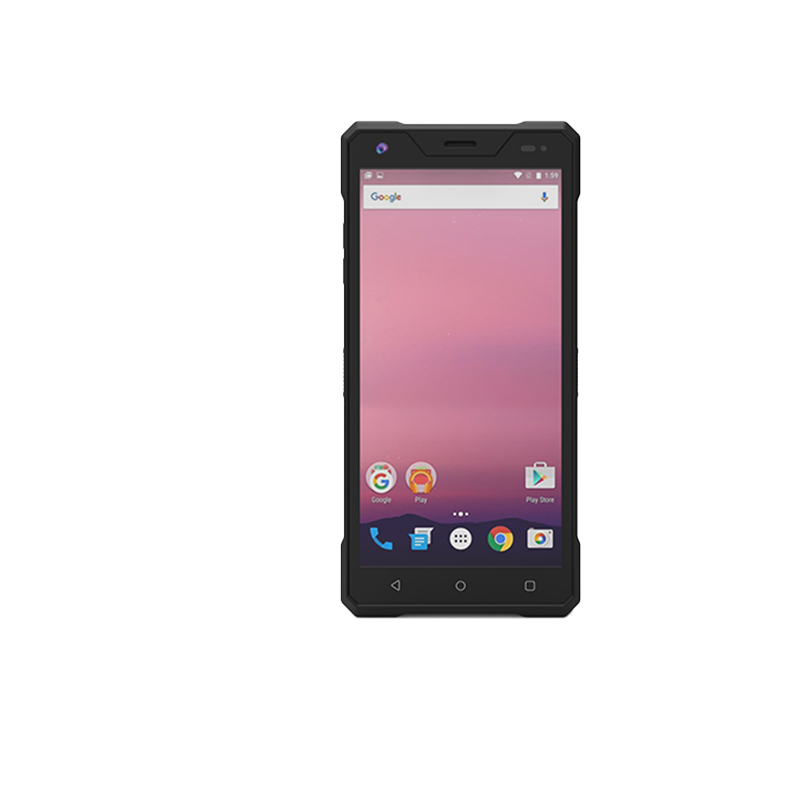
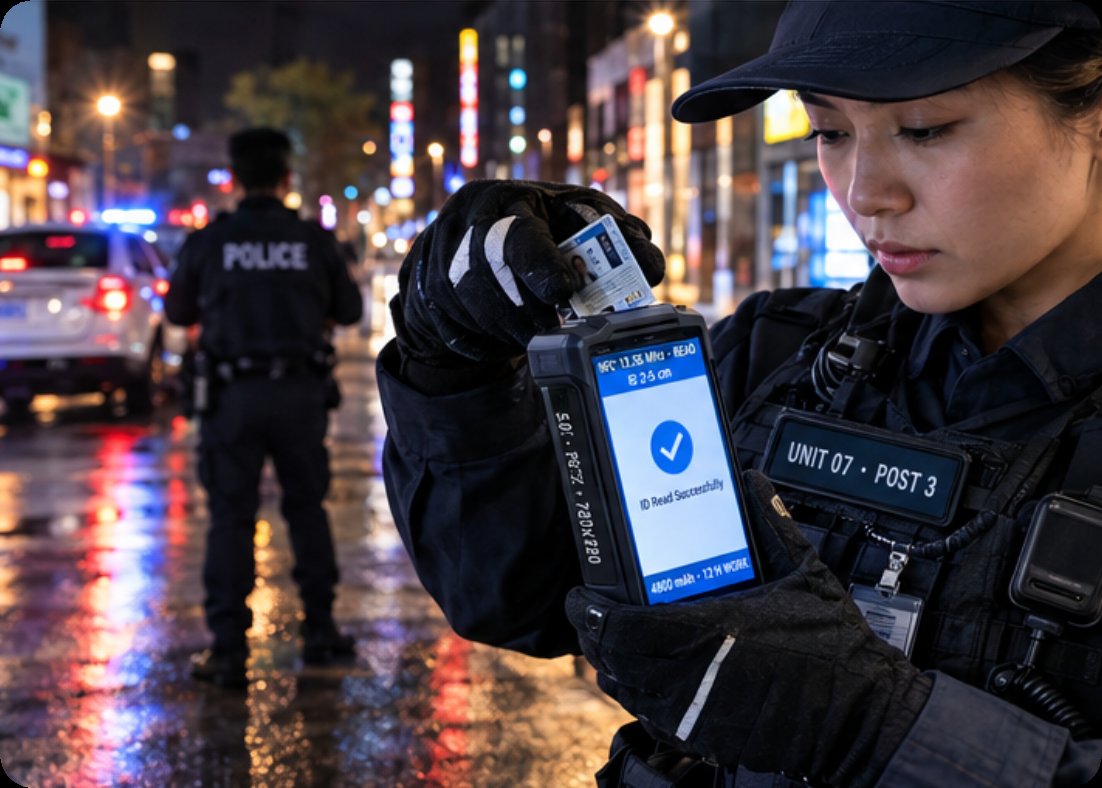
Once the vehicle station is settled, the next decision is what leaves it. The rule I would apply is that the device which leaves should be the one whose loss is least disruptive and whose battery is most easily replaced at a shift change. That points to a handheld with a removable cell rather than a sealed tablet, and it is exactly what the U9000 Handheld PDA is shaped for. The panel is 5.0 inches at 720 by 1280 — small enough to hold in one hand while the other hand is doing something else.
Its battery is a 4800 mAh pack at 3.7 volts, and it comes out of the body. Working time is quoted at over twelve hours and standby at over 350, which covers a long shift without a dock in the middle of it, and the charging cycle is under four hours on a standard adapter. The touch layer is Corning glass that accepts a gloved hand and a wet one, which is the specification that decides whether a device is usable on a wet night or merely carried on one. Data capture is expandable through the optional modules: NFC at 13.56 MHz with a read distance of two to five centimetres for a credential, and a UHF module rated to 840-960 MHz for a tag read beyond 1.5 metres. Both are options rather than defaults, and a force that only needs a barcode scan should not pay for either.
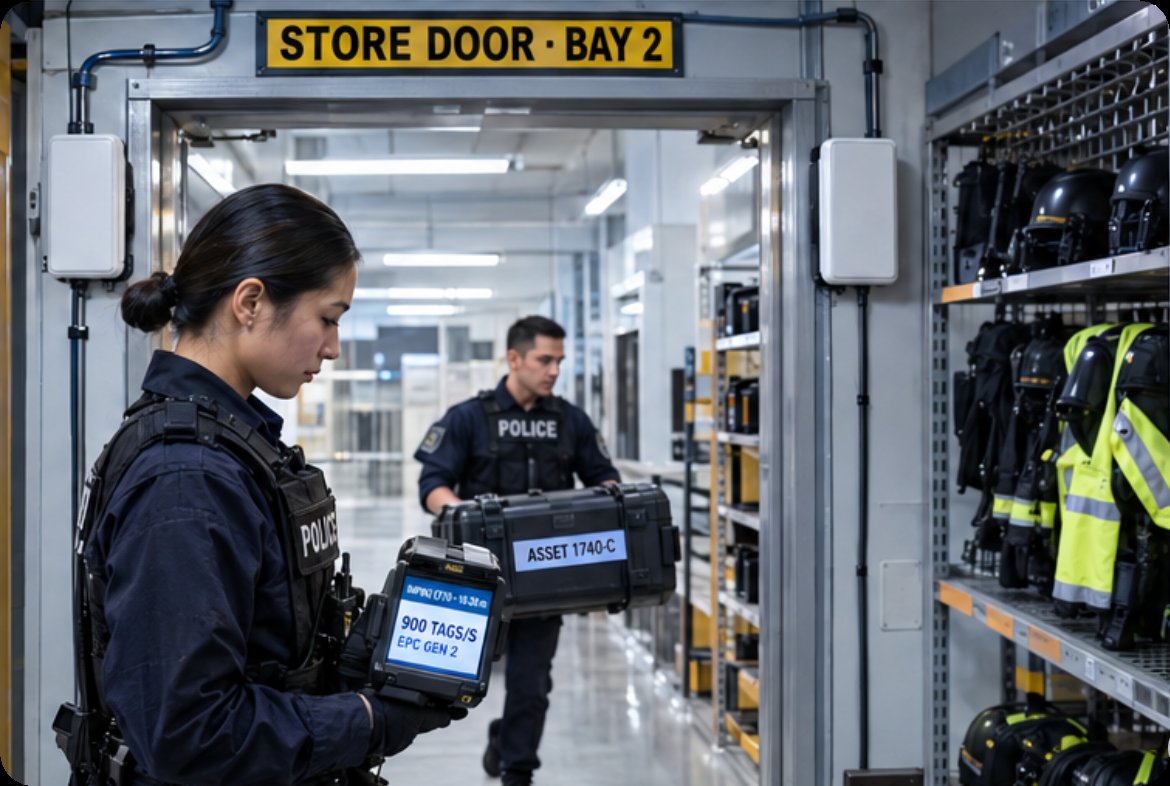
The third position is the one that is not carried at all. Where equipment crosses a line — a kit store, an armoury, a vehicle bay — the job is to record what went out and what came back without a person writing it down. That is a fixed read, not a walk-past read, and it wants a different radio from the one in a handheld.
The R366C-S UHF Reader is built around an Impinj E710 module rated above 900 tags per second, with a read distance of 10 to 20 metres on the supplied 4 dBi antenna. It works across the UHF bands a force is likely to be licensed for — 902-928 MHz, 865-868 MHz, and the 840-845 and 920-925 MHz ranges — and speaks EPC Class 1 Gen 2, so tags bought for one site are not orphaned at the next. The unit itself is a 5.5-inch handheld at 720 by 1440, which means the person standing at the door can confirm a read on screen rather than walking to a desk. Two PSAM slots are there for credential work where a force needs them. The point of putting a reader at the door is not speed for its own sake; it is that the exit record is created by the same event that moved the equipment.
Vehicle power is where a neat installation plan usually meets reality. A dock wired to a permanent live keeps charging a unit in a vehicle that is parked for a week, which is how batteries age out early. A dock wired to the ignition line is the better answer, but it introduces a second problem: every start of the day is a cold start, and a device that takes an extra moment to settle at seven in the morning will be the one that drops out at noon. Sealed hardware that tolerates a wide operating range is what makes that trade acceptable, which is the argument for the three-proof hardware built for field work rather than for a consumer tablet in a rugged case.
Battery architecture follows from the same logic. The RT82 carries a sealed 10000 mAh pack at 3.8 volts, so its charging story belongs entirely to the dock. The R366C-S carries the same 10000 mAh at 3.8 volts but in a detachable form, and the U9000 uses a smaller 4800 mAh pack that also comes out. That difference decides the spare strategy: a depot that stocks spare cells for two of the three units can swap a battery at a shift change and put a full one back on the shelf, where a sealed unit has to be docked and waited for.
The physical position of the cradle deserves more thought than it usually gets, because two of the three failure modes in a vehicle install come from placement rather than from hardware. Antenna and reader performance is the first. A UHF antenna pressed against a steel bulkhead will read a shorter distance than the same antenna in open air, and an NFC reader built into a handheld has to be presented to the credential rather than held near a metal panel. The second is the cable run: a Type-C lead that crosses the cabin floor will be stepped on, and the fix is routing rather than a thicker cable.
The practical sequence that avoids rework is to choose the panel position first, then the dock, then the cable path, and only then the software profile. Doing it in the other order is what produces a mount that fits the dashboard but not the officer's reach, and a retrofit that costs more than the original install.
What each unit publishes is worth reading side by side, because the three are not competing for the same requirement. Two of them share an operating system generation and one does not, and that single line changes how a device is enrolled and how long a configuration profile takes to apply.
| Specification | RT82 Rugged Tablet | U9000 Handheld PDA | R366C-S UHF Reader |
|---|---|---|---|
| Processor | Qualcomm QCM6690 octa-core 2.9 GHz | Cortex-A53 quad-core 2.0 GHz | Qualcomm SM6225 octa-core 2.4 GHz |
| Operating system | Android 13 | Android 9.0 | Android 13 |
| Memory and storage | 8 GB + 128 GB, TF to 256 GB | 2 GB + 16 GB, expandable | 4 GB + 64 GB, TF to 256 GB |
| Display | 10.1-inch IPS FHD 1200x1920, 400 nits | 5.0-inch IPS 720x1280 | 5.5-inch IPS HD+ 720x1440 |
| Battery | 10000 mAh 3.8 V, sealed | 4800 mAh 3.7 V, removable | 10000 mAh 3.8 V, removable |
| Working time | Not published | Over 12 h | Not published |
| Data capture | 2D scanner optional, 3 mil | NFC, 1D and 2D scan, LF and UHF optional | Impinj E710, 900 tags/s, 10-20 m |
| Wide area | 5G SA and NSA, LTE-FDD | 2G, 3G, 4G, 5G | 4G LTE, 3G and 2G fallback |
| Wireless | Wi-Fi 6E 2.4/5/6 GHz, Bluetooth 5.2 | 2.4 and 5 GHz 802.11ac | 2.4 and 5 GHz, Bluetooth 5.1 |
| Positioning | GPS L1+L5, BeiDou, RTK optional | GPS, Galileo, GLONASS, BeiDou | GPS, GLONASS, BeiDou |
| Card slots | 2 Nano-SIM, TF, Type-C, 12-pin Pogo | 2 PSAM, SIM, TF, POGO, Type-C | 2 Nano-SIM, TF, 2 PSAM, Type-C |
| Size and mass | 252 x 170 x 14.6 mm, under 650 g | 178 x 78 x 24 mm | 170 x 79 x 22.6 mm, under 700 g |
| Environmental | IP67, 1.2 m drop, -10 to 50 C | Not published | -10 to 50 C |
Read the table for what it leaves out. The U9000 does not publish an ingress rating or a drop height, and neither does the R366C-S; only the RT82 carries a full environmental line. That is not a defect in the smaller units so much as a statement about where each was expected to live. A handset that stays inside a jacket pocket needs less of an envelope than a panel that spends its life on a bracket in a vehicle.
| What the shift is doing | Device that fits | Why |
|---|---|---|
| Working from the vehicle | RT82 Rugged Tablet | 10.1-inch panel holds a case sheet and a map; the Pogo dock keeps power and data on one cable |
| Walking a check on foot | U9000 Handheld PDA | 5.0-inch screen, removable 4800 mAh cell, over 12 h working time, gloved and wet-hand touch |
| Reading a tag at a door | R366C-S UHF Reader | Impinj E710 above 900 tags per second, 10-20 m on the 4 dBi antenna, EPC Gen 2 |
The last piece of an installation is the paper that goes with it. A handover sheet that lists serial numbers is not enough on its own, because the questions that come up in week three are about behaviour rather than identity. Three lines cover most of them. Which vehicle or post the unit is assigned to, so a swap is a recorded event rather than a corridor conversation. Which profile build is on it, so a unit that behaves differently can be traced to a version rather than to a person. And what the unit is expected to report, in the words the recording system uses, so that the first audit does not turn into a translation exercise.
The operating system line in the table above is the reason that sheet cannot be generic. Two of these units run Android 13 and one runs Android 9.0, and enrolment paths and profile behaviour differ between those generations. A force that writes one profile description and applies it everywhere will discover the difference on the day it matters. For operators weighing these three against the rest of the range, product comparisons and competitor analysis sets out how the wider family lines up. Install the vehicle station first, put the smallest screen on the person who moves most, and give the door a reader that records the crossing — then let the numbering scheme decide whether the installation is actually finished.