An orchard scouting season generates two kinds of records: the disease notes crews collect block by block, and the repair tickets that pile up in the shed drawer when someone decides a tablet has failed. At the end of one growing season a twenty-hectare fruit operation pulled its drawer open and found eleven tickets — and by reading each one against what the machine was actually being asked to do, nine of them dissolved into fixes that cost nothing. This troubleshooting review walks through the three most repeated complaints, using the rugged tablet fleet the crews carry, and shows where a fault was real and where the orchard itself was the culprit.
A Season of Repair Tickets, Read Backwards
The operation runs three scouting crews from bud break through harvest, and each carries a different machine: a ten-inch Windows unit for the lead scout, an eight-inch Windows unit for the second pair of hands, and an Android-field unit dedicated to positioning work between rows. The tickets that survived scrutiny shared a pattern. None of the reported faults happened while the tablet was idle on a seat; every one of them happened at the moment the scout needed the screen, the battery percentage or the data connection most. That timing is the first diagnostic clue — a machine that fails only under peak demand is usually telling you about its environment, not its electronics. The crews now write the block number, the hour and the weather into every ticket before the tablet leaves the row, and the difference in repair quality has been immediate.
🖥️ ☀️ The Screen That Was Never Broken
The most frequent ticket read simply: screen dead in the top rows. The lead scout works the sun-facing side of the blocks between eleven and two, holding the HTNJ10C 10.1-inch rugged Windows tablet at chest height while leaning into the canopy. Its 10.1-inch IPS panel resolves 1200×1920 at 560 nits of brightness — bright enough for direct sun on paper-like reading, but the angle at which a scout tilts the panel against a bright sky changes perceived contrast dramatically. When the crew learned to square the screen to the sun instead of tilting it, the dead screens stopped being dead. The panel itself is a 10-point capacitive unit with 7H hardness that takes stylus input and wet-hand operation, so the leaf-surface swipes that scout crews actually perform never needed the tickets to begin with. What looked like hardware failure was ergonomics wearing a hardware costume.

Cold Mornings Drain Percentages, Not Cells
The second ticket came from April: battery fell from sixty to fifteen percent in twenty minutes, three mornings in a row. The machine was the HTNJ08C 8-inch rugged Windows tablet, carried by the second scout on the dawn circuit when block temperature still sat near two degrees. Lithium cells report wildly optimistic percentages when they warm up after a cold start, and the drop was chemistry reading its own gauge, not capacity leaving the cell. The fix was procedural: the 7.6V 3500mAh battery is removable, so crews now start the dawn circuit with a warm spare in an inside pocket and swap at the row end without shutting the machine down. Rated for IP67 dust and water, MIL-STD-810G drops from 1.22 metres and an operating window of -20°C to 55°C, the chassis itself never featured in a single ticket — the eight-inch panel shares the same 1200×1920 resolution and 560-nit brightness as its larger sibling, and at 1.8KG gross it rides a harness all morning without complaint.
The Upload That Waited at the Row End
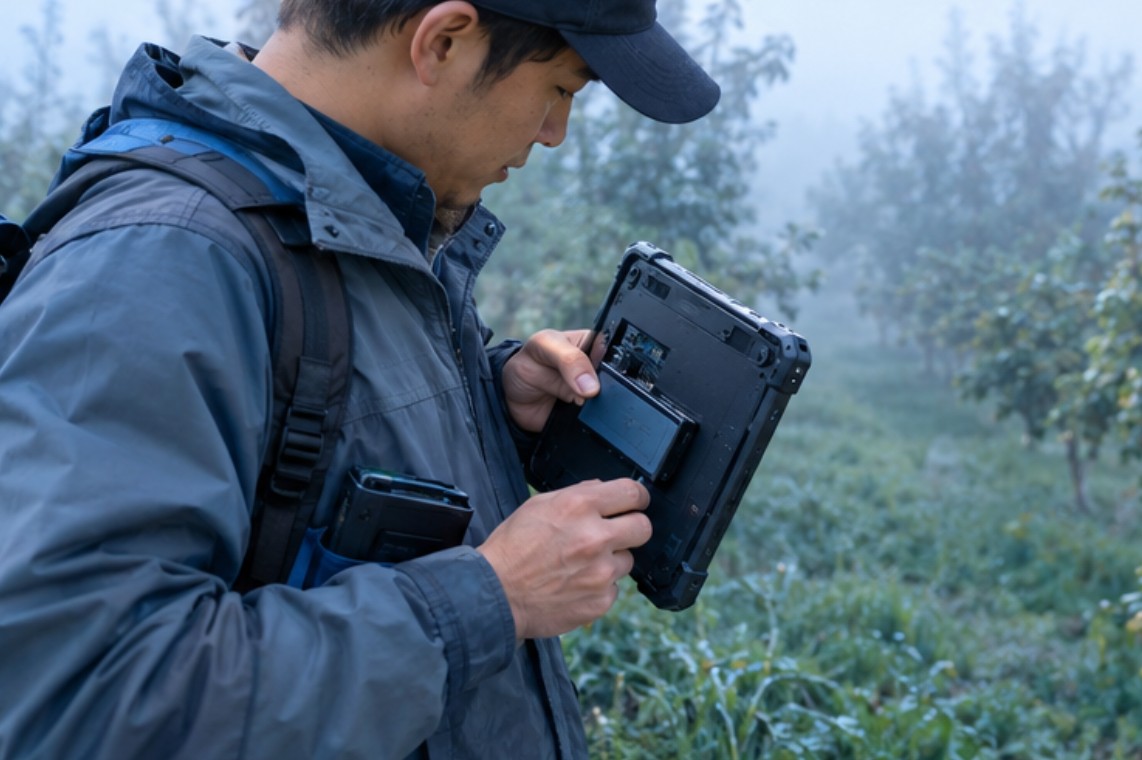
The third ticket looked like data loss: photos taken in the interior rows never reached the office server. The positioning unit, an RT81 rugged tablet, sits on this post because its Qualcomm SM6115 octa-core platform and independent Beidou plus RTK positioning hold row-level coordinates that the disease map depends on — but dense canopy at full leaf is hostile to any signal, and the 4G connection dropped in exactly the blocks where the worst infection pressure was found. Nothing was lost. The machine queued the evidence photos and pushed them the moment the scout reached the headland, a delay the office mistook for failure. Its 3.8V 10000mAh removable battery with power-delivery fast charging also absorbed the longest scouting days without a mid-shift swap, and the crew's fix was to treat the row end as the sync point — a habit, not a repair.

What the Season Log Weighs
Figures settle arguments that anecdotes start, so the shed now keeps the specification table below pinned beside the ticket drawer. When a new complaint arrives, whoever reads the ticket first checks the claim against the relevant row before touching the machine — and nine times out of ten the row explains the symptom. Buyers running their own fleets can copy the table straight into their maintenance binder; every figure comes from the current factory sheet for each model.
| Comparison Dimension | HTNJ10C — Lead Scout | HTNJ08C — Second Scout | RT81 — Positioning Unit |
|---|---|---|---|
| Display | 10.1" IPS, 1200×1920, 560 nits | 8" IPS, 1200×1920, 560 nits | 10.1" IPS, 1200×1920, 400 nits |
| Touch | 10-pt capacitive, 7H, stylus & wet-hand | 10-pt capacitive, 7H, stylus & wet-hand | G+G 10-pt capacitive |
| Platform / OS | Intel N100 (4C/4T, up to 3.4GHz), Windows 10/11 Pro | Intel N100, Windows 10/11 Pro | Qualcomm SM6115 octa-core 2.0GHz |
| Battery | 7.6V 3500mAh removable | 7.6V 3500mAh removable | 3.8V 10000mAh removable, PD fast charge |
| Operating temp | -20°C to 55°C | -20°C to 55°C | -10°C to 50°C |
| Durability | IP67, MIL-STD-810G, 1.22m drop | IP67, MIL-STD-810G, 1.22m drop | IP67, 1.2m drop |
| Positioning | BDS/GPS/GLONASS | BDS/GPS/GLONASS | GPS/GLONASS/Galileo, Beidou + RTK |
| Gross weight | 2.1KG | 1.8KG | Not published on the spec sheet |
| Warranty | 3-year limited | 3-year limited | 3-year limited |
Ports, Spray Drift and the Weekly Wipe
Two tickets in the drawer were maintenance wearing a fault costume. Spray drift settles a fine, slightly waxy film on every horizontal surface in the block, and after a month of season the USB-C ports and the charging pins on the dock develop just enough resistance to make a connection intermittent — the ticket reads charging fault, the reality is a film that a cotton bud and isopropyl alcohol remove in a minute. The shed routine is now a Friday wipe-down of every port on every machine, timed to the sprayer schedule so it never gets skipped in a busy week. Crews who want to compare notes on how other operations structure their hardware upkeep can find product comparisons and competitor analysis in the news section, where several fleet-maintenance threads have been covered in detail.
When a Fault Is Real: A Swap Bench at the Shed
Nine dissolved tickets still left two genuine faults, and the way they were handled is the part worth copying. One machine took a canopy branch strike that cracked the display corner; the other developed a port that no amount of cleaning recovered. Both went onto a swap bench — a shelf with one spare per post — and the damaged unit came off the roster the same hour, because every machine in this HOTUS product line carries a 3-year limited warranty and the swap-out took less time than diagnosing would have. The bench rule ends the argument about whether a scout finishes the day on a failing machine: nobody does. A ticket that survives the environment check, the film check and the cold-morning check is a real fault, and a real fault is a swap plus a warranty claim, not a debate in the row.