Police, fire and ambulance crews do not choose their weather, their lighting or the hour their equipment fails. A patrol-car tablet has to stay readable in direct afternoon sun, stay alive for a full shift and keep working after a drop onto pavement. The gap between a rugged tablet that merely survives and one that fits patrol work is wider than most spec sheets suggest.

HTXUK10A-55, HTNJ08C and HTYJ08A in Public Safety Patrol Duty
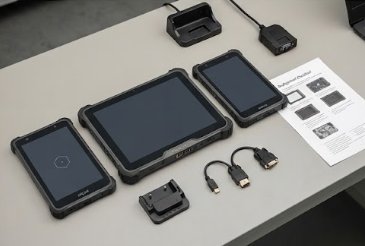
Three Hotus tablets cover three jobs in one fleet. The HTXUK10A-55 is a ten-inch Windows machine with desktop-class compute, the HTNJ08C pairs an eight-inch body with an efficient Intel N100, and the HTYJ08A puts a Core i5 or i7 into that same shell. Against them sit the Handheld Group Algiz 10XR, which lists public safety among its target applications, and the Dell Latitude 7230 Rugged Extreme, the enterprise default for public-sector fleets.
What a Patrol Shift Asks of a Tablet
A warehouse scanner works in bursts; a patrol tablet runs continuously from briefing to handover. Four demands dominate: a screen that stays legible in direct sun, enough battery to cross twelve hours, sealing that survives a roadside downpour, and a mounting path into a vehicle that does not change every model cycle.

Sunlight Readability: The First Thing That Fails
Brightness splits the field cleanly. Hotus lists 550 nits on the ten-inch panel with an optional 700-nit build, and 560 nits on both eight-inch models. The Algiz 10XR is specified at 850 nits, the Latitude 7230 at roughly 1000. For a device that lives on a dashboard or in a hand outdoors, that is the difference between reading a plate number and shielding the screen with a jacket.
Power That Outlasts the Shift
The Latitude 7230 carries dual hot-swappable cells, so a crew changes batteries without shutting down. The Algiz 10XR also uses a hot-swap pack. The ten-inch Hotus lists a detachable 11200 mAh pack rated near seven hours, and the eight-inch pair list 3500 mAh cells. None of the three Hotus pages claims hot-swap operation, which matters when the device must run a whole shift without a shutdown window.
The HTXUK10A-55: Compute Headroom for a Vehicle Bay
A Core i7-1255U with ten cores and an all-core turbo of 2.70 GHz is more processor than most mobile data terminals need, and that is the point. A vehicle-mounted unit that also runs mapping, video review or licence recognition benefits from headroom, and 16 GB of memory with storage to 1 TB leaves room for offline map caches and footage pulled during a shift.
The HTNJ08C: Eight Inches, N100, Built to Be Carried
The Intel N100 is a four-core part running to 3.4 GHz — modest, cool and frugal. In an eight-inch body that is the right trade for an officer on foot. The chassis is IP67 sealed and rated for a 1.22 m drop, with 5 MP front and 8 MP autofocus rear cameras and an LED fill light for documentation after dark.
The HTYJ08A: Same Body, Stronger Engine
The HTYJ08A shares the shell, the IP67 sealing, the 1.22 m rating and the port layout with the HTNJ08C, and swaps the N100 for a Core i5-10210Y or i7-10510Y. That makes them the most useful pair in the range: one dock, one case, one training programme, two performance tiers.
Handheld Group Algiz 10XR: Built for Public Safety
The Algiz 10XR is the competitor most explicitly aimed at this work. Its 10.1-inch 1920 by 1200 panel runs at 850 nits, it carries 5G and LTE, and its u-blox NEO-M8U GNSS receiver supports unconstrained dead reckoning — keeping position tracking alive in urban canyons and underground parking. Glove and rain touch modes are specified and the battery is hot-swappable.
Dell Latitude 7230 Rugged Extreme: The Benchmark
Dell's twelve-inch entry is the reference point most procurement teams can already price. Around 1000 nits, MIL-STD-810H, IP65, dual hot-swap batteries, a four-foot drop rating and an operating range from minus 20 to 145 degrees Fahrenheit. Twelve-generation Core i3, i5 or i7, 8 to 32 GB of memory and up to 1 TB of storage, at a published list price of roughly 2,443 to 3,343 US dollars.
Specification Comparison
| Model | Display and brightness | Compute and memory | Power | Sealing and drop | Price |
|---|---|---|---|---|---|
| HTXUK10A-55 | 10 in, 1920x1200, 550 nits (700 opt.) | Core i7-1255U, 16 GB, to 1 TB | 11200 mAh, about 7 h | IP65, drop not published | On request |
| HTNJ08C | 8 in, 1200x1920, 560 nits | Intel N100, RAM not published | 3500 mAh, hot-swap not stated | IP67, 1.22 m drop | On request |
| HTYJ08A | 8 in, 1200x1920, 560 nits | Core i5-10210Y or i7-10510Y | 3500 mAh, hot-swap not stated | IP67, 1.22 m drop | On request |
| Algiz 10XR | 10.1 in, 1920x1200, 850 nits | Atom x6413E, 8 GB, 128 GB | Hot-swappable | IP65, MIL-STD-810G | 2,500 to 3,500 USD |
| Latitude 7230 | 12 in, 1920x1200, about 1000 nits | Core i3/i5/i7, 8 to 32 GB, to 1 TB | Dual hot-swap | IP65, MIL-STD-810H, 4 ft | 2,443 to 3,343 USD |
Where Hotus Falls Short
Three gaps deserve to be stated plainly. None of the three Hotus models publishes a MIL-STD-810 claim, while both competitors do, and some tenders require it as a line item. The eight-inch pair publish no memory, storage or operating system, so a buyer cannot size them from the sheet alone. And Hotus lists only a gross shipping weight — 1.8 kg for the eight-inch models, 2.0 kg for the ten-inch — not the net weight that matters when a device is worn on a belt for twelve hours.
Ports, Mounting and Legacy Equipment
Where Hotus does lead is physical integration. All three models carry a full-size RJ45 port, a 12-pin pogo connector for a charging or vehicle dock, and RS232 or RS485 as a factory option. The Algiz 10XR offers three USB-C ports and no serial or Ethernet; adapting it to older in-vehicle equipment means carrying dongles. Fleets running legacy printers, radios or fixed readers feel that difference on installation day.
Choosing by Deployment Type
| Deployment | Recommended | Reason |
|---|---|---|
| Vehicle-mounted, high compute | HTXUK10A-55 | i7 class silicon, pogo dock, RJ45 |
| Foot patrol, single application | HTNJ08C | IP67, low draw, 8 in body |
| Foot patrol, multi-app or video | HTYJ08A | Same chassis and dock, stronger CPU |
| Urban canyons, GNSS critical | Algiz 10XR | UDR dead reckoning, 850 nits, 5G |
| Tender requires MIL-STD-810H | Latitude 7230 | Published certification, dual hot-swap |
Final Word
If the tender demands published MIL-STD-810H and hot-swap power, the Latitude 7230 is the safer signature. If position tracking through tunnels and dense streets drives the decision, the Algiz 10XR is built for exactly that. If the job is integrating with existing in-vehicle hardware and standardising one dock across two performance tiers, the Hotus range deserves a close look — provided the gaps above are confirmed first. Our public safety solutions page covers the wider deployment picture, the rugged tablet lineup lists every chassis we build, and the comparison library carries the rest of our head-to-head reviews.