A retail checkout asks three things of a device in about thirty seconds: read a barcode, take a payment, and hand over a receipt. Most enterprise handhelds do the first well and leave the other two to separate boxes on the counter. That holds up until the queue reaches the door.
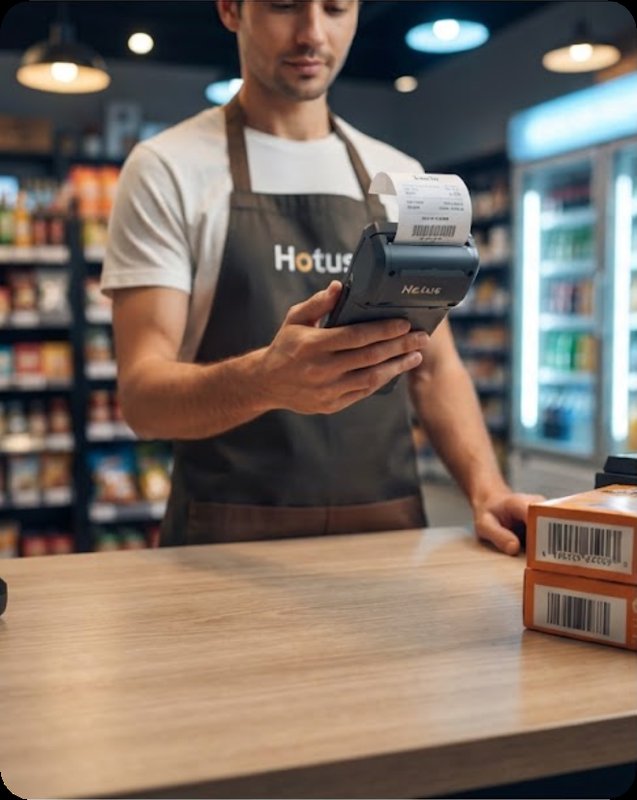
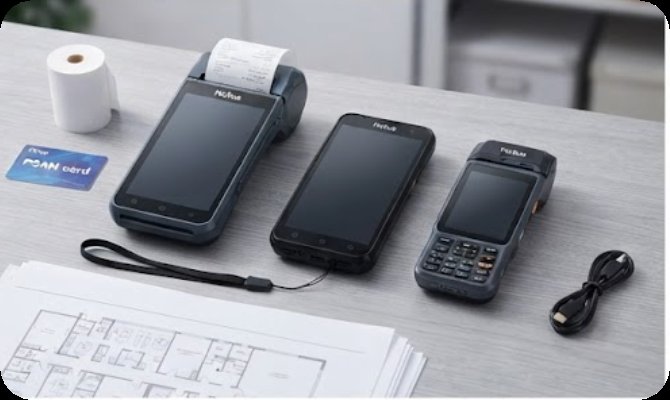
This comparison puts three Hotus terminals that each internalise one of those jobs against two generalists most retail buyers shortlist anyway. The Hotus R860-S prints, the Hotus R366-S handles secure payment credentials, and the Hotus R350C is built for fast keyed entry in one hand. Against them sit the Sunmi L3 and the Point Mobile PM84, two 5.5-inch terminals that scan well and leave printing to somebody else. Our industrial PDA range covers the wider category.
🛒 Hotus R860-S, R366-S and R350C: Three Answers to the Same Counter
All three share a platform family, take a Nano-SIM and a TF card, and support the same optional 2D imager rated to 3 mil. Where they split is the physical job each absorbs: the R860-S carries a thermal printer, the R366-S carries two PSAM slots, and the R350C carries a full keypad on a four-inch body.
💡 Why a Busy Queue Punishes General-Purpose Handheld Terminals
Retail floors fail differently from warehouses. A retail terminal lives in a hand at chest height, in front of a customer, so every stall is visible. Three pressures define it: spill exposure near chilled displays, drops onto tiled flooring, and eight hours of one-handed use where every extra hundred grams shows up by hour six.
Hotus R860-S: A Receipt Printer That Also Scans Barcodes
The built-in thermal printer runs at 70 mm per second on 57 mm rolls, handling both continuous receipt stock and black-mark labels. That covers a till receipt and a shelf-edge label on one device, which is what a store needs during a price change. It also takes four PSAM slots, an optional UHF module, and a 5600 mAh battery.
🪧 Hotus R366-S: Paying Without a Separate Payment Terminal
At 170 by 79 by 17.6 millimetres and under 300 grams, the R366-S is the thin one. What it adds is two PSAM slots, which removes a second device from the counter for stores running their own loyalty cards, staff credentials or a regional scheme that still expects a physical secure element. Its 4600 mAh cell supports hot swap without a reboot.
Hotus R350C: Four Inches, a Keypad and No Excuses
The R350C drops to a 4.0-inch panel and adds a physical keypad: digits zero to nine plus delete, back, enter, function, star, hash and a dedicated scan key. For gloved staff, or quantity entry where eyes stay on the shelf, that beats any on-screen keyboard. A Qualcomm QCM2290 quad-core on 11 nm keeps a 4000 mAh cell going a full shift.
🛒 Where the Sunmi L3 Genuinely Wins on the Shop Floor
Sunmi built the L3 for retail and hospitality first, and it shows. Its IP68 rating is the strongest sealing here by a clear margin. The hot-swap battery is rated at sixteen hours, Android 14 is current, and Sunmi charges no per-device licensing fee. At 260 grams it also undercuts every Hotus device here.
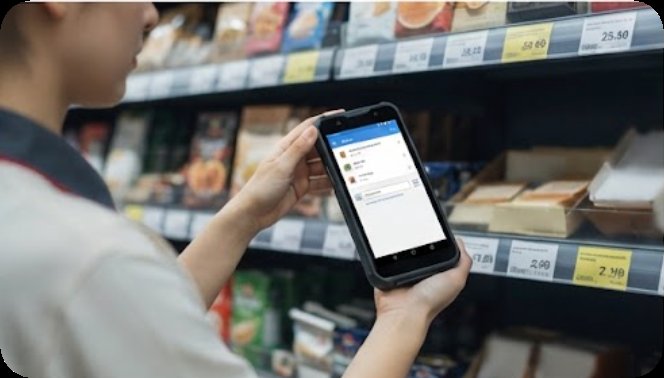
Where the Point Mobile PM84 Makes a Longer-Term Case
The PM84 answers a different objection: how long the fleet stays supportable. Point Mobile commits to seven years of security updates and holds Android Enterprise Recommended certification, with dual IP65 plus IP67 sealing and a 1.5-metre drop rating. Its 7020 mAh extended cell is larger than anything Hotus lists.
Specification Comparison at a Glance
| Device | Display | Battery | Weight | Sealing | The extra job |
|---|---|---|---|---|---|
| Hotus R860-S | 5.5" 720x1440 | 5600 mAh | <500 g | Not published | Thermal printer 70 mm/s, 4x PSAM |
| Hotus R366-S | 5.5" 720x1440 | 4600 mAh | <300 g | Not published | 2x PSAM |
| Hotus R350C | 4.0" 480x800 | 4000 mAh | <300 g | Not published | Full keypad |
| Sunmi L3 | 5.5" 1600x720 | Hot-swap, 16 h | 260 g | IP68 | None |
| Point Mobile PM84 | 5.5" 720x1440 | 4950 / 7020 mAh | 266 g | IP65 + IP67 | None |
What the Specification Table Does Not Show
Four of these five converge on nearly identical core specifications: the same memory, the same screen class, the same optional imager, the same NFC. The only real differentiation left is the last column, which physical task a device absorbs so a second box can leave the counter.
The Honest Trade-Off
None of the three Hotus devices publishes an IP rating, while the Sunmi L3 carries IP68 and the PM84 carries IP65 plus IP67; on a floor with a produce section or a drinks chiller, that is a real gap in documented evidence. The R860-S also pays for its printer in mass, at under 500 grams nearly double either competitor. And the R860-S and R366-S pages are inconsistent: the specification tables list a Qualcomm SM6115 at 2.0 GHz with Android 16, while the long-form copy describes an SM6225 at 2.4 GHz with Android 13. Confirm the build before ordering.
🛒 Matching the Terminal to the Store Format
| If your counter needs | Choose | Why | When a competitor is better |
|---|---|---|---|
| Receipts or labels on the spot | Hotus R860-S | Only device here with an integrated printer | A fixed printer sits within arm's reach |
| Secure card or credential handling | Hotus R366-S | Two PSAM slots under a 300 g body | Payments are fully cloud tokenised |
| Fast gloved keyed entry | Hotus R350C | Physical keypad, one-handed body | Staff only ever scan, never type |
| Best documented sealing | Sunmi L3 | IP68 and 16 h hot-swap at 260 g | The counter always stays dry |
| Longest support window | Point Mobile PM84 | Seven years of security updates | Fleet is replaced inside three years |
Where a store needs a larger screen for planogram work or supervisor review, a tablet beats any handheld here, and our rugged tablet lineup covers that end of the floor.
🛒 What We Would Tell a Store Manager
Buy for the slowest ten minutes of your busiest day, not the average one. If those minutes involve somebody walking to a fixed printer, the R860-S pays for itself. If they involve a shopper waiting while a card reader reconnects, the R366-S removes a pairing step. If they involve staff squinting at an on-screen keypad in gloves, the R350C is the cheapest fix on this page. Otherwise buy the L3 for the sealing or the PM84 for the support window.
🔮 Where to Go Next
These five are one slice of a wider market, and the right answer shifts with store format, payment mix and fleet life. For more side-by-side breakdowns across handhelds, tablets and mini PCs, see more device comparisons.