Proof at Every Checkpoint
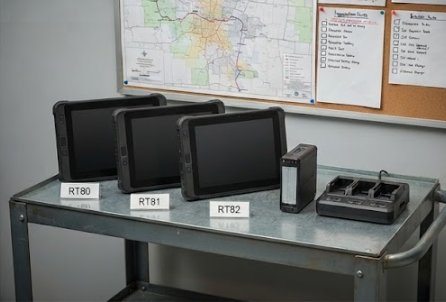
A factory inspection route is a chain of small claims. This gauge read 4.7 bar. This valve shows no corrosion. This bearing sounds normal. Each claim is only as good as its record: the scan proving the inspector reached that exact asset, the photo showing what was seen, the position log placing the visit, and the upload carrying it all back before shift end. The tablet an inspector carries decides how many of these proofs survive the plant floor.
⚖️ Hotus RT80, RT81 and RT82 vs Juniper Systems Mesa 4 and MobileDemand xTablet T8655 for Factory Inspection Routes
Three Hotus RT-series Android tablets line up against two established inspection platforms. The Juniper Mesa 4 is a 7-inch Windows machine built in the United States, trusted from Antarctic research decks to utility fleets. The MobileDemand xTablet T8655 is an 8-inch Windows tablet aimed at warehouses and inspection crews. The RT80, RT81 and RT82 take a different position: a 10.1-inch Android 13 body under 650 grams, with optional 2D scanning, NFC, fingerprint unlock and — the differentiator — an optional BeiDou RTK module putting centimetre-level positioning inside the tablet itself.
Confirming the Asset: Scan and Tap
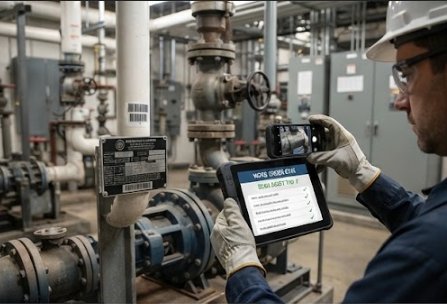
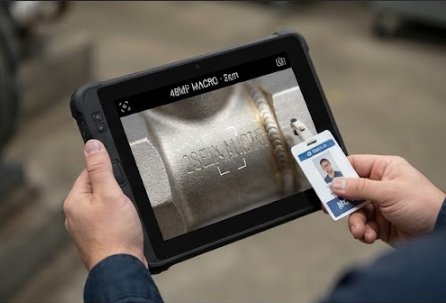
Every record starts by proving the inspector reached the right machine. All three Hotus tablets offer an optional 2D imager rated to 3mil — dense codes on small labels included — with a dedicated physical SCAN button findable through gloves without looking. NFC on all three reads ISO14443A/B and ISO15693 tags: tap the asset tag, and the checkpoint registers. RT80 adds fingerprint unlock, which matters when compliance systems must know who checked what.
The rivals answer differently. The Mesa 4 offers an optional built-in barcode imager plus a UHF RFID module with region-specific power — a genuine edge where assets carry RFID labels, and something the RT series covers only through ODM customisation. The T8655 integrates a Honeywell N6803 2D imager with laser aiming and an NFC module. On scanning hardware all three are credible; Android's app ecosystem simply makes third-party scanning workflows on the RT series quicker to assemble.
Photo Evidence That Survives Scrutiny
A defect photo is evidence only if it shows the detail. The RT80 pairs a 48MP autofocus camera with LED flash and an optional 8MP macro focusing down to 2 centimetres — close enough to read an etched serial number or photograph a hairline weld crack. The RT81 and RT82 carry a 20MP autofocus rear camera. The Mesa 4 documents 13MP with LED illumination; the T8655 lists front and rear cameras without publishing resolution or macro capability.
The RT80's processor adds an 8-trillion-operation NPU, which allows on-device image recognition — flagging a reading on an analogue dial, for instance, before the photo ever leaves the tablet. None of the Windows rivals publishes an equivalent on-device AI capability.
Positioning: Where the Record Says It Happened
Here the product pages genuinely diverge. The Mesa 4 uses a Quectel LC79H dual-frequency receiver rated at 2 to 5 metres; centimetre work requires the external antenna port and third-party RTK equipment. The T8655 publishes GPS without accuracy claims. The RT series offers an optional independent BeiDou module with RTK correction, delivering 2-5cm horizontal accuracy without external base stations — the module runs on its own, so it does not tax the main processor. The RT82 adds GPS L1+L5 dual-band reception, resisting the multipath reflections that metal racking causes indoors and in yards.
For an audit trail the meaning is simple: a scan plus a 2-5cm fix is a defensible record of which of six identical pumps was inspected. A 5-metre fix often is not, because at 5 metres the wrong pump sits inside the error circle. Hotus's RT81 deployment notes claim a utility fleet cut per-pole inspection time by 40% and lifted asset-database accuracy from 78% to 98% after dropping consumer tablets plus separate GPS receivers — one device, no manual re-entry.
Screens, Sunlight and the Brightness Gap
Honesty first: this is where the RT series is weakest. All three Hotus models use a 10.1-inch 1200×1920 panel at 400 nits. The T8655 runs 650 nits on an 8-inch screen. The Mesa 4 is rated 800 nits typical and measured 1,027 nits in independent testing. In direct sun the Mesa 4 is the comfortable read, the T8655 workable, and the RT series the one where an inspector tilts the screen or finds shade. Indoors — where most factory routes run — 400 nits at FHD is adequate, and the 10.1-inch display shows more form or schematic at once than either rival's smaller panel.
Batteries You Cannot Swap
Second honest gap: the RT series battery is fixed. The 10000mAh cell delivers 12-14 hours of mixed scanning and transmission, covering most shifts, but when it empties the tablet goes to a charger rather than taking a fresh pack. Both rivals are built for battery changes: the Mesa 4 carries a removable 43.2Wh pack with an optional internal 21.6Wh battery enabling genuine hot-swap — the main pack changes without powering down. The T8655 offers 64Wh and 98Wh packs, up to 16 hours, with a spare-battery charger. Continuous three-shift operations should weigh this seriously; a single-dayshift crew, less so.
⚖️ Android 13 versus Windows 11
The software question decides more purchases than any spec. The RT series runs Android 13 (RT80 offers Harmony OS), deploying through standard MDM with firmware close to AOSP. Most modern inspection platforms — CMMS clients, form builders — ship Android apps. The Mesa 4 and T8655 run Windows 11 Pro. If the plant's inspection software is a legacy Windows program, the Windows tablets are the only options here that run it, full stop. The reverse holds too: a team standardised on mobile forms gains little from Windows and pays for it in weight (680-907g for the Mesa 4, about 1.2kg for the T8655, against under 650g for any RT model).
🛡️ Rugged Ratings and Operating Range
The Mesa 4 is the reference here: IP68 sealed — tested to 1.4 metres for two hours, with protection maintained while ports are in use — plus MIL-STD-810H procedures and -20°C to 50°C operation. The RT series and the T8655 both start at -10°C, which rules out deep-freeze and unheated winter yards at the bottom end. The RT tablets carry IP67 (1 metre, 30 minutes) with 1.2m drops on the RT81 and RT82; the T8655 is IP65 with a 1.5m drop rating and a million-tumble test. For washdown-adjacent routes the IP67/IP68 tier matters more than marketing: all three survive hosing; only the Mesa 4 claims submersion.
Choosing by the Route
Map the route before choosing. If checkpoints need defensible position proof — identical assets, audit trails, regulatory scrutiny — the RT series' built-in RTK is the capability neither rival matches without extra equipment, and the RT80's macro camera turns small print into readable evidence. If inspectors work outdoors in bright sun all day, the Mesa 4's measured 1,027-nit screen and IP68 sealing justify its place despite the smaller panel. If the plant runs Windows software and three shifts, the T8655's swappable 98Wh battery fits best. Hotus publishes no RT pricing; factory-direct quotes and OEM options (UHF RFID, custom bands, preloaded apps) matter for fleets above roughly fifty units.
See deployment patterns on our factory inspection page and route examples on the industrial inspection solutions page, then compare the hardware: the RT80 5G, the RT81 4G and the RT82 5G with Wi-Fi 6E. More device comparisons cover other matchups.