- Select Language
The X501 Handheld PDA combines advanced barcode sc...
The R501 PDA combines a powerful MT6762 Octa-Core ...
R530C 6.0-inch Industrial PDA | Qualcomm Octa-core...
The N60 PDA is a cutting-edge device for inventory...
Explore our customized PDA designed for versatile ...
Full SpecificationsModelHotus ST9‑MOSWindows 10/11...
This dual touchscreen gaming laptop combines cutti...
Rugged hardware is usually sold on one word: proof. Buyers then discover that IP67, ATEX Zone 1 and MIL-STD-810H certify three unrelated things, and that a device can hold one while failing the other two. This comparison separates those claims and sets three Hotus tablets against two certified specialists.
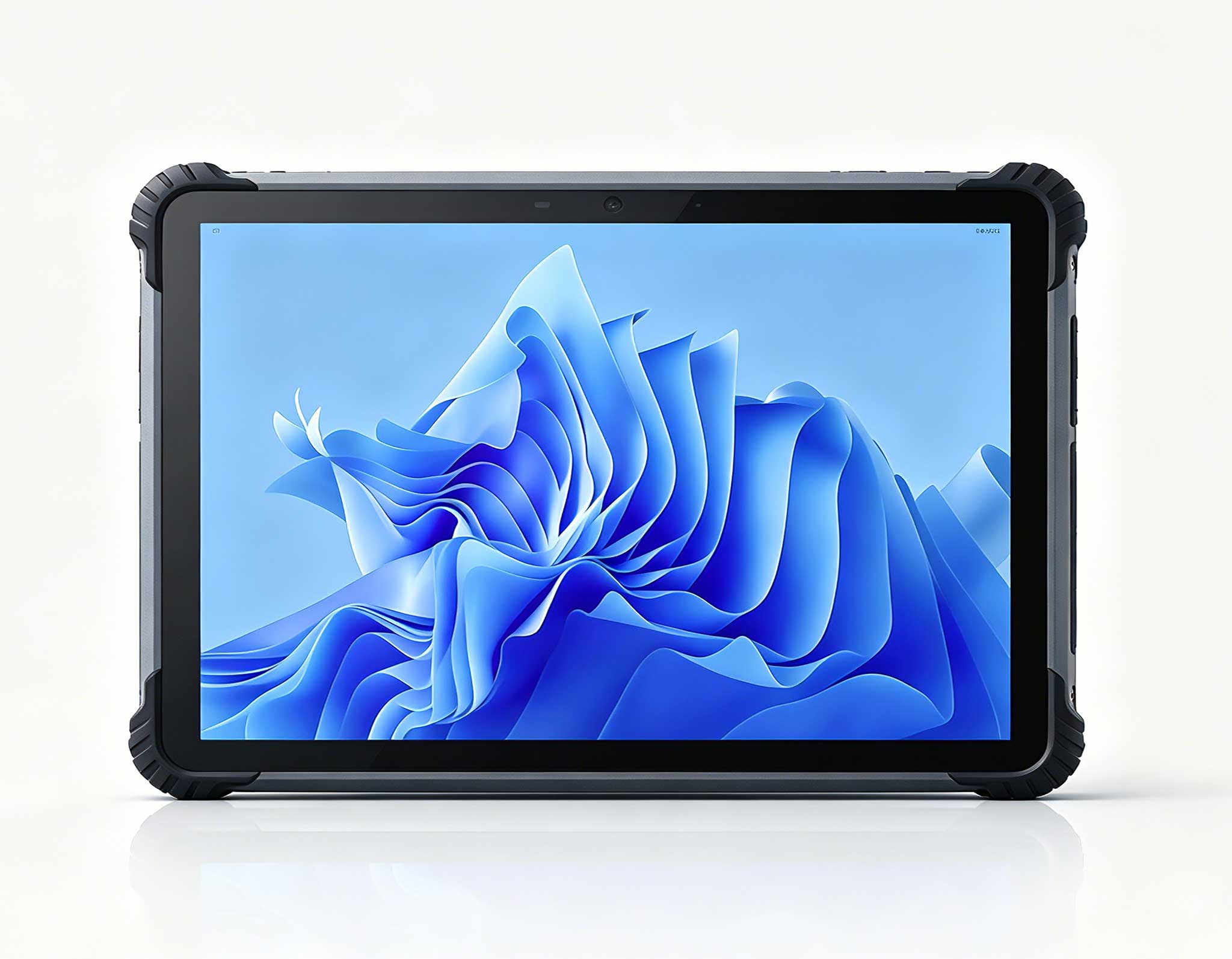
The three Hotus devices are the eight-inch HTNJ08B and the ten-inch HTNJ10B and HTNJ10C, all built on the same double-layer sealed enclosure. The opposing pair represents the two hardest certification routes in the market: the Aegex Aegex100M, certified for explosive atmospheres, and the MilDef DS16P, qualified to military environmental and electromagnetic standards. Where a manufacturer does not publish a figure, this article says so rather than estimating. Hotus positions this family for industrial three proof solutions in factories, warehouses and field work.
IP67 is a two-digit ingress protection code. The first digit, six, means the enclosure is dust-tight. The second, seven, means it survives immersion in one metre of water for thirty minutes. Nothing in that code covers an explosive gas atmosphere, a drop onto concrete, electromagnetic emissions or a temperature swing, which is why an IP67 tablet and an IP67 phone are not comparable devices.
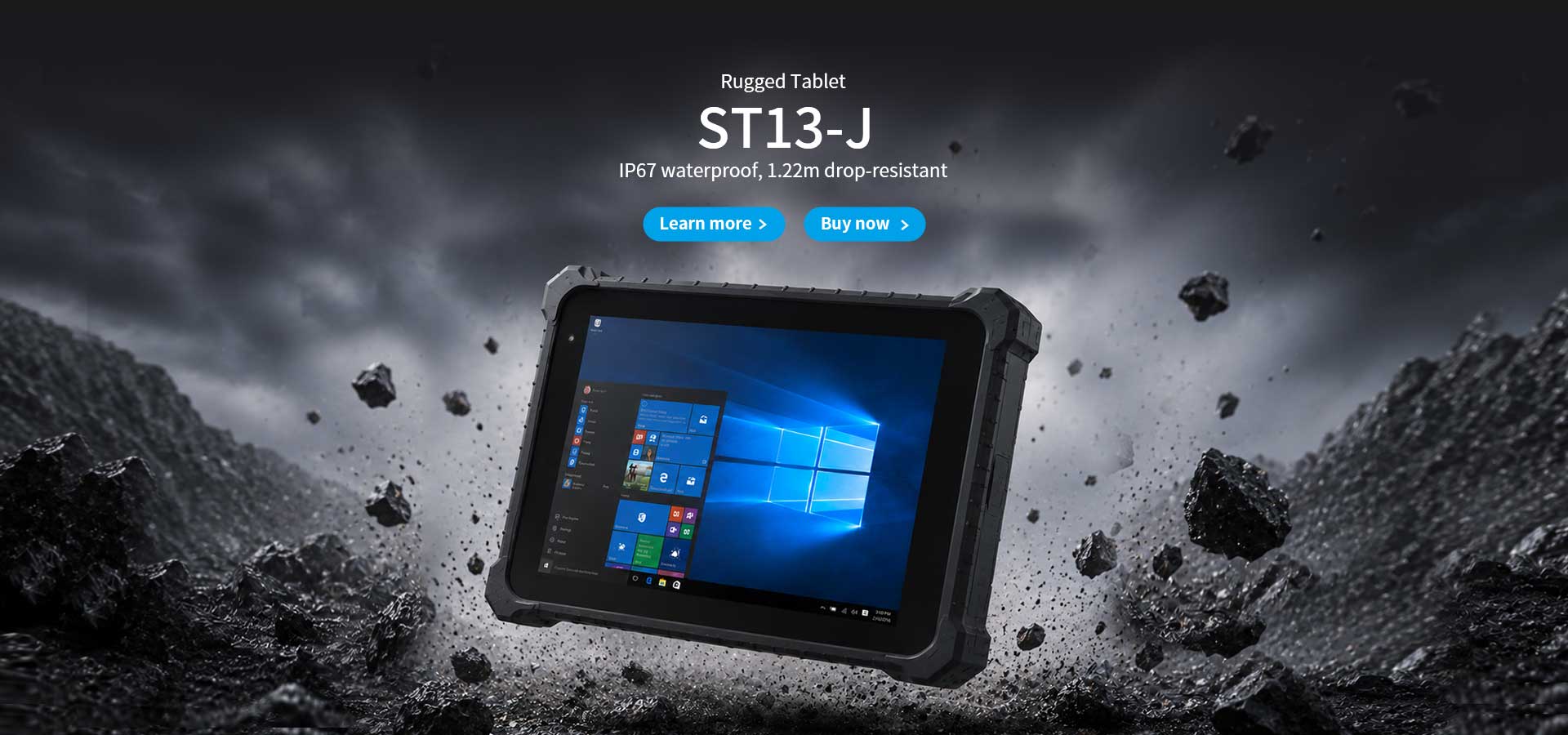
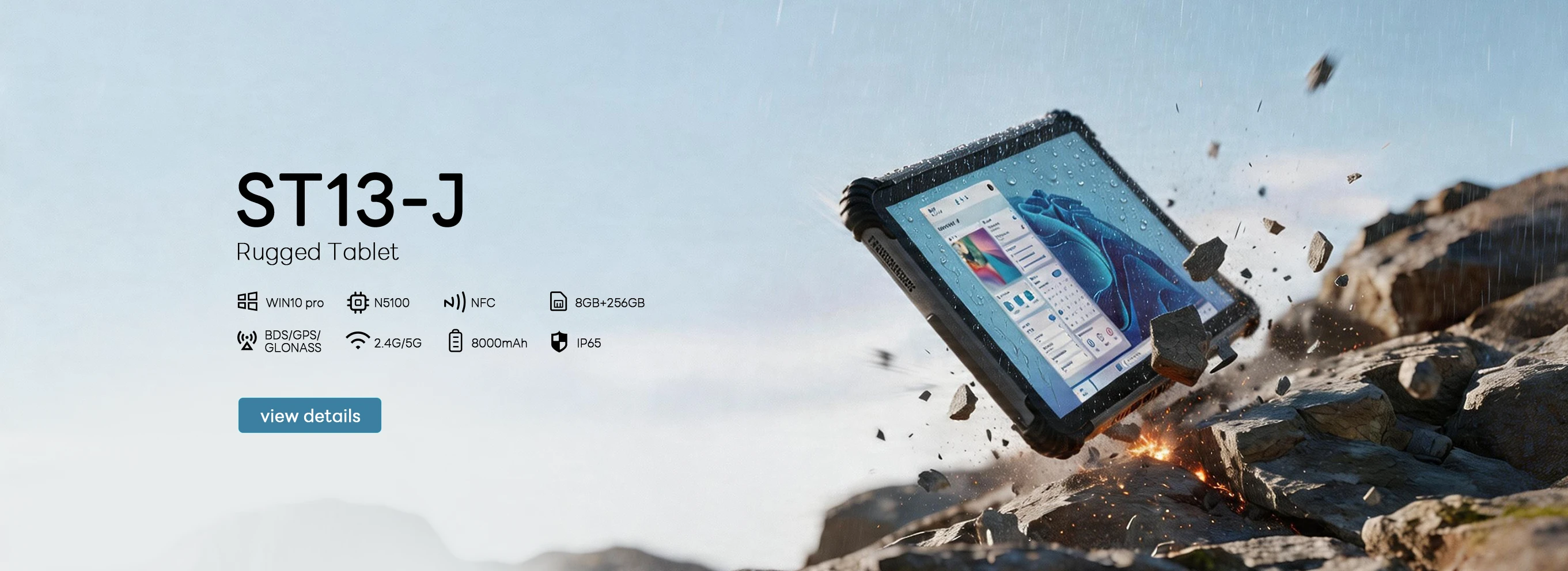
The Hotus HTNJ family publishes exactly that scope: IP67, plus a 1.22 metre drop resistance figure, on a body the manufacturer describes as double-layer. That is a legitimate three-proof claim covering dust, water and impact, and it is the level at which most factory, warehouse and vehicle-mounted deployments operate. It is also the point where the two competitors start answering a different question.
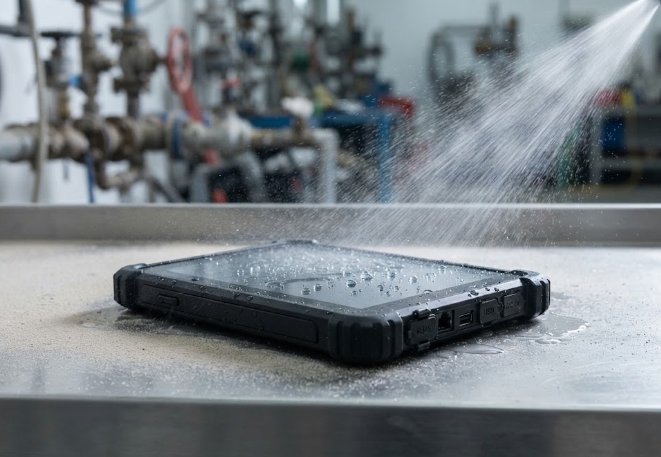
The HTNJ08B pairs an Intel Pentium N6000 quad-core processor running at up to 3.3 GHz with an eight-inch LCD at 1200 by 1920 and a 560 nit brightness rating. The touch layer is ten-point capacitive and hardened to 7H, so it tolerates gloves and a stylus. Radios are WiFi 5 and Bluetooth 4.2, with 4G LTE and NFC available as options, and the camera set is a 5 MP front unit beside an 8 MP auto-focus rear unit.
Published protection is IP67 with a 1.22 metre drop rating. The body measures 238 by 160 by 25 mm, and the interface set is unusually complete for the size: audio, Mini HDMI, USB Type-A, USB Type-C, DC input, RJ45 Ethernet, a TF card slot, a SIM slot and a 12-pin POGO connector for a charging dock. Battery capacity is 3500 mAh at 7.6 volts. Memory, storage and runtime are not published for this model. Full figures sit on the HTNJ08B Rugged Tablet page.
The two ten-inch models share an enclosure measuring 284 by 190 by 25 mm, a 10-inch 1200 by 1920 display rated at 560 nits, the same IP67 and 1.22 metre drop ratings, and the same battery and connector set. The difference is the compute generation. The HTNJ10B Rugged Tablet carries a Pentium N600 with WiFi 5 and Bluetooth 4.2; the HTNJ10C Rugged Tablet carries a newer Intel N100 quad-core at 3.4 GHz with WiFi 6 and Bluetooth 5.
Because the sealed shell is identical, the choice between them is not a durability decision at all. The question is whether the deployment needs current-generation wireless and a newer instruction set, or whether the older platform is sufficient. Hotus publishes no MIL-STD number and no hazardous-area certificate for either model, and neither page lists an operating temperature range.

The Aegex Aegex100M answers the explosive-atmosphere question. It is a 10.1-inch Windows 11 IoT tablet with an Intel quad-core processor at 1.6 GHz, 8 GB of memory and 256 GB of storage, and it carries the same IP67 ingress rating as the Hotus family. What separates it is certification rather than hardware: ATEX and IECEx Zone 1 for explosive gas atmospheres, plus UL913 Class I Division 1 for North America. Equipment without that certificate cannot legally enter those areas. Aegex publishes a range of 2,459 to 3,404 US dollars.
The MilDef DS16P answers the military question. It is a 10.1-inch ultra-rugged tablet with an Intel Core Ultra 7 processor, a user-removable SSD, Thunderbolt 4 and five configurable function keys, built around circular Fischer connectors instead of consumer ports. Its published qualification list is MIL-STD-810H with a 1.5 metre drop figure, and MIL-STD-461G for electromagnetic emissions and immunity across ground, navy and army profiles. MilDef publishes a range of 4,000 to 6,000 US dollars.

| Device | Display | Protection published | Processor | Wireless | Storage | Certification scope | Approx. price |
|---|---|---|---|---|---|---|---|
| Hotus HTNJ08B | 8 in, 1200x1920, 560 nits | IP67, 1.22 m drop | Intel Pentium N6000 | WiFi 5, BT 4.2 | Not published | Dust, water, impact | On request |
| Hotus HTNJ10B | 10 in, 1200x1920, 560 nits | IP67, 1.22 m drop | Intel Pentium N600 | WiFi 5, BT 4.2 | Not published | Dust, water, impact | On request |
| Hotus HTNJ10C | 10 in, 1200x1920, 560 nits | IP67, 1.22 m drop | Intel N100 | WiFi 6, BT 5 | Not published | Dust, water, impact | On request |
| Aegex Aegex100M | 10.1 in | IP67, ATEX and IECEx Zone 1, UL913 Class I Div 1 | Intel quad-core 1.6 GHz | Not published | 256 GB, fixed | Explosive atmosphere | $2,459-3,404 |
| MilDef DS16P | 10.1 in | MIL-STD-810H, 1.5 m drop, MIL-STD-461G | Intel Core Ultra 7 | Not published | User-removable SSD | Military environmental and EMC | $4,000-6,000 |
The hazardous-area gap comes first, and it is absolute. No Hotus device here carries ATEX, IECEx or UL913 certification, so none may be taken into a Zone 1 or Class I Division 1 atmosphere, while the Aegex100M may. Second, Hotus publishes no MIL-STD number and no electromagnetic compatibility qualification for the HTNJ family, whereas MilDef publishes both MIL-STD-810H and MIL-STD-461G and quotes a 1.5 metre drop against the 1.22 metres available here.
Third, the compute ceilings differ sharply: a Pentium N6000 or N100 is an entry-level industrial platform, the Aegex100M sits slightly above that with a 1.6 GHz quad-core, and the Core Ultra 7 in the DS16P belongs to a different class. Memory and storage are also unpublished for every HTNJ model, so capacity planning becomes a conversation with the supplier rather than a specification comparison, and the Type-A, Type-C and Mini HDMI ports here are consumer connectors rather than the circular Fischer fittings MilDef uses for tactical cabling.
The decision starts with the atmosphere, not the processor. A site inside a refinery, a solvent store or a grain silo needs Zone 1 or Class I Division 1 equipment, and the Aegex100M is the only device here that qualifies. A deployment that must survive military electromagnetic environments and permit field replacement of its storage should look at the MilDef DS16P. Everything else, from factory floors to vehicle-mounted terminals, sits inside the three-proof envelope, where IP67 and a 1.22 metre drop rating are the operative numbers and the real question becomes screen size and wireless generation. Buyers sizing the rest of the range can browse the rugged tablet lineup, and comparisons against other manufacturers are collected in the device comparison library.