In my ten years advising clinical IT teams, I have rarely seen a paper-to-digital switch succeed on the first try. Most fail because the hardware cannot survive the floor. A regional clinic group came to us last year with a familiar complaint: their consumer tablets died within months in triage, at the nurse station, and on the mobile cart. We proposed a different approach - deploy purpose-built rugged hardware from the desk to the bedside. Here is how the deployment actually played out, and what we learned from the three devices that carried it.
🔍 The Workflow Problem We Were Asked to Solve
A 120-bed community hospital running three satellite clinics needed one patient record surface that worked everywhere - the admitting desk, the ward, and the treatment cart. Their legacy setup mixed paper charts with a handful of off-the-shelf tablets that overheated, cracked, and lost Wi-Fi at the worst moments. The brief was simple to say and hard to deliver: one durable endpoint per role, zero downtime during a 12-hour shift, and a single management plane for the IT team. We mapped the three roles to three Hotus rugged tablets rather than forcing one device to do everything - the same approach we apply across our rugged hardware built for clinical environments.
ST13-J: A Fixed Desk Anchor
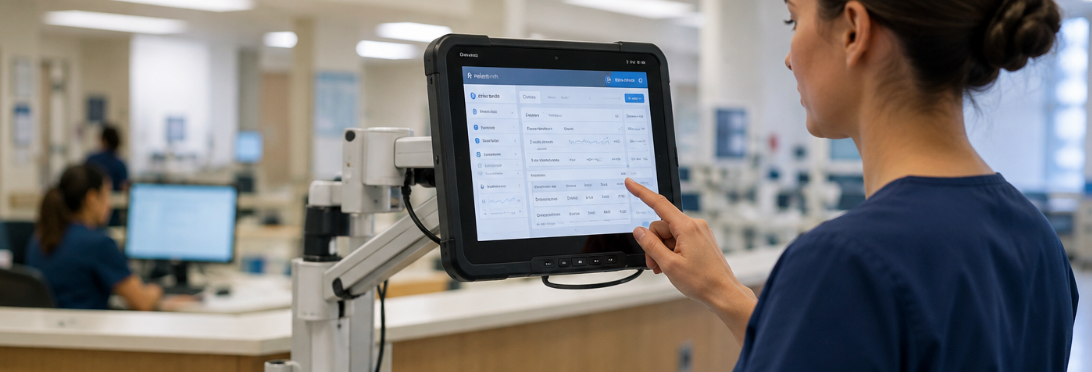
The ST13-J 13.3-inch rugged tablet became the permanent fixture at every admitting and nurse station. Its 13.3-inch Windows display gives staff a full clinical application window without squinting, and the fanless chassis stays silent in a quiet ward. We mounted it on an articulated arm and let it run shift after shift. What sold the client was not the screen size but the consistency: the same Windows image they already managed, now on hardware that shrugs off the occasional spill and the daily disinfecting wipe. In a customer case like this, the fixed anchor has to be boring in the best way - always on, never in the way.
HTYJ08A: The Bedside Companion
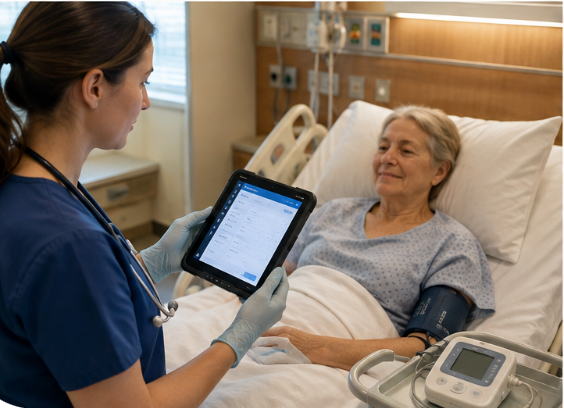
Where the ST13-J stayed put, the HTYJ08A rugged tablet traveled. This 8-inch Android rugged tablet is light enough for a nurse to carry through a full round, yet sealed well enough to survive the handoff between dozens of patients per day. We loaded the ward app, paired it with a Bluetooth vitals cuff, and let staff chart at the bedside instead of scribbling and transcribing later. The smaller footprint matters more than people expect - at the bedside, every extra centimeter of device is one more thing in the way of the patient. The HTYJ08A proved that a clinic does not need a laptop to close the chart where care happens.
✅ HTYJ10A: The Mobile Cart Standard
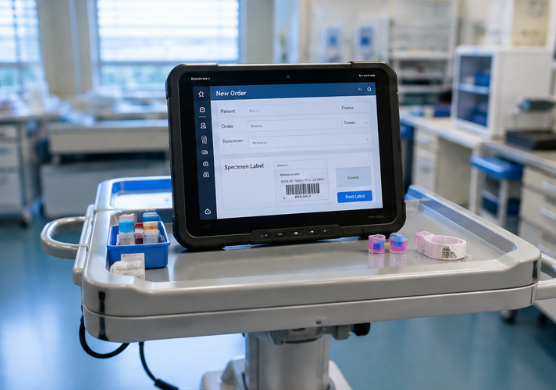
The third role belonged to the mobile treatment cart, and the HTYJ10A rugged tablet fit it precisely. Its 10.1-inch Android screen is the compromise between the desk anchor and the bedside companion - large enough for a procedure checklist, compact enough to live on a rolling cart without dominating it. In procedure rooms and the mobile phlebotomy cart, the HTYJ10A became the shared surface for order entry and specimen labeling. Because it runs the same management profile as the HTYJ08A, the IT team provisions both from one console.
Spec Sheet: What Each One Carries
| Device | Display | Platform | Best Role | Build |
|---|---|---|---|---|
| ST13-J | 13.3-inch | Windows | Fixed station | Fanless, wipe-down chassis |
| HTYJ08A | 8-inch | Android | Bedside round | Compact, sealed |
| HTYJ10A | 10.1-inch | Android | Mobile cart | Shared procedure surface |
Specific processor, memory, and wireless options vary by build configuration - confirm the exact bill of materials with the configurator before you order, because clinic networks and EMR clients differ from site to site.
One Clinical Network, Three Endpoints
None of this works if the three devices talk different languages. We joined the ST13-J, HTYJ08A, and HTYJ10A to the same secure SSID, pointed them at the same EMR endpoint, and let the clinic's existing identity provider handle login. The IT lead told us the single biggest win was removing the "which tablet does what" confusion - each device boots straight into the role it was assigned. That is the quiet advantage of a managed rugged fleet over a drawer of consumer slabs.
Choosing the Right Mix for Your Site
If you are planning a similar rollout, start from roles, not devices. Count your fixed stations, your bedside rounds, and your mobile carts, then match counts to the three form factors above. A small clinic may need one ST13-J and a pair of HTYJ08A units; a multi-wing hospital leans on HTYJ10A carts between the anchors. Resist the urge to standardize on a single size - the savings you think you gain disappear the first time a nurse cannot read a chart at the bedside or a cart screen is too small for a checklist. For the complete lineup and configuration options, explore the full rugged tablet range before you commit counts.
💰 Deployment Lessons Worth Repeating
The clinic has now run the trio for over a year with no hardware failures that interrupted care. Two lessons stuck with us. First, durability is a workflow feature, not a spec-sheet footnote - when the device never fails, staff stop working around it. Second, role-based deployment beats one-size attempts every time. We have since reused this exact three-device pattern for a surgical day-center and a dental group, with the same result: charts close where care happens.
If your clinic is still patching paper and fragile tablets together, the faster path is a purpose-built fleet. Talk to our team about mapping your roles to the ST13-J, HTYJ08A, and HTYJ10A, and we will help you spec a rollout that survives the floor.