Walk into a renovated hotel room today and the thing driving the television is invisible. It sits behind the panel on a VESA bracket, draws power from its own supply, and answers to a management console three floors away. Ten years ago the same job was done by a plastic dongle hanging out of an HDMI port, and before that by nothing at all.
That progression is worth tracing, because it explains why the buying conversation has changed. Hotels are no longer asking "which box is fastest" - they are asking which shape of device survives a three-year service life across housekeeping, front desk, engineering, and the guest room itself. The answer that most properties land on is not one device. It is three classes of device, each matched to a job.
This article follows that evolution through its three generations and shows where the rugged mini PC solutions range fits in the modern property.
💡 📺 The Dongle Era and Why It Ended
The first generation was a consumer product pressed into commercial service. A streaming stick or an Android box, plugged into the TV's HDMI port, powered by the TV's own USB socket, configured once by a technician with a remote control.
It worked well enough for a single room, which is exactly why it spread. Then operators discovered what it cost at scale:
Attrition. A device hanging in plain view from an HDMI port is a device that leaves the room. Properties that tracked it reported double-digit annual loss rates, and every loss was also a support call.
No remote hands. When a stick froze, the fix was a physical visit. Nobody could reboot it from the front desk, push a firmware update, or check whether it was online at all.
Dirty power cycles. Drawing power from the television means the device loses power the moment a guest switches the TV off at the wall. Unclean shutdowns corrupt storage over time.
Credentials baked in. Guest Wi-Fi passwords were typed in once and stayed there. When the network changed, every room needed a visit.
The dongle did not fail because it was slow. It failed because it was unmanaged, unsecured, and easy to take home.
🖥️ 🔧 The Box Behind the Screen
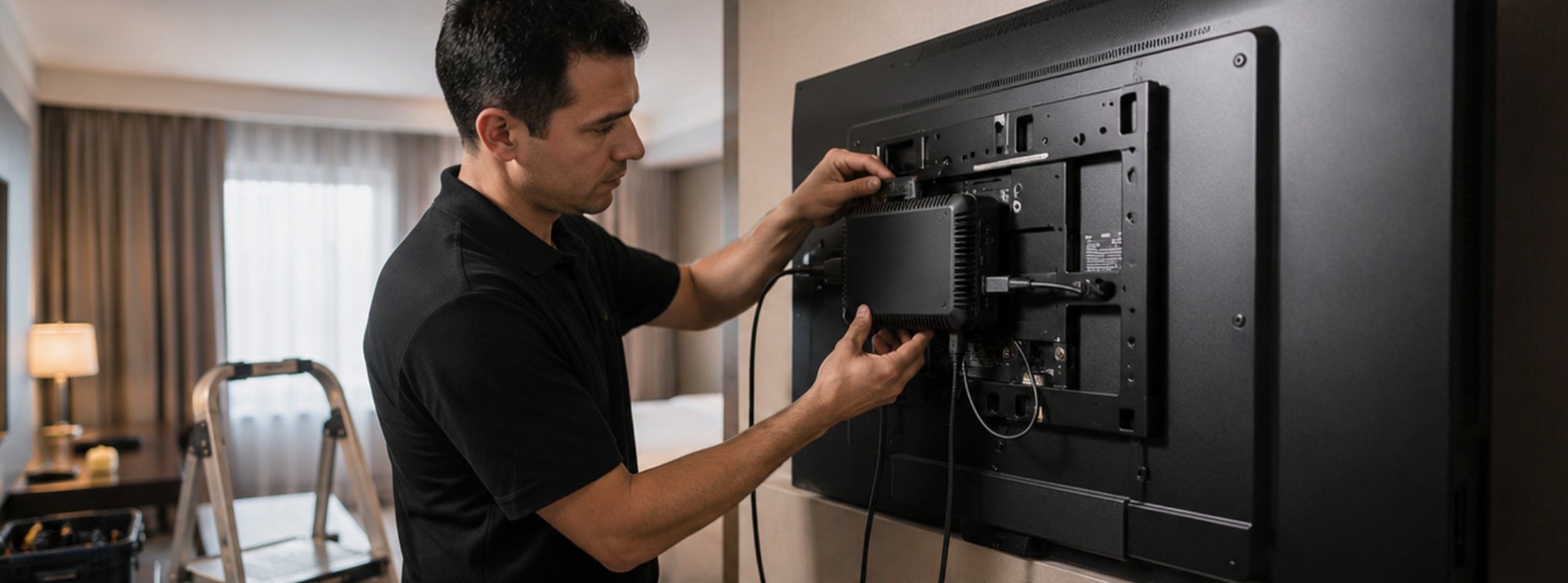
The second generation moved the computer off the port and onto the wall. A commercial mini PC mounts to the VESA pattern on the back of the panel, runs its own power supply, and connects to the network by cable rather than by whoever last typed in a password.
The Palm-sized miniPC is representative of this generation: a fanless low-voltage platform small enough to disappear behind a display, with enough I/O to drive the panel, take a wired network drop, and stay powered independently of the television's own state.
What this changed was not raw performance. It changed the operating model:
The device became an asset. It has a serial number, a bracket, and a location. It gets counted during inventory instead of going missing.
It became reachable. Reboot, wake, image, and update all happen from a console. Most faults clear without anyone walking to the floor.
It became predictable. Clean shutdown behaviour, wired networking, and a fixed power source remove three of the four failure modes that made the dongle generation painful.
The trade-off is installation discipline. A bracket-mounted host needs power and data at the panel position, so the decision has to be made during renovation rather than after. Retrofitting a property that was never wired for it is the single most common reason a rollout stalls.
💡 📱 Why Handhelds Split by Job
The third generation is not a replacement for the second. It is the recognition that the guest room is only one of several places a hotel runs software, and that the people using it are standing up, walking, and carrying things.
Once that became the framing, a single handheld spec stopped making sense. A housekeeping runner and a maintenance engineer do different work, hold the device differently, and need different screens. The result is two size classes rather than one compromise device.
🖐️ The Five-Inch Class
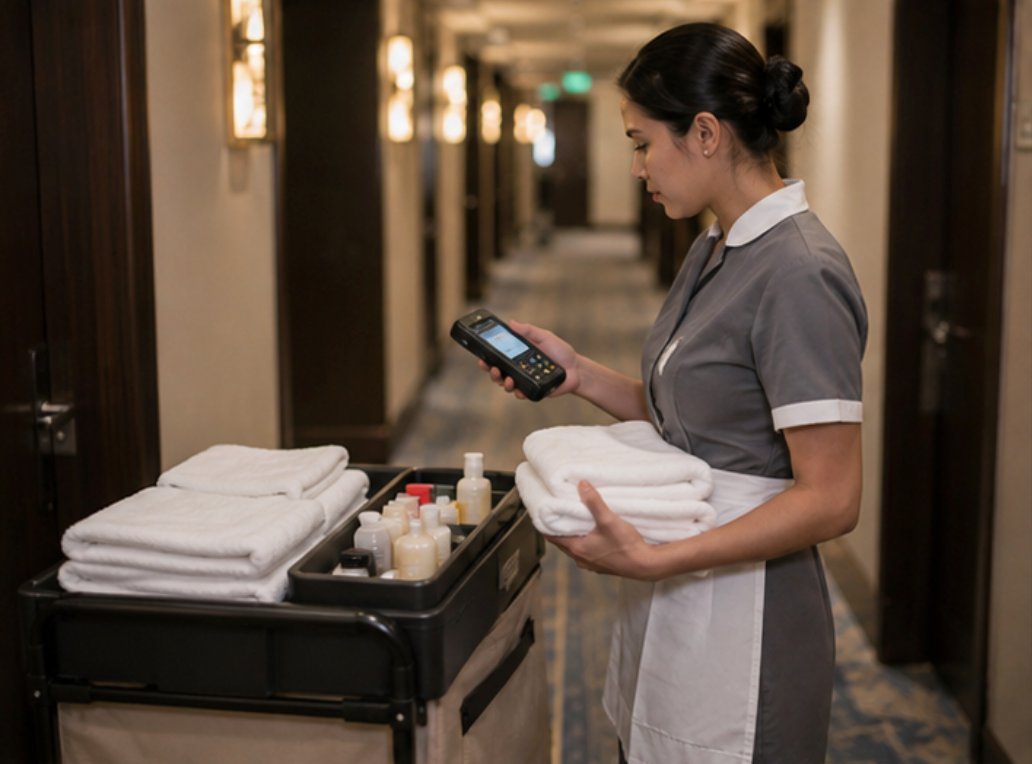
The smaller class is defined by one-handed use. Housekeeping, minibar rounds, and linen counts are all tasks where the other hand is occupied - carrying supplies, opening a door, holding a tray.
The SH5-W sits in this class at 5.5 inches. It is pocket-sized, readable in one hand, and tolerant of the two things that kill consumer phones in hotel service: repeated drops onto hard floors and hands that are wet or gloved. Barcode scanning turns a minibar check into a pass down one corridor rather than a clipboard exercise at the end of a shift.
The pattern it replaces is the paper round sheet. The gain is not speed so much as timing - a room status updates the moment it is cleaned, so the front desk can sell it immediately rather than at the next reconciliation.
🗂️ The Eight-Inch Class
The larger class is defined by typing and by forms. Anything that involves filling in fields, showing a guest something to sign, or reading a schematic needs more screen than a pocket device can give.
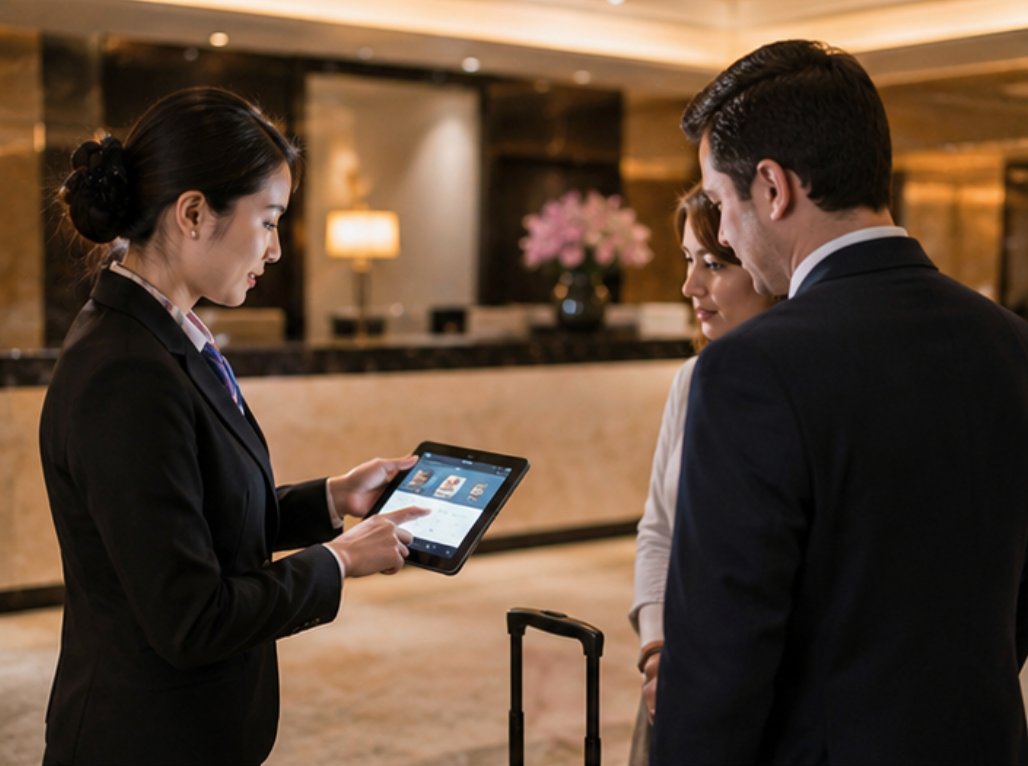
The HTNJ08A Rugged Tablet occupies this slot at eight inches. In practice it shows up in three places: the front desk during a check-in queue, where a staff member walks the line and pre-registers guests before they reach the counter; engineering, where a technician reads a plant-room diagram or photographs a fault for the work order; and room service or spa, where a guest signs on glass instead of on paper.
Both classes share the same management story as the room host. They are enrolled, they are tracked, and they can be locked down to the applications they should be running.
📊 Three Generations Compared
| Attribute | First: HDMI dongle | Second: VESA-mounted host | Third: job-matched endpoints |
|---|---|---|---|
| Typical location | Hanging from the TV port | Bracketed behind the panel | Room host plus staff handhelds |
| Power source | Television USB socket | Independent supply | Mains plus battery endpoints |
| Remote management | None | Full - reboot, image, update | Full, across all classes |
| Annual attrition | Double-digit, untracked | Near zero - it is bolted on | Tracked per assigned user |
| Fault response | Physical visit every time | Remote first, visit if needed | Remote first, swap if needed |
| Installation window | Any time | Renovation or structured cabling | Any time for the endpoints |
| Best fit today | Not recommended | Guest room and signage | Service, engineering, front desk |
The progression is not about faster silicon. Every generation solved a management problem that the previous one created.
🔮 Where to Start
The practical sequence for a property mid-renovation is to fix the room layer first, because it is the one with a physical installation window. Mount the host behind the panel, run the network drop, and give it its own power. That decision is difficult to revisit later and cheap to make now.
The endpoint layer can follow on any schedule, because handhelds need no cabling. Start where the paper is - usually housekeeping rounds and minibar checks - then extend to engineering and front-desk queue work as the workflow settles.
If you are planning either layer, our industrial hardware solutions overview covers the full range, and the product pages for the three device classes carry the specifications you need to measure against. We help properties map rooms and job roles to hardware before the order goes in, so the second rebuild is not needed eighteen months later.