Hotel technology purchases are usually argued per unit. A device costs a certain amount, the property needs a certain number of them, and the comparison happens on that line. It is the wrong denominator, and it is the reason so many handheld rollouts get approved for the wrong reasons and cancelled for the right ones.
The return on a staff handheld is not in the hardware. It is in the shift - specifically, in the minutes each role stops spending on work that the device removes. This article prices that out role by role, because the three main handheld classes in a property earn their money in completely different ways. Our industrial hardware solutions range covers all three.
💡 🧮 Why Unit Price Is the Wrong Denominator
Two numbers decide whether a handheld programme pays back: how many minutes it removes per shift, and how many shifts run per year. The device price appears in the calculation once. The minutes appear three hundred and sixty-five times.
That is why the cheapest device is rarely the best value in a hotel. A unit that survives one season in housekeeping service costs its purchase price several times over in replacement and support. A unit that a room attendant leaves in the locker because it is too heavy to carry has a return of zero, regardless of what it cost.
So the sequence is: measure the minutes first, size the device to the task second, and only then look at the price.
🧹 Housekeeping: the Walk and the Sheet
Housekeeping is where the arithmetic is most favourable, because the baseline is entirely manual and the shift is long.
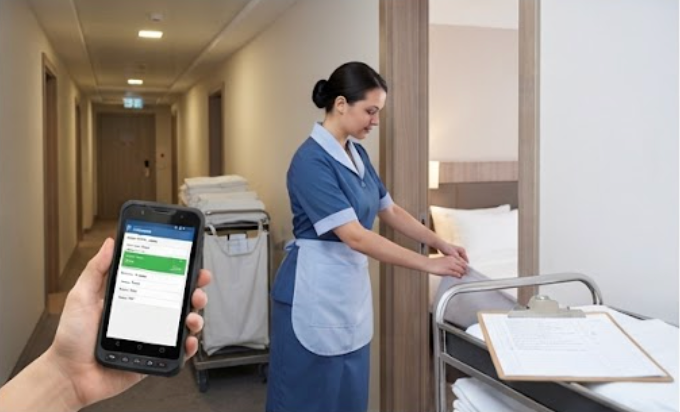
Two things disappear. The first is the round sheet - the paper carried through the floor, filled in as rooms are cleared, then transcribed or handed in at the end of the shift. The second is the walk to report status: the trip to the desk or the radio call to say a room is ready.
The SH5-W is the shape that fits this work specifically because it is small enough to be carried rather than put down. At 5.5 inches it stays in a hand or a pocket through a full round, which is the precondition for any of the time savings being real. Status updates from the room as it is finished, so the front desk can sell it immediately instead of at the next reconciliation.
To cost it: count the rooms per shift, estimate the minutes saved per room (typically transcription plus status reporting), multiply by shifts per year, and apply the loaded hourly rate. For most properties this single line exceeds the hardware cost within the first year.
🚀 🛎️ Reception: Queue Time and Throughput
Reception is different in kind. Housekeeping saves time; reception converts time into revenue, or fails to.
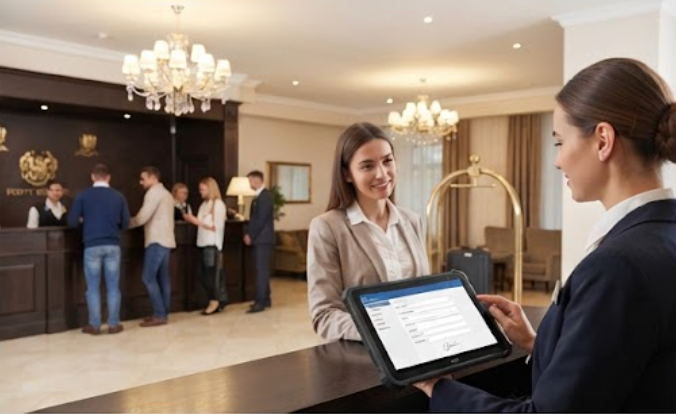
The constraint at a front desk is the arrival peak. For ninety minutes in the late afternoon, demand exceeds counter capacity, guests queue, and a proportion of them decide the queue is not worth it - they go elsewhere next time. A handheld does not make the check-in faster at the counter. It moves part of the check-in out of the counter: a staff member walks the queue with a device, captures details, and hands the guest a key rather than a wait.
The SH6 suits this at 6.5 inches - large enough to show a registration form and to hand to a guest for a signature, small enough to carry one-handed while standing.
Modelling this one is less about minutes and more about abandonment. If the peak regularly produces a queue, estimate the number of guests who leave it and the value of the stays they do not rebook. That is the number to compare against, and it is usually much larger than the labour line.
🔧 Engineering: Work Orders and Return Visits
Engineering produces the least obvious and often the largest saving, because it is about doing the job once.
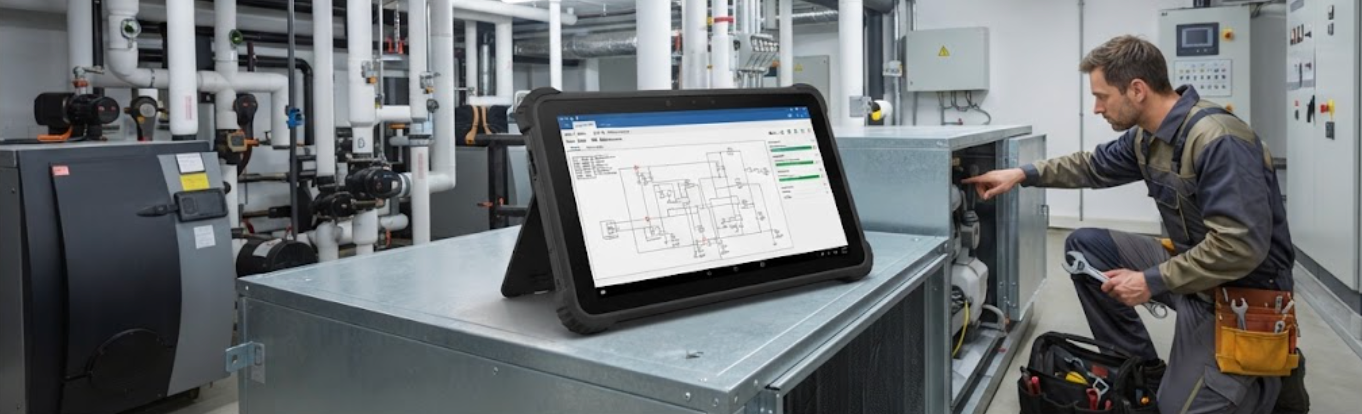
A maintenance visit without a device follows a familiar path: attend, diagnose, discover a part is needed or a drawing is back in the office, leave, return. Diagnosing from a schematic or a photograph on site converts some of those two-visit jobs into one-visit jobs.
The HTNJ10C Rugged Tablet sits here at ten inches. It is the one class in the set that is not really portable in a pocket - it is carried to a job and set down to work at, which is exactly what reading a plant diagram or filling in a detailed work order requires. It also runs a full desktop operating system, so the maintenance software the team already uses does not need a mobile rewrite.
Price it on avoided return visits: count second visits per month, apply the labour and the response time, and take the proportion a better first visit would remove.
📊 Putting the Numbers Side by Side
| Role | What it removes | How to measure it | Typical payback |
|---|---|---|---|
| Housekeeping | Round sheet transcription, status walks | Minutes per room × rooms per shift × shifts per year | Fastest - long shifts, fully manual baseline |
| Reception | Queue abandonment at peak | Guests lost from the queue × stay value × rebook rate | Strong where a real peak exists; weak without one |
| Engineering | Second visits | Return visits per month × labour + response time | Variable - depends on current first-visit rate |
| Guest room host | Nothing directly | Treat as infrastructure, not a saving line | Not a direct return |
The pattern across the rows: the return is largest where the existing process is most manual and the shift is longest. It is smallest where the device is a convenience rather than a replacement for something.
⚠️ Where the Model Overstates Itself
Three assumptions inflate handheld business cases, and all three are worth challenging before signing:
Counting minutes that were never worked. If a room attendant already updates status by radio in passing, the device saves seconds, not minutes. Measure the current process instead of assuming a worse one.
Assuming full adoption. A device that is carried for the first month and left on a trolley in the second delivers a fraction of the modelled return. Adoption, not capability, is the usual gap.
Double-counting a saving already booked elsewhere. If a property management system upgrade already claimed the check-in time saving, it cannot be claimed again here.
🎯 🔮 How to Measure It in Your Property
The pilot that answers the question is small and boring. Pick one role - housekeeping is the usual choice - and one floor. Time the current process for two weeks before any hardware arrives. Then run the same floor with devices for four weeks and time it again.
Two weeks of baseline matters more than it sounds. Without it the comparison becomes a matter of opinion, and opinion in a hotel is usually decided by whoever is most enthusiastic in the meeting.
Keep the rest of the variables fixed: same floor, same team, same supervisor. If the numbers move, they move because of the device. If they do not move, that is also an answer, and a cheaper one than a full rollout would have been.
If you are building the case now, the product pages for the three classes carry the specifications you need to cost against, and our rugged tablet range covers the full set. Send us the room count, the shift pattern, and the current process timing - with those three, the strongest role is usually obvious, and it is rarely the one the budget was written for.