- Select Language
One Device, Dual Functions – A Projector and a Com...
Enterprise Flagship SeriesEngineered for mission-c...
R860-S 5.5-inch Industrial PDA with Thermal Printe...
Full SpecificationsModelHotus ST13‑UOSWindows 10 P...
P11 Series Next-Gen Enterprise Rugged Industrial ...
R350C 4-inch Industrial Handheld PDA | Qualcom...
Enterprise Flagship SeriesEngineered for mission-c...
From the unknown so simpleUsed for mobile phones, ...
R366-S 5.5-inch Industrial PDA | Qualcomm Octa-cor...
A field crew does not work at a desk, so the usual questions about deployment — where the dock goes, who signs off the build — never quite fit. The unit rides out in a vehicle, spends eight hours moving between hands and surfaces, and comes back coated in whatever the site is made of. What a planner can actually control is narrower and more useful: where the device sits between jobs, how it is carried when both hands are needed, and what happens to the charging port when the ground is wet. The three units below differ less in the way they are set up than in which of those problems they solve first.
Whatever the trade, a work site exposes hardware to the same short list. It gets wet, whether from rain or from a wash-down hose. It gets put down on surfaces that are not desks, and sometimes it does not stay there. It gets handled by people wearing gloves, often in poor light. And it is left somewhere for hours at a stretch, which turns battery capacity and charging habits into planning decisions rather than conveniences. Most deployment failures on site trace back to one of those four, not to software. Getting a rugged unit through a shift is largely a matter of deciding, in advance, which of them the site will throw at it hardest — and for teams who want the category-level view before the model-level one, our industrial three proof solutions page covers the same ground from a hardware standpoint.
The HTYJ10A Rugged Tablet is a ten-inch unit with a 1200 by 1920 LCD rated at 560 nits and a touch layer measuring 7H on the hardness scale. Sealing is IP67, and the drop rating is stated at 1.22 metres. Its battery is 7.6V at 3500mAh, and the port list is unusually long for a panel of this size: audio, Mini HDMI, USB Type-A, Type-C, DC in, RJ45, TF, SIM, and a 12-pin pogo connector. Shipping weight, box included, is 2.1kg.
That port row is the part that matters at deployment time. An RJ45 socket means the panel can be wired rather than left on Wi-Fi, which is often the difference between a fixed position at a site office and a unit that has to be walked to a signal. The 560-nit panel and the 7H surface point the same way: this is a device meant to be readable in daylight and to survive being wiped down. The pogo connector opens the option of a cradle, so the charging decision can be made once and then forgotten.
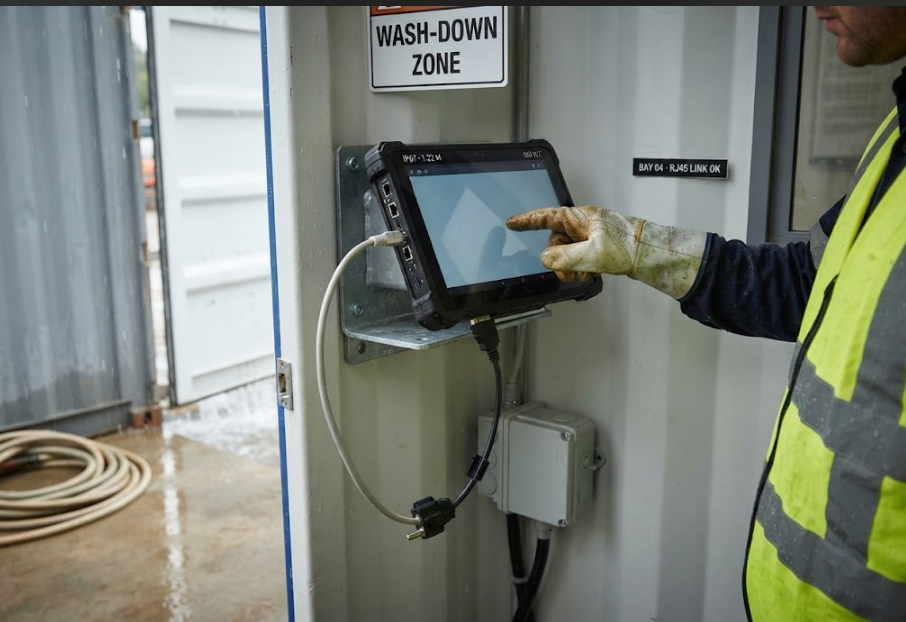
A 560-nit panel bolted to a site-office wall, RJ45 cable running to the port on its edge.
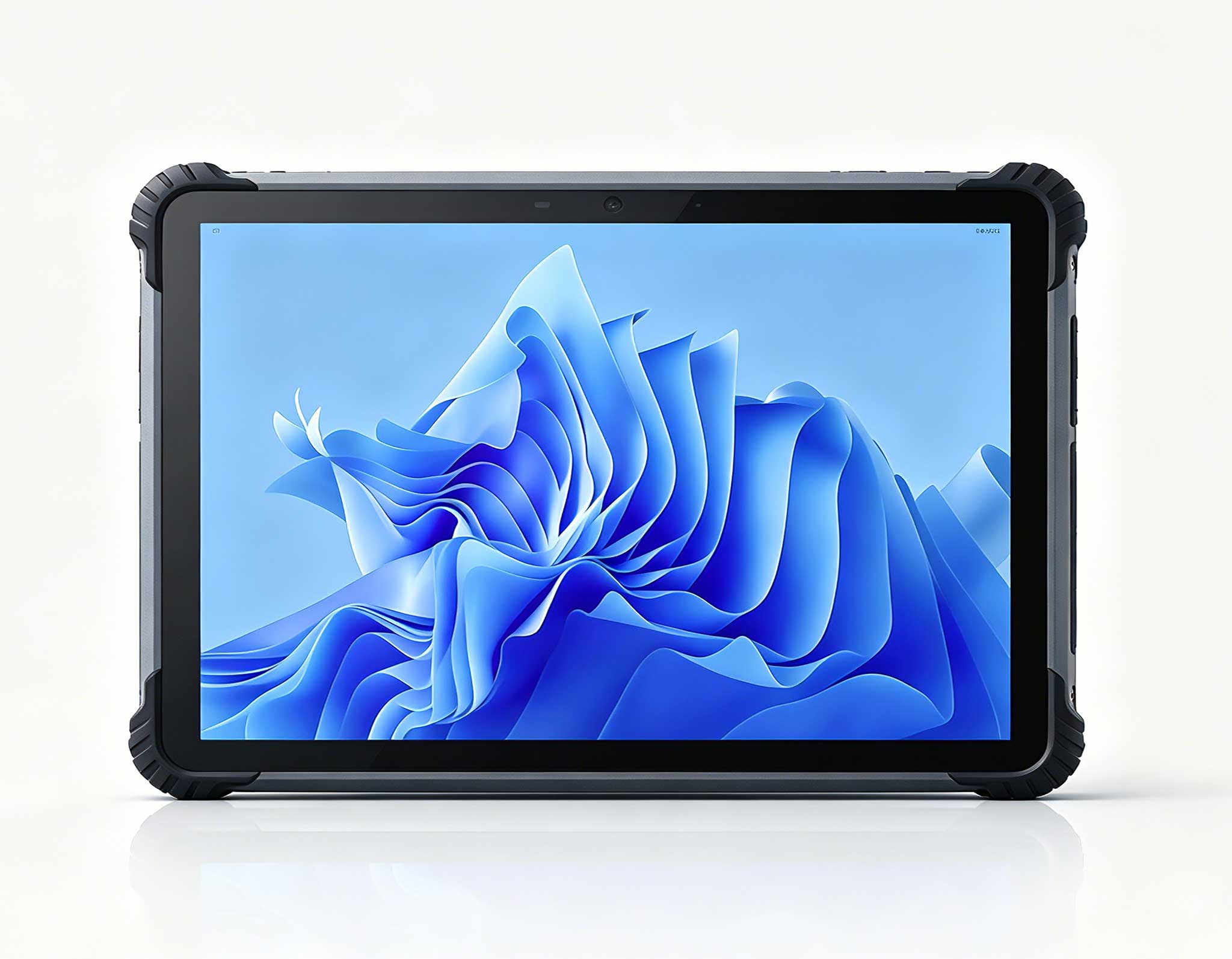
The RT81 Rugged Tablet approaches the same shift from the other end. Its 10.1-inch IPS panel runs at 1200 by 1920 and 400 nits, the battery is 10000mAh, and the body comes in at under 650 grams — light enough to hold through a long walk, still IP67, with a stated drop rating of 1.2 metres and an operating band of -10 to 50 degrees Celsius. Radios are where it separates itself: 4G LTE with regional band variants, dual-band Wi-Fi, Bluetooth 5.0, and a positioning chain that includes an independent Beidou option with RTK centimetre-level accuracy. A 2D imager rated to 3 mil and 13.56MHz NFC are both options rather than defaults.
Positioning accuracy is the first thing to plan for, because it depends on where the unit is. Independent Beidou and RTK want an unobstructed view of the sky, so a bracket under a metal canopy or deep inside a container will quietly cost the accuracy that justified the hardware in the first place. The 10000mAh pack is the other planning input: it is large enough that a full shift rarely needs a mid-day top-up, which takes charging out of the daily routine altogether.
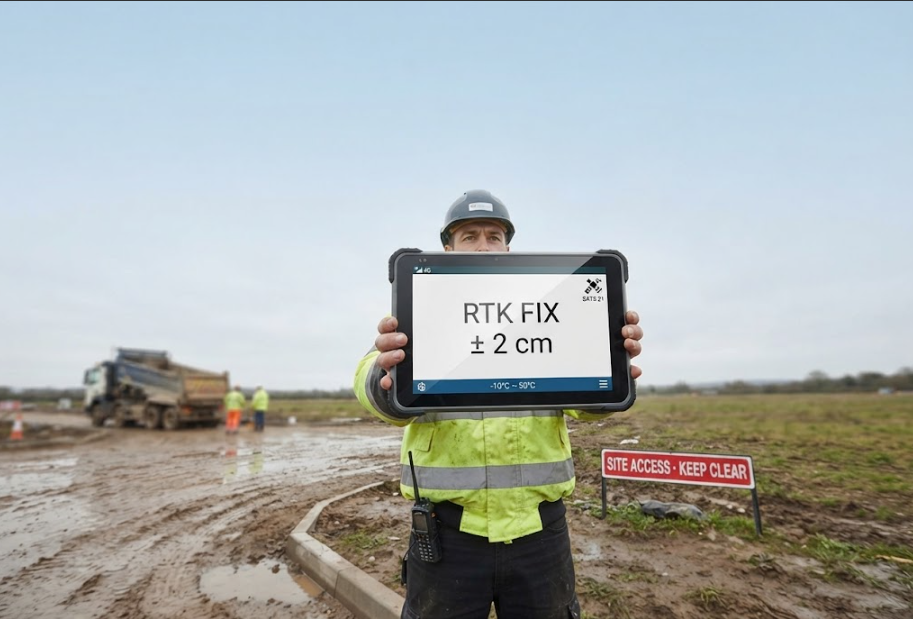
An RT81 held at chest height on open ground, sky clear above the antenna for an RTK fix.
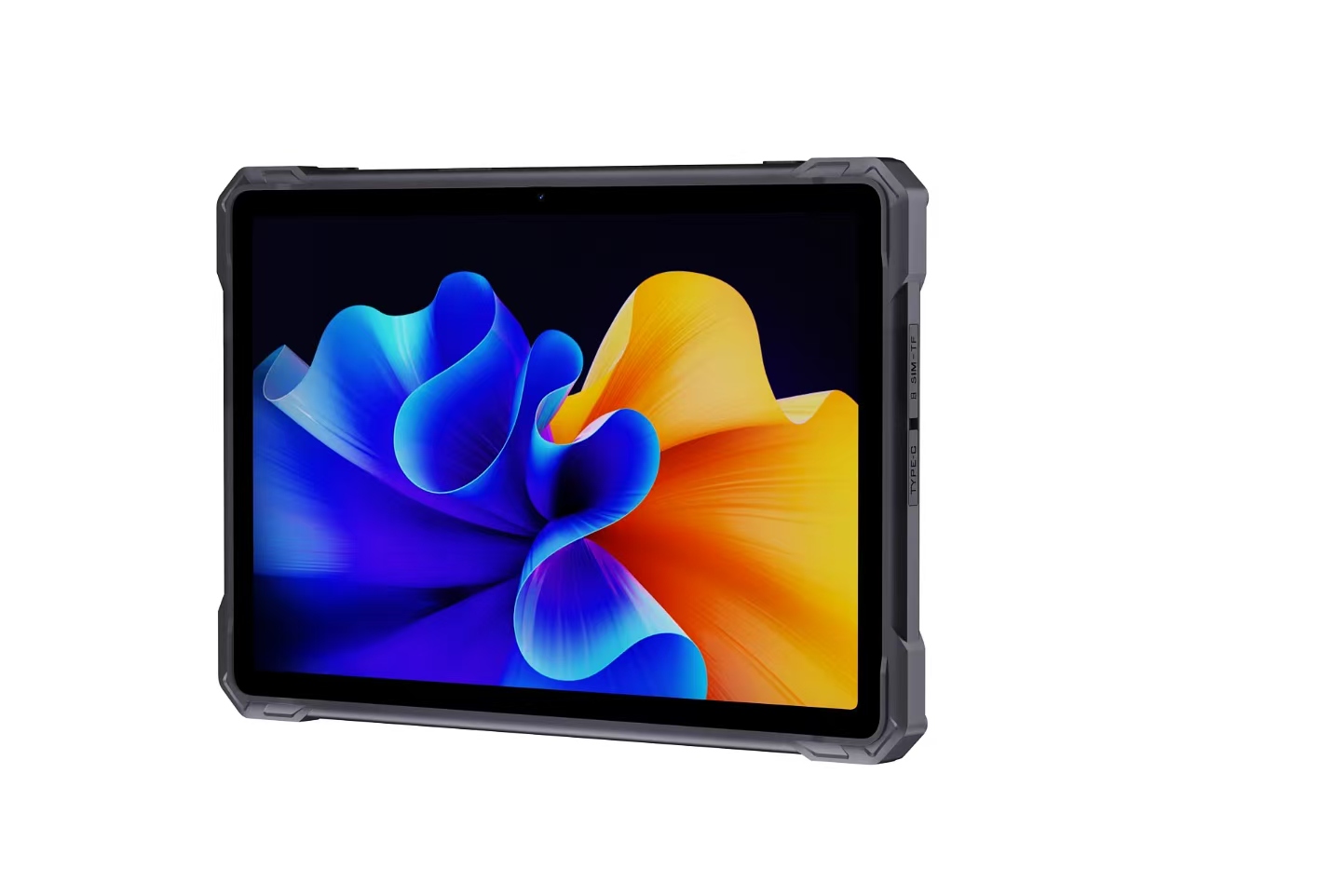
The HTQ10A Android Rugged Tablet runs on an eight-core 2.0GHz processor with Android 12, 8GB of memory and 128GB of storage. The screen is a ten-inch 1920 by 1200 LCD at 560 nits with the same 7H hardness figure, and the network chip is Wi-Fi 5 with Bluetooth 4.2. Its battery is 7000mAh and its operating band is the widest of the three, from -20 to 60 degrees Celsius. Protection is again IP67 with a 1.22 metre drop rating, and shipping weight is 1.7kg.
Two details make it the easiest of the three to put into new hands. The temperature band means the same unit can be issued for a cold store in the morning and a sunlit yard in the afternoon without a second hardware decision. And the preinstalled memory and storage mean there is no procurement step between receiving the box and starting work — a consideration that matters when a crew is assembled at short notice and nobody has time to spec a build.
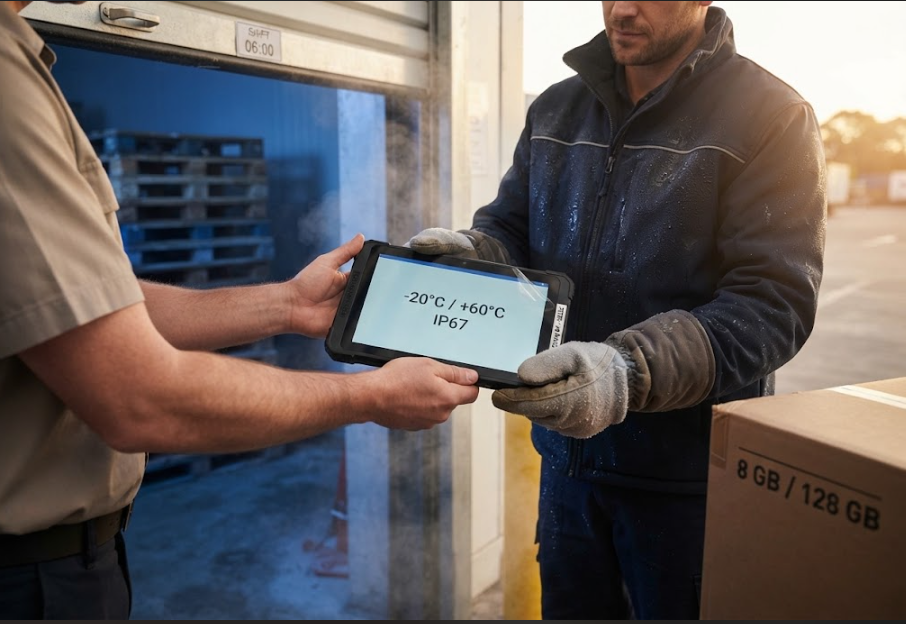
A brand-new HTQ10A being handed to a crew member at the gate, still in its protective film.
| Item | HTYJ10A | RT81 | HTQ10A |
|---|---|---|---|
| Display | 10-inch LCD, 1200 x 1920, 560 nits | 10.1-inch IPS FHD, 1200 x 1920, 400 nits | 10-inch LCD, 1920 x 1200, 560 nits |
| Touch layer | Ten-point capacitive, 7H hardness | Ten-point capacitive, glass-on-glass | Ten-point capacitive, 7H hardness |
| Battery | 7.6V, 3500mAh | 10000mAh, 3.8V, sealed | 3.8V, 7000mAh, sealed |
| Protection | IP67, 1.22m drop | IP67, 1.2m drop | IP67, 1.22m drop |
| Dimensions | 284 x 190 x 25mm | 252 x 170 x 14.6mm | 284 x 175 x 15mm |
All three agree on the fundamentals: every one is IP67, every one is rated for a fall of roughly 1.2 metres, and every one uses a ten-inch class panel with a ten-point touch layer. They diverge on battery format, panel brightness and the port list, which is where the deployment decision actually sits. The wider rugged tablet range follows the same logic at other sizes.
Weight is deliberately absent from the table. RT81 quotes an unboxed figure, while the other two list a shipping weight with packaging, so the three numbers describe different things and setting them side by side would mislead. Anyone comparing the range by hand should check which term each page uses before treating the figures as equivalent.
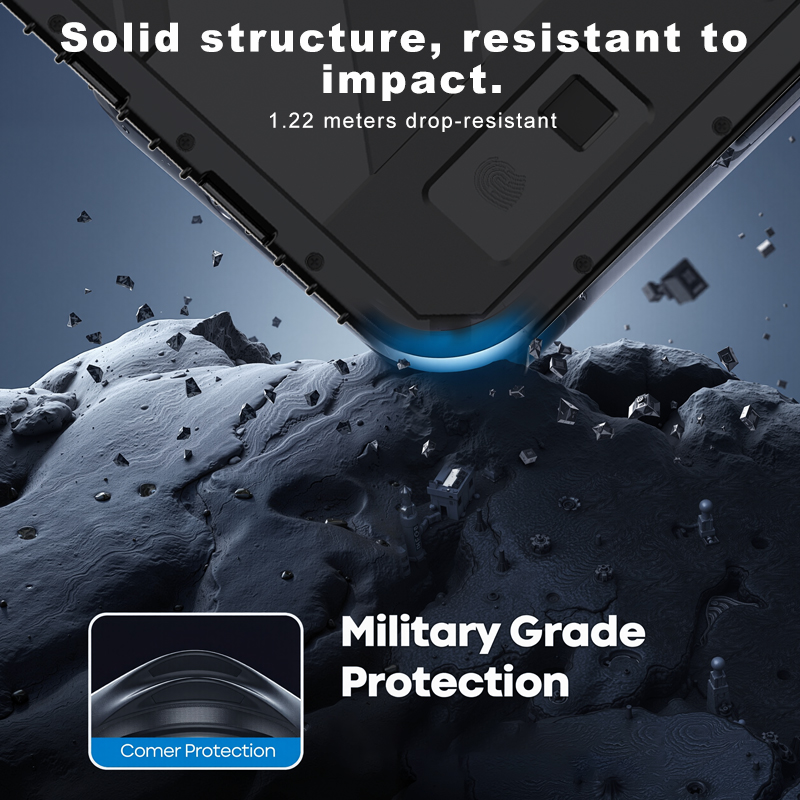
A stated drop rating is a test condition, not a promise about every fall. What it measures is a unit landing on a flat surface from a set height. A crew working from a ladder or a mezzanine is not reproducing that test, and the difference between 1.2 and 1.22 metres is not the interesting part. The interesting part is how the device leaves the hand. A unit carried in a pocket or on a wrist strap falls less often than one balanced on a rail while both hands are busy, and a cradle that holds it at reach height removes the exposure altogether. For the heavier panel, a fixed position is not just convenience — it is the difference between a controlled environment and a drop test performed daily.
Two of the three publish an operating band, and the bands are not the same shape. HTQ10A is rated from -20 to 60 degrees Celsius, which covers cold storage and direct summer sun with room to spare. RT81 is rated from -10 to 50 degrees Celsius — narrower at both ends, adequate for most outdoor work in temperate regions, but worth checking against a site that runs a freezer aisle or a summer loading dock. HTYJ10A does not state an operating range on its product page, so that figure should be confirmed with the supplier against the actual site conditions rather than inferred from the other two. Capability claimed outside a published band is not covered by the rating, and no amount of sealing compensates for it.
Four questions settle most of the risk before units leave the yard. Where will each one sit when it is not in a hand? Is the charging point inside or outside the weather? Which positions need wiring rather than Wi-Fi? And does anyone on the crew work from a height that makes a strap a better answer than a pocket? Answer those and the setup stops being a guess about hardware and becomes a plan about the site. Teams that run the same cycle every season usually find the answers stay valid for years, and our Field Maintenance Solutions pages carry that planning further into the day-to-day routine.