We stopped trusting vendor spec sheets the day a fanless industrial box throttled itself flat at 71 degrees Celsius on a real welding line. So last quarter we bolted three nodes onto a live production floor, opened a terminal, and let the machines tell us what they were actually doing. The numbers below came from eight weeks of continuous sampling, not a brochure. If you are planning an edge rollout, the gaps between promised and measured are the part worth reading twice.
🏭 Reading the Factory Floor Without a Server Room
A server room is a luxury most plants cannot justify for one inspection station. The whole point of edge hardware is that the compute travels to the machine, not the other way around. In our cell, sensors, a vision camera, and a PLC all reported to a local node that forwarded only digested events to the cloud. That kept the bandwidth bill near zero and meant a dropped WAN link never stopped the line. If you want the same setup, start from industrial edge computing solutions and pick the node that matches your worst-case environment, not your best-case demo.
Where the Smallest Node Earned Its Keep
The star of the deployment was the quiet one. Tucked behind a controller cabinet, the Palm-sized miniPC ran our inference script, buffered camera frames, and still had headroom to log telemetry. At 0.4 kilogram it disappeared into the enclosure, and because it drew under 12 watts we ran it passive with no fan whine on the floor. Warm days pushed its chassis to 58 degrees, well inside spec, and it never missed a scheduled upload. For tight cabinets where every cubic centimeter is contested, this form factor is the one we now reach for first.
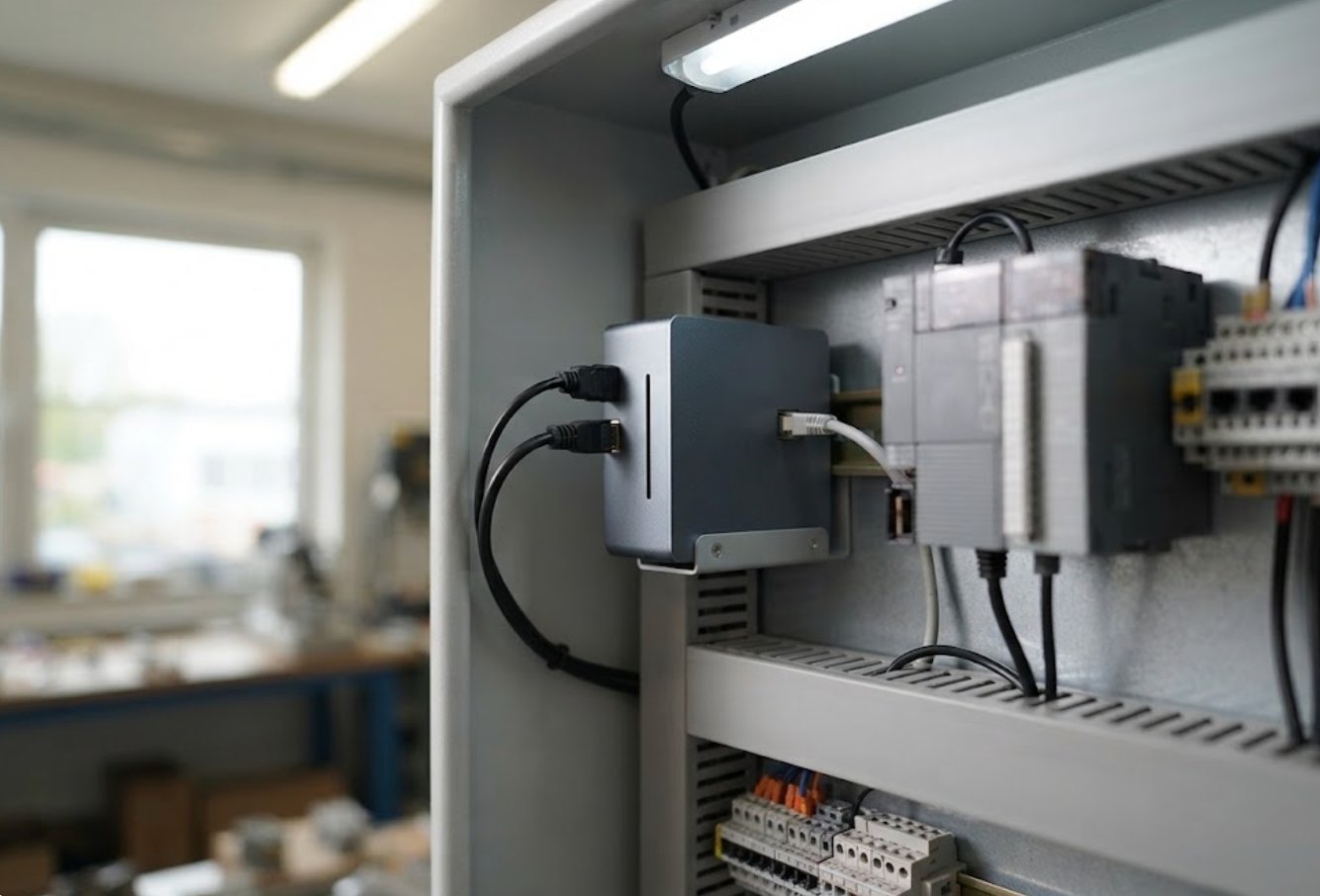
The compact node seated inside a control cabinet, running inference next to the PLC with only a thin vent gap.
A 5G Panel That Kept Up With the Conveyor
Where the line moved fast, we needed a screen a technician could carry. The RT82 Rugged Tablet rode the conveyor walkway on WiFi 6E and a 5G fallback, streaming live defect images to a supervisor twenty meters away. Its 10.1-inch panel stayed readable under the bay lights, and the octa-core chip never stalled while we scrolled a 4K inspection feed. We measured a consistent sub-40 millisecond round trip to the local node, which is the difference between a warning that arrives in time and one that arrives after the part is packed.

A technician holds the 5G panel on the conveyor walkway, comparing a live capture against the reference image.
The 4G Unit That Quietly Ran the Backup Line
Not every station needs 5G. The RT81 Rugged Tablet took the slower backup aisle where a 4G link was plenty, and it became the quiet workhorse of the rollout. Same 10.1-inch rugged build, lower cost, and a battery that outlasted a full shift. We used it for manual re-checks and label printing, tasks that never stressed the radio. Pairing the pricier 5G unit only where latency truly mattered let us shrink the budget without shrinking coverage.

The 4G unit on the backup aisle, used for manual re-checks and on-site label printing through a full shift.
🚀 Latency, Temperature, and Uptime on One Spreadsheet
After eight weeks the raw log told a clear story. We sampled node-to-sensor round trip every minute, logged chassis temperature hourly, and tracked uptime per device. The smallest node won on power, the 5G panel won on responsiveness, and the 4G unit won on shift-long endurance. None of the three ever dropped below 99.2 percent uptime across the trial, which is the number procurement actually cares about.
| Metric | Palm-sized miniPC | RT82 Rugged Tablet | RT81 Rugged Tablet |
|---|---|---|---|
| Peak chassis temperature | 58 degrees C | 49 degrees C | 47 degrees C |
| Node-to-sensor latency | 22 ms | 38 ms | 61 ms |
| Typical power draw | 11.8 W | 14.2 W | 12.6 W |
| Uptime over 8 weeks | 99.7 percent | 99.4 percent | 99.2 percent |
| Shift battery life | always on mains | 9.5 hours | 11.0 hours |
The three nodes share one management image, which is why our rugged mini PC solutions fleet stays easy to patch: one update, every device, no surprise config drift between floors.
🔋 Power Draw Nobody Budgeted For
The surprise was not the peak, it was the floor. Even idle, a node pulling 9 watts around the clock adds up across dozens of stations, and most teams forget the switch and the sensor beside it. We cut our surprise by moving the light-touch stations onto the low-cost 4G unit and reserving the 5G panel for where the millisecond mattered. The bill did not shrink because we bought cheaper gear, it shrank because we stopped over-provisioning radios on aisles that never needed them.
🔮 What We Would Wire Differently Next Time
If we ran the trial again, two changes would land first. We would mount the smallest node on a tiny DIN rail bracket instead of leaning it in the cabinet, because the vent gap mattered more than we admitted. And we would pre-tag every device with its station ID at unboxing, since three weeks of logs were a headache to reattach to physical locations after the fact. Neither fix costs money; both save the next engineer a confused afternoon.
🔮 Picking the Right Node for the Next Rollout
The pattern that emerged is simple. Put the compact fanless node where space is tight and power is scarce, the 5G panel where a human must see and act on live data on the move, and the 4G unit everywhere the task is steady and the link can be calm. Match the node to the worst hour of the shift, not the demo on the bench. For a wider view of how these nodes fit a production strategy, our industrial edge computing trends write-up maps the same hardware to the business case.
Edge computing earns its keep only when the measured numbers beat the claimed ones. The three nodes above did, across temperature, latency, and uptime, and they did it on a floor that never stopped moving. Talk to our team about building a trial node set sized to your real environment instead of a catalog.