Why Three Handovers Ended Up on One Route
A service call is judged by what is finished before the van pulls away, not by what was planned over breakfast. Three separate handovers decide that judgement. One is a piece of paper the customer keeps after the engineer leaves. One is a drawing the engineer has to read while standing at the equipment. One is a position the dispatcher needs before the next job can be assigned to anybody. For most of the last two decades none of the three could be produced where the work happened. Each one travelled back to the office with the technician and was completed hours later, on a desk, from memory and a folder of photographs. That gap is what the current generation of rugged hardware closes, and it sits inside a wider set of field maintenance solutions rather than being a single product decision.
The shift did not arrive as one device. It arrived as three, because the three handovers ask for incompatible things from a machine. One has to turn out a physical object on demand. One has to show a drawing at a size and a brightness that survive daylight. One has to know where it is and report that answer without being asked. Trying to satisfy all three inside one housing is where most dispatch kit conversations go wrong, and it is why the roles split rather than merged.
The Paper the Customer Walks Away With
Start with the handover that is easiest to underestimate, because paper looks like the oldest technology on the list. The R860-S carries a thermal printer inside the body, and it prints at 70mm/s onto 57mm rolls with a 30mm core. That covers both continuous receipt paper and labelled stock, with black mark sensing so the machine stops at the right place instead of halfway through a label. Overheat and no-paper protection are built in, which matters more than it sounds when the printer is the only one on site.
The rest of the device is arranged around that job rather than around being a general purpose terminal. Its screen is a 5.5in HD+ panel, roughly what you need to confirm a line item and nothing more. The battery is 5600mAh and detachable, quoted at over 350 hours of standby and three to four hours to charge, which allows a spare to travel in the van. Cellular is 4G LTE, the scan engine is optional at 3mil accuracy, and an optional UHF module reads tags at up to two metres. Four PSAM slots and a 2.0W speaker round out the parts that only couriers and meter readers tend to ask about.
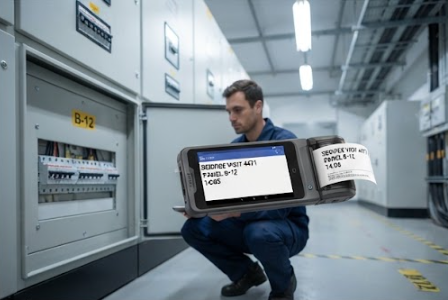
A Drawing You Can Read Outdoors
The second handover is the one that fails most often in practice, because it fails quietly. A schematic that is legible on a bench becomes a grey rectangle the moment the same tablet is held up in front of a wall in the middle of the afternoon. The RS50 moves that record to the moment it is created. It runs 5G on the same band set as the tablet, and it can be supplied with an independent BeiDou positioning module that reaches RTK centimetre accuracy, so the report and the location are produced by the same action instead of by two different people at two different times.
The handheld is built to be carried rather than set down. It measures 172 by 76.6 by 16.5mm at under 500g, with a 6.3in FHD+ panel at 1080 by 2340, a 4800mAh detachable battery, and IP67 sealing against a 1.2m drop. The rear camera is 48MP with autofocus and LED flash, the optional macro module adds close-up captures, and a 2-pin pogo connector handles charging in a vehicle mount. Android 13 ships as standard with Harmony OS offered as an alternative.

What Slips When a Handover Waits Overnight
Each of the three handovers has its own failure mode once it is deferred, and the modes are not equally visible. A receipt that is written up the following morning still exists, so nobody escalates it, but the customer has already spent a night without a document to show a supervisor. A drawing that gets read back at the office is usually read by somebody who was not standing at the panel, and the correction arrives after the enclosure is closed. A position that is reconstructed from notes is the kind of record that looks complete and is wrong by a few hundred metres.
The common thread is that all three failures are silent. Nothing throws an error, and the job closes normally. What changes with the split kit is not the capability of any one device but the point on the timeline where each handover lands, and that is the part worth examining through factory inspection workflows before a fleet is specified around a single form factor.
Comparing the Three on the Handovers They Own
Set side by side, the three devices divide cleanly rather than compete. The table below keeps only the fields all three publish, so that every cell carries a real number instead of an estimate.
| Model | Hands over | Display | Processor | Battery | Cellular | Weight |
|---|---|---|---|---|---|---|
| RS50 | A live position | 6.3in IPS FHD+ (1080x2340) | Unisoc octa-core 2.7GHz | 4800mAh, detachable | 5G SA/NSA | Under 500g |
| R860-S | A printed slip | 5.5in IPS HD+ (720x1440) | Qualcomm octa-core 2.0GHz | 5600mAh, detachable | 4G LTE | Under 500g |
| RT80 | A readable drawing | 10.1in IPS FHD (1200x1920), 400 nits | Unisoc octa-core 2.7GHz | 10000mAh, fixed | 5G SA/NSA | Under 650g |
Two fields were deliberately left out of the table rather than filled with a guess. Ingress protection is published for the handheld and the tablet as IP67, but the PDA page does not state a rating, and a column with one blank cell invites the reader to assume the missing value. Drop height appears on one page only. Both are worth confirming against the datasheet of the exact configuration being ordered, because optional modules can change the enclosure and the rating that goes with it.
What Each Device Cannot Do
None of the three is a compromise product, and it is more useful to state what each one gives up than to pretend the choice is free. The R860-S has no 5G and no published ingress rating, which pushes it towards appointment work where a printed file matters more than a live uplink. The RT80 is the heaviest of the three at under 650g, its battery is fixed rather than swappable, and it is the least comfortable thing to hold while walking a long route. The RS50 has the smallest screen of the three, and a 6.3in panel is not where anybody wants to read a multi-sheet schematic.
Read that way, the weaknesses map onto the handovers rather than onto the products. A kit that has to produce all three handovers on the same route needs all three forms, which is a different procurement conversation from the one about replacing a single ageing terminal. Buyers working through our handheld terminal range usually arrive with a device replacement in mind and leave with a role split.
Weighing a Dispatch Kit for the Next Season
The practical question is not which of the three is best, because the answer depends entirely on which handovers a given route has to complete before the van moves. A route that issues a document at every stop will pay for the printer. A route that diagnoses equipment on site will pay for the large panel. A route whose value is the record of where the work happened will pay for the positioning. Where two of those overlap, the sensible first step is to run the three side by side on the same jobs for a month and count which handover slips most often, rather than deciding from a specification sheet.
That measurement is also the only reliable way to size a fleet. Handovers that are already finished on site rarely look urgent in a spreadsheet, and the cost of the ones that are not tends to surface months later in rework.