HT500, HCAR5000 MI and SH6: Which Collaboration Gear Keeps Its Value After a Refit
Every collaboration budget is defended with a depreciation schedule, and that schedule is nearly always written in years. Offices do not change on a year boundary. They change when a floor plate is redrawn, when two teams are merged into one wing, or when a lease is renewed with less space and more desks per square metre. On that morning the hardware is not retired because it wore out. It is either still useful or it is material for the strip-out contractor, and what decides which of the two it becomes is not its condition but the way it was fastened to the building. This article takes three units that a typical enterprise collaboration deployment keeps on the same floor, and asks one question of each of them: what becomes of it on the day the walls move.
The three are a portable projector that runs its own Windows system, a desktop mini PC built on an AMD Ryzen platform, and a 6.5-inch rugged handheld. They look unrelated on a shelf and they do unrelated jobs, which is exactly why setting them together is useful. The unit that comes through a refit is rarely the fastest or the cheapest on the list. It is the one whose mounting, power and network assumptions do not have to be rebuilt along with the room.
💡 Why the Partitions Get Redrawn First
Manufacturers publish a serviceable life measured in hours of operation. Facilities teams work to a different clock, and it is shorter. A meeting floor is typically re-planned somewhere between three and five years, not because anything has failed but because headcount, working patterns and desk ratios have drifted. A unit that has run four hundred hours a year is nowhere near the end of its published life at the moment the wall it hangs on is taken down, and the takedown is what ends its service. Judging a purchase by hours therefore flatters anything that has been fitted into the building. Judging it by how many layout changes it can sit through is the harsher and more truthful measure.
The Day Fixed Gear Stops Being an Asset
Anything that has been drilled, trunked or bracketed into the fabric of a room has its remaining worth tied to that room. Trunking is cut to length. Brackets are set for one screen height and one ceiling void. A patch panel is terminated for the desks that existed on the day it was installed. When the layout changes, that material is not re-used, it is removed, and the labour is paid for a second time. The equipment inside the enclosure may be perfectly healthy. The difficulty is not condition, it is attachment: the worth sits in the fixing rather than in the device. Gear that was never fixed to anything does not face that loss.
🏟️ A Projector That Moves With the Team
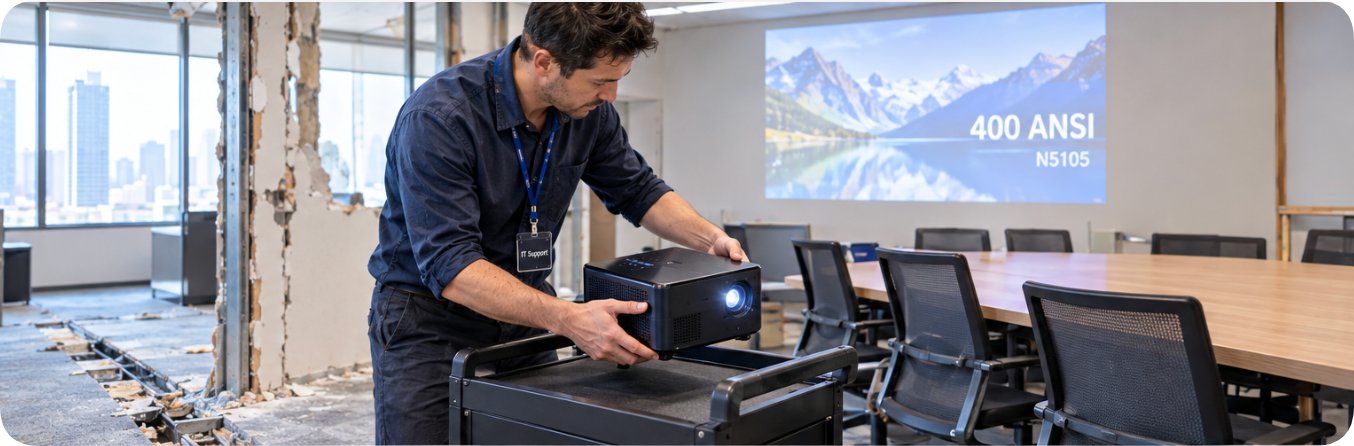
The Hotus HT500 is the clearest case in the group. It pairs a DLP light engine and a German Osram 3LED source with 400 ANSI lumens at 1280×720 and a contrast ratio of 340:1, and it carries its own Windows 11 installation on an Intel Celeron N5105 quad-core processor with 4GB or 8GB of LPDDR4 memory and a 256GB or 512GB SSD. The detail that settles its value after a refit is the mounting. At 183×164×61mm and 1080g it is a fraction of the weight of the business projectors it replaces, and it runs from an internal 3700mAh battery with 100W fast charging. There is no bracket, no ceiling void and no cable run to abandon. Auto-focus and keystone correction handle the aiming. When the floor is re-planned the unit is carried to the next room and switched on.
One Chassis Serving More Than One Room
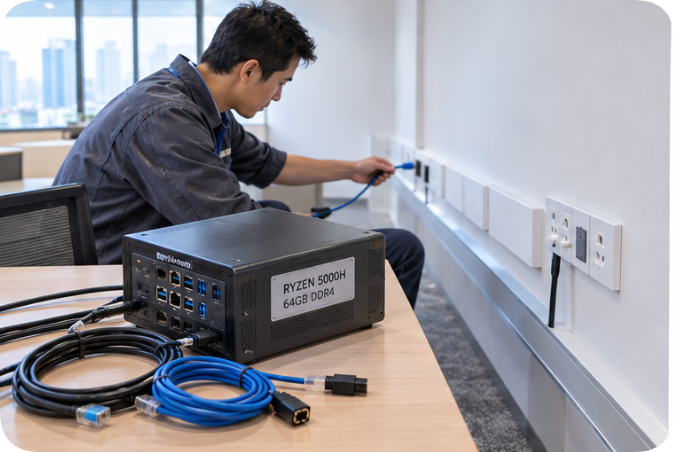
The HCAR5000 MI takes the opposite route and still holds its value. It is a desktop unit built on an AMD Ryzen 5000H series processor, offered as 5900HX, 5800H or 5600H, with Radeon graphics, up to 64GB of DDR4 3200MHz memory and storage from 128GB to 1TB of SSD or a 500GB/1TB 7200rpm drive. Around that it carries RJ45, three USB 3.0 ports, two USB 2.0 ports, DisplayPort 2.0b, a 3.5mm audio jack, two 3.5mm combo ports for microphone and audio, and a Type-C port with video support. It measures 202×212×65mm and weighs 2455g. Because it is a loose box rather than a fitted appliance, one chassis can serve a meeting room, a training bench and a reception desk in turn, running Windows 10, Windows 11 or a Linux soft-router image. The only thing a refit takes from it is the position of a socket.
🪧 A Terminal That Never Asked for a Wall Socket
The SH6 ignores the question altogether. It is a 6.5-inch rugged handheld built on an Intel N100 quad-core processor with 8GB of memory and a 256GB drive, a 380-nit HD+ panel and ten-point capacitive touch. Its 5000mAh cell runs at 7.6V, which is close to 38 watt-hours and up to 4.5 hours of work, and it keeps its own connectivity through Wi-Fi 6, Bluetooth 5.2 and 4G LTE on global bands, with GPS, BDS and GLONASS for position. At 178.3×83×23mm and 460±20g, sealed to IP65 with a 1.2m drop tolerance across minus 20 to 55 degrees, it is designed to be carried rather than installed. A refit changes the corridor it walks down and very little else.

Two Ways to Count the Same Purchase
Two columns are worth setting side by side before an order is raised. One counts the outlay across a fixed accounting life and divides it into months. The other counts it across the number of layout changes an estate is likely to make and asks what has to be paid again at each of them. The table below sets the same three units against the physical events a refit produces, and marks what is re-done at each event and what simply travels.
| What a layout change touches | Which unit it lands on | What has to be re-done | What keeps its worth |
|---|---|---|---|
| Trunking, conduit and wall outlets | Desktop mini PC | Re-routing the feed and finding a new bracket position | The chassis and its storage |
| Ceiling or wall hanging point | Portable projector | Re-hanging and re-aiming a fixed unit | The unit, if it was never bolted down |
| Desk and counter positions | Rugged handheld | Re-siting charge points and docks | The terminal and its dock |
| Room count and seating plan | All three | Re-checking who signs for which item | Whatever travels by hand |
| Network termination | Any fitted appliance | Re-terminating a patch panel | Devices that bring their own radio |
What Comes Through Moving Day Intact
Read together, the published figures show how different these three are in kind. They are not alternatives to one another, and the columns below are not a ranking. They are the facts a facilities team wants when deciding which items leave a room on a trolley and which are left for the strip-out crew. Weight is listed as the handling figure the pages publish, not as a comparison between a projector, a desktop chassis and a handheld.
| Item | HT500 | HCAR5000 MI | SH6 |
|---|---|---|---|
| Operating system | Windows 11, built in | Windows 10 or 11, Linux soft router | Windows 11 Pro |
| Processor | Intel Celeron N5105, quad core | AMD Ryzen 5000H series | Intel N100, quad core |
| Memory and storage | 4GB or 8GB LPDDR4, 256GB or 512GB SSD | Up to 64GB DDR4 3200MHz, 128GB to 1TB SSD | 8GB with 256GB, expandable to 16GB and 512GB |
| Dimensions | 183×164×61mm | 202×212×65mm | 178.3×83×23mm |
| Unit weight | 1080g | 2455g | 460±20g |
🔮 What the Next Team Inherits From This One
A refit is also a handover, and the figure that decides residual worth is what the incoming team can put to work on its first morning. A screen that must be re-bracketed, a rack that must be re-terminated and a room PC that must be re-imaged all arrive as projects with owners and dates. Gear that arrives powered, paired and already carrying its own operating system arrives as an asset instead. That is the argument for choosing on mounting assumptions and not only on a specification sheet. All three of these sit inside the same rugged mobile computing solutions catalogue, and the difference between them is the difference between equipment that belongs to a room and equipment that belongs to the team that uses it.
If you are about to re-plan a floor and want to know which of these units can be carried through the change without a second installation, the side-by-side figures are collected in our product comparisons and competitor analysis, and a configuration can be matched to the rooms you expect to keep.